

If you’re after cheap UK buys, balance price-to-rent, maintenance needs, and supply signals with solid transport links, reliable schools, and resilient local economies. Target regions offering first-time buyer value, steady price trajectories, and infrastructure momentum, while prioritizing affordable starter homes with practical layouts and good transit access. Assess neighborhoods for safety, social cohesion, and long-term demand, then use a repeatable online bargain checklist to verify listings and avoid overcapitalization. Curious about how this all stacks up in practice? Continue and you’ll uncover more.
Assess Affordable UK Areas: Core Criteria That Matter

Evaluating affordable UK areas starts with clear, data-driven criteria that reveal value beneath the surface. You’ll map affordability by price-to-rent ratios, capex needs, and long-term maintenance costs, then validate through market momentum metrics.
Consider transport accessibility, schooling quality, and local employment density to forecast stability. You weigh supply signals—new builds versus underutilized stock—and overlay with demographic trends to assess resilience.
In luxury neighborhoods, property archetypes often command premium rents; in historic districts, preservation constraints can modulate future value. Your framework must separate noise from signal: normalize for regional price dispersion, adjust for renovation cycles, and stress-test for interest-rate shifts.
The result is a transparent rubric guiding prudent purchases without sacrificing aesthetic appeal or neighborhood character.
Regions With the Best Value for First-Time Buyers
You’ll map affordability hotspots and identify entry-level housing markets that balance price with growth potential.
These value-driven localities guide first-time buyers toward practical options without sacrificing long-term equity.
Think in clear metrics—price per square foot, deposit requirements, and neighborhood fundamentals—to start the conversation.
Affordability Hotspots Regions
Affordability hotspots among UK regions offer the best value for first-time buyers by balancing purchase price, mortgage costs, and long-term growth potential. You’ll notice how regional scoring combines affordable entry points with stable price trajectories, enabling predictability in monthly commitments and future equity.
In these zones, historical property trends reveal measured appreciation without spikes, supporting prudent leverage and planning. You’ll also observe infrastructure and employment catalysts that sustain demand without inflating immediate costs.
The balance favours practical living over speculative glamour, yet remains sensitive to macro cycles, so you monitor region-specific indicators and mortgage affordability metrics. While you evaluate options, keep an eye on evolving supply pipelines, as steady completions modestly temper price pressure.
Luxury housing developments appear peripheral, reinforcing the focus on attainable, long-run value for first-time buyers.
Entry-Level Housing Markets
Entry-level markets represent the sweet spot where entry cost, ongoing mortgage payments, and long-run value align for first-time buyers. You’ll find regions that balance upfront affordability with predictable monthly dues, minimizing initial stress while maximizing future equity.
In these markets, supply chains of starter homes are aligned with steady demand, reducing price volatility and aiding reliable appraisal trajectories. You’ll notice thoughtfully designed developments, practical layouts, and efficient transport links that sustain long‑term value.
Consider pockets near emerging infrastructure, where redevelopment cycles enhance appreciation without premium-entry barriers. Luxury neighborhoods may occasionally border these zones, offering scalable luxury investments without forcing you into overextended loans.
Investment opportunities arise from rental demand stabilization and return profiles that outperform traditional savings, especially when paired with favorable mortgage terms and local growth forecasts.
Value-Driven Localities for Buyers
Value-driven localities place emphasis on regions where price-per-square-foot aligns with long-term growth prospects and reliable rental demand, particularly for first-time buyers. You’ll focus on areas that balance affordability with upside potential, ensuring you don’t overpay while securing steady cash flow.
Key indicators include wage growth, infrastructure plans, and landlord-friendly regulations that support sustainable appreciation and occupancy. This approach also considers diversification across property types, including up-and-coming residential pockets and selective commercial properties that underpin mixed-use worth.
Luxury investments and commercial properties are evaluated for correlation with neighborhood vitality, not as sole drivers.
- Target neighborhoods with rising transit access and job hubs
- Compare cap rates against regional growth forecasts
- Screen for developer activity and long-term municipal planning
How Transport Links Affect Value and Livability
Transport links are a key driver of both value and livability: access to fast rail, motorways, and frequent buses reduces travel times, expands commuting options, and broadens neighborhood appeal.
You’ll notice how public transit efficiency and road connectivity shape daily routines, impact property desirability, and influence resale value. In practical terms, frequent service intervals, reliable punctuality, and direct routes cut waiting and transfer costs, while highway access supports weekend mobility and freight ease.
This combination raises demand in areas with orderly zoning, balanced density, and preserved character. You assess value by nearby station catchments, cycle-friendly corridors, and integration with shared mobility.
Livability emerges through predictable schedules, reduced car dependence, and coherent multimodal networks that maintain a pedestrian-friendly streetscape and aesthetically pleasing urban rhythm.
Local Amenities That Help Keep Costs Down
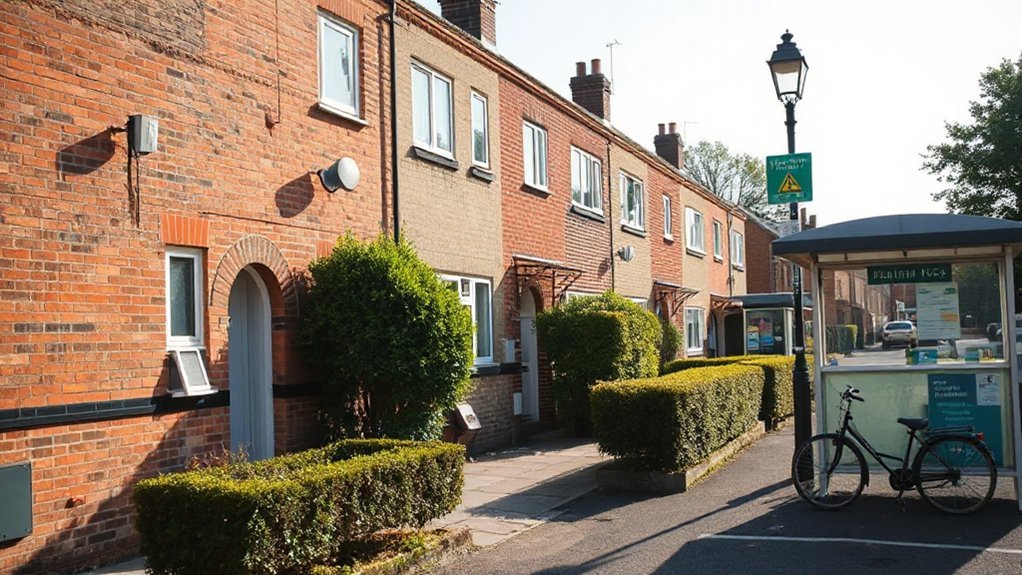
Local transport links and nearby daily provisions shape total housing costs by reducing reliance on cars and frequent trips for essentials.
You’ll notice that well-connected areas with walkable amenities tend to keep ongoing expenses lower, even if upfront prices seem similar.
This discussion starts with how accessible transit and convenient nearby shops influence budgeting and livability.
Local Transport Links
When you’re weighing affordable UK neighborhoods, strong local transport links can cut daily costs and boost resale value. You’ll notice how efficient access to public transit and rail connections shapes both commute timelines and apartment desirability.
A compact transport spine often correlates with lower car reliance, steadier rent arrivals, and predictable maintenance costs. Prioritize routes that offer frequent service, robust daytime coverage, and simple park-and-ride options to maximize affordability and flexibility.
- Public transit efficiency: frequent buses, reliable trams, and direct routes to city job hubs
- Rail connections: nearby stations with cross-country and regional services
- Integrated pricing: affordable season passes and smart card options for cost control
These elements collectively create a transport-forward value proposition without overinvesting in private vehicle expenses.
Nearby Daily Provisions
In areas with compact amenities, you reduce transit outlays and impulse buys, while maintaining nutritional variety and meal planning discipline. The layout of local shops influences price competition, stock consistency, and seasonal promotions, shaping your cost trajectory over months.
Proximity to grocery options and quick-visit outlets supports safer budgeting, enabling fewer trips, smarter bulk purchases, and efficient meal scheduling. You should evaluate walking radius, delivery options, and store formats to balance price, quality, and time.
Aesthetic consistency in retail zoning often correlates with predictable pricing, enhancing overall affordability without sacrificing choice. Prioritize neighborhoods where daily provisions are both accessible and economically stable.
Schools, Safety, and Community Fit: What to Weigh

Schools, safety, and community fit matter more than price alone because they determine long-term value and life quality. When evaluating a UK-area buy, you weigh school quality and neighborhood safety as core metrics, then assess how the community aligns with your lifestyle and goals.
This approach minimizes future disruption and maximizes appreciation potential through stable demand.
- Assess school quality indicators, catchment boundaries, and recent OFSTED ratings to gauge consistency.
- Gauge neighborhood safety through crime statistics, lighting, and resident sentiment to forecast daily peace of mind.
- Consider community programs, transport links, and local rhythm to ensure sustainable belonging and predictable social capital.
Ultimately, the right balance reduces risk, enhances daily life, and supports durable investment returns.
Practical Online Bargain Checklist for Home Buyers
Finding online bargains requires discipline: start with a practical, repeatable checklist that filters price, condition, and risk before you fall for a deal. You’ll verify listing accuracy, compare price-per-square-foot, and flag oversized repairs. Scrutinize photos for staging vs. reality, assess structural indicators, and confirm title integrity.
Assess neighborhood metrics: growth trajectory, commute accessibility, and maintenance costs. Cross-check assessor and lender notes to detect overcapitalization risks. Rate online listings by condition, proximity to amenities, and redevelopment plans.
In Luxury neighborhoods, demand can outpace value—demand a conservative adjustment for premium features. In Historical districts, verify planning constraints, restoration costs, and grant eligibility.
Maintain a disciplined budget buffer and document provenance of all data points. End-to-end, this checklist minimizes impulse buys and clarifies genuine bargains.
Real-World Outcomes From Affordable UK Buys
- Price discipline improves leverage tolerance and equity build
- Cash flow resilience hinges on occupancy, maintenance, and rent growth
- Market segments, including Luxury neighborhoods and Historical districts, shape risk profiles
Frequently Asked Questions
How Often Do Prices Rebound After Market Dips in Cheap UK Areas?
You’ll observe market recovery typically within 1–5 years after dips, though price fluctuations persist. You’ll see resilience driven by local demand, liquidity, and housing supply, so plan for cycles, not single rebounds, and monitor macro indicators closely.
Are There Hidden Costs When Buying in Lower-Priced Regions?
Hidden fees can surprise you; yes, there are additional costs when buying in lower-priced regions. You’ll need to budget for legal costs, surveys, stamps, and potential taxes, which can substantially affect your overall purchase investment.
Which Local Reforms Could Boost Long-Term Property Value?
Historically, property values rise when targeted reforms align with infrastructure, job growth, and affordable housing incentives. You’ll see long-term gains through prudent zoning regulations and well-planned development, reflecting a steady historical development trajectory and resilient market fundamentals.
Do Cheaper Areas Have Higher Resale Risk or Vacancy Rates?
Yes, cheaper areas can exhibit higher vacancy risk, but rental yield may compensate, while property appreciation depends on demand. You’ll balance vacancy probability against income, using precise metrics to evaluate potential resale risk and long-term appreciation.
What Funding Options Best Suit First-Time Buyers Here?
You should explore mortgage options and government schemes suited to first-time buyers here, prioritizing fixed-rate plans for stability, and leveraging shared ownership or deposit-boost programs to maximize affordability and minimize upfront costs.
Conclusion
You scan the map like a coastline, where cheap plots shimmer beyond the breakers. You weigh rail timetables and school gates as if they’re buoys guiding a wary ship toward shore. The prices whisper practicality, then hold you to details: transport, safety, local charm. In the end, buying isn’t sprinting for a bargain, it’s charting a harbor you can grow into—stable walls, quiet routines, a community that makes room for your future to rise from affordable, trustworthy foundations.
About the Author