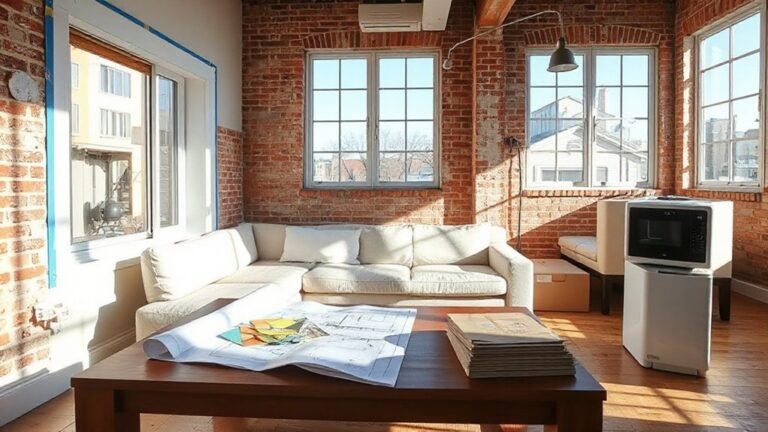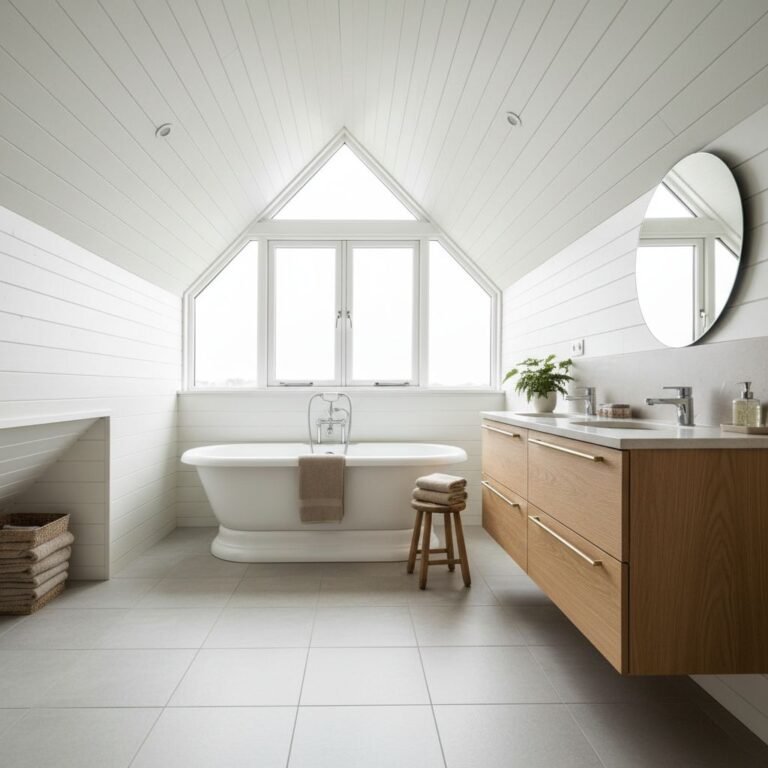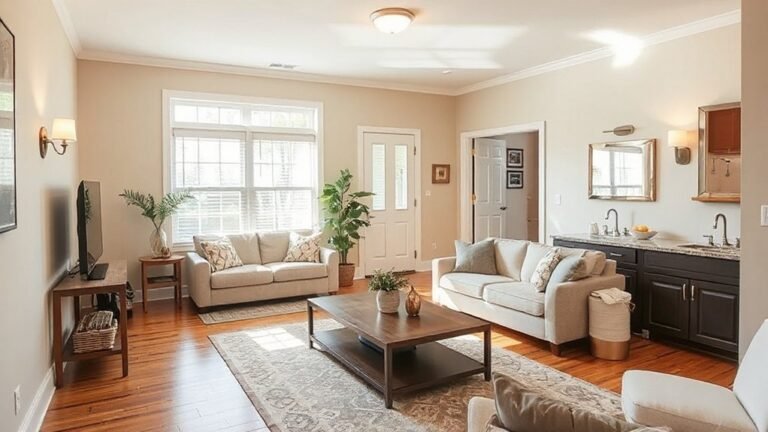
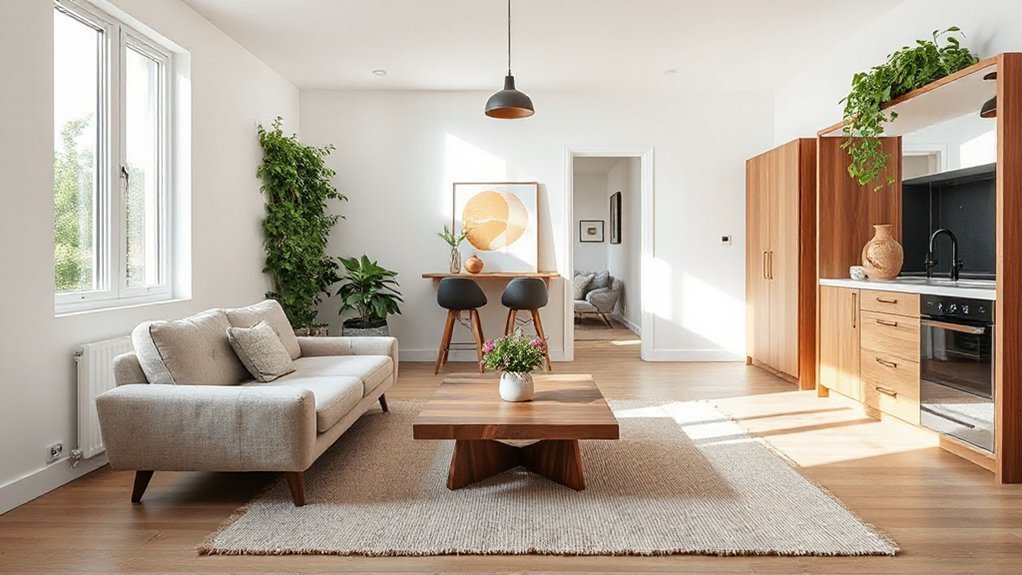
Maximize appeal in small apartments by defining clear goals and planning zones for flow, then choosing multipurpose furniture that saves square footage. Layer lighting for mood and clarity, and pick color palettes that visually expand rooms. Update kitchens and baths with compact, efficient layouts and durable surfaces, plus smart storage solutions. Guarantee outlets and tech are well organized, and keep maintenance in mind for long-term charm. Quick weekend wins release bigger changes—keep going to discover even more effective tweaks.
Define Goals for Small-Space Design
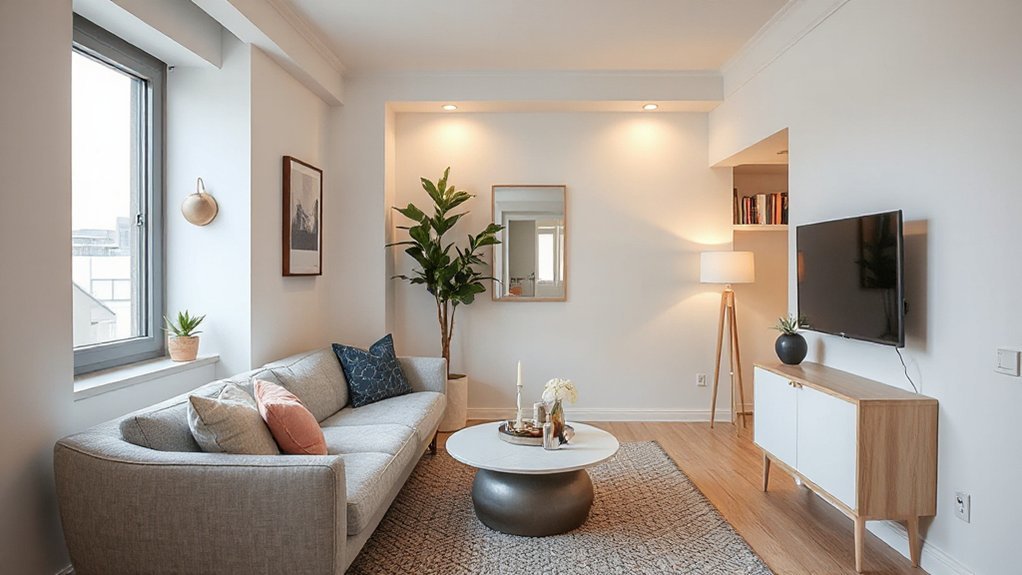
Define clear goals before you start redesigning a small space. You’ll save time, money, and frustration by outlining what must improve and what you can live without.
Begin with function: identify the rooms you’ll use most, the activities you’ll support, and the flow you expect.
Then set priorities: storage, lighting, and atmosphere.
Translate goals into concrete criteria—traffic paths, surface durability, and scale suitable to the footprint.
Use a simple checklist to prevent scope creep.
Decide how decorative accents will serve purpose, not clutter.
Consider personal expression as a guiding principle, selecting colors, textures, and finishes that feel authentic yet cohesive.
Finally, document milestones and a realistic timeline, so you stay focused and evaluate progress against your defined outcomes.
Plan Measurements and Zone for Maximum Flow
To maximize flow, start by mapping the space and establishing clear zones based on how you’ll move and use each area. Measure walls, doorways, and clearances, then note furniture footprints and switchable layouts.
Prioritize a logical sequence from entry to primary functions to minimize backtracking. Use a simple grid or room-by-room plan to compare possibilities, focusing on sightlines, traffic pockets, and reach distances.
Define zones for cooking, dining, lounging, and work, ensuring at least one unobstructed path between them. Favor compact, flexible arrangements that keep walkways clear to support flow optimization.
Mark designated storage to reduce clutter and preserve open areas. Revisit measurements after any change to confirm scale and relationships, keeping space planning precise and actionable for small apartments.
Choose Multipurpose Furniture That Saves Square Footage
Think about furniture that does double duty to reclaim precious square footage without sacrificing function. You’ll choose pieces that disappear into your daily routines, balancing form and function. Look for space saving furniture that doubles as storage, seating, or a workspace, so every inch pulls its weight.
Multifunctional decor helps you keep intentional surfaces and clean lines.
- Opt for wall beds with integrated desks or shelving
- Use storage ottomans and coffee tables with hidden compartments
- Pick nesting tables that expand when needed
- Choose modular sofas with built-in storage options
- Seek foldaway desks and wall-mounted consoles
These choices reduce clutter while preserving comfort, ensuring a streamlined apartment that feels larger than its footprint.
Layer Lighting for Mood and Clarity
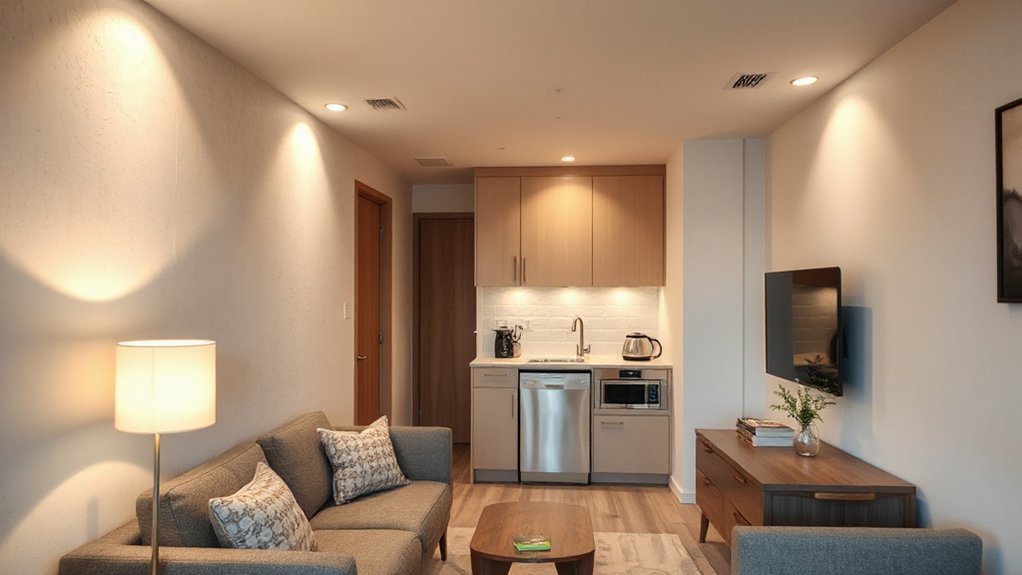
Layering light is essential for both mood and clarity in a compact space. Start with a solid base of ambient lighting, then add task and accent layers to sculpt the feel you want.
In small rooms, ambient illumination should be even and glare-free, using ceiling or wall fixtures that wash without harsh hotspots. Add task lighting where you perform daily activities—desk lamps, under-cabinet LEDs, or reading sconces—so you don’t strain your eyes.
Finish with accent lighting to highlight architecture or artwork, creating depth and a sense of space. Use dimmers to modulate intensity across tasks and moods.
This layered lighting approach keeps rooms versatile, functional, and visually expansive, while avoiding clutter.
Pick Color Palettes That Visually Expand Rooms
Lightness wins space, so start with pale, airy tones and light-reflecting finishes to visually stretch boundaries. Use cool hues sparingly to add depth without shrinking the room, and pair them with brighter accents to keep the eye moving.
Keep color decisions intentional, testing how each shade shifts perceived size before you commit.
Lightness Wins Visual Space
Light colors make rooms feel larger by reflecting more light and reducing visual clutter. When you choose palettes, prioritize light neutrals and soft pastels that bounce daylight across surfaces. Keep contrast intentional but restrained to avoid breaking the openness.
Incorporate textures through matte finishes, woven textiles, and subtle patterns rather than saturated hues. Natural ventilation and acoustic insulation should inform color decisions: lighter shades can make vents and panels feel airy, while sound-absorbing fabrics prevent echo without darkening the space.
Use consistent ceilings, walls, and floors to extend lines. Keep accessories minimal and monochrome to maintain flow.
- Prefer off-white, dove gray, and warm creams for walls
- Use lighter woods and natural fibers for texture
- Choose small-scale patterns sparingly
- Limit metal accents to avoid glare
- Coordinate windows and textiles for cohesion
Cool Tavors For Depth
Cool tones can create perceived depth and expand a room’s feel when used strategically. You’ll pair cool palettes with lighter surfaces to push walls back and ceilings up, making tight spaces feel taller.
Start with a dominant cool base—pale blues, greens, or greys—and introduce depth through layered textures and subtle contrast. Textured accents, like a ribbed velvet throw, linen drapes, or a tactile rug, catch the eye without cluttering.
Add statement decor in a slightly warmer hue to anchor the eye and avoid a flat look. Keep furniture low-profile and mirror-backed pieces to reflect light.
Use metallic or glass accents sparingly to enhance sparkle without overpowering the palette. This approach yields a calmer, more expansive feel while remaining practical.
Use Mirrors, Glass, and Subtle Shine to Open Spaces
Consider using mirrors, glass, and subtle shine to visually expand small rooms without overhauling their structure. You’ll boost light, reflect depth, and create an airy feel that still feels cohesive.
Use mirrors opposite windows to bounce natural light, and choose glass surfaces for surfaces that don’t visually weigh down a space. Keep reflections intentional with clean lines and minimal framing.
Integrate wall art and decorative accents to draw attention without clutter. Subtle shine comes from polished metals, glass vases, and lacquered finishes that catch the eye rather than shout.
- Position mirrors to extend sightlines without duplicating clutter
- Opt for clear or frosted glass over heavy frames
- Choose lightweight frames and streamlined silhouettes
- Pair with restrained wall art and decorative accents
- Maintain clean, clutter-free surfaces for maximum glow
Smart Storage Ideas That Stay Out of Sight
Smart storage should disappear into the room, not dominate it. You’ll maximize space by choosing hidden compartments that blend with cabinetry, floors, or walls. Look for seams, pull-out panels, and lightweight traps that keep belongings tucked away yet accessible.
Prioritize Convertible furniture that earns its keep: storage-rich beds, desks with hidden drawers, ottomans you can sit on and unload, tables with lift-top storage, and sleeper sofas with built-in bins. Design decisions should emphasize clean lines and uninterrupted surfaces, so clutter stays out of sight.
Install modular units that can reconfigure as needs shift, avoiding bulky, fixed solutions. Use coordinating finishes to maintain a cohesive look, ensuring storage is practical without drawing attention.
Your goal: a calmer, more functional space.
Wall Treatments: Paneling, Texture, and Hung Details
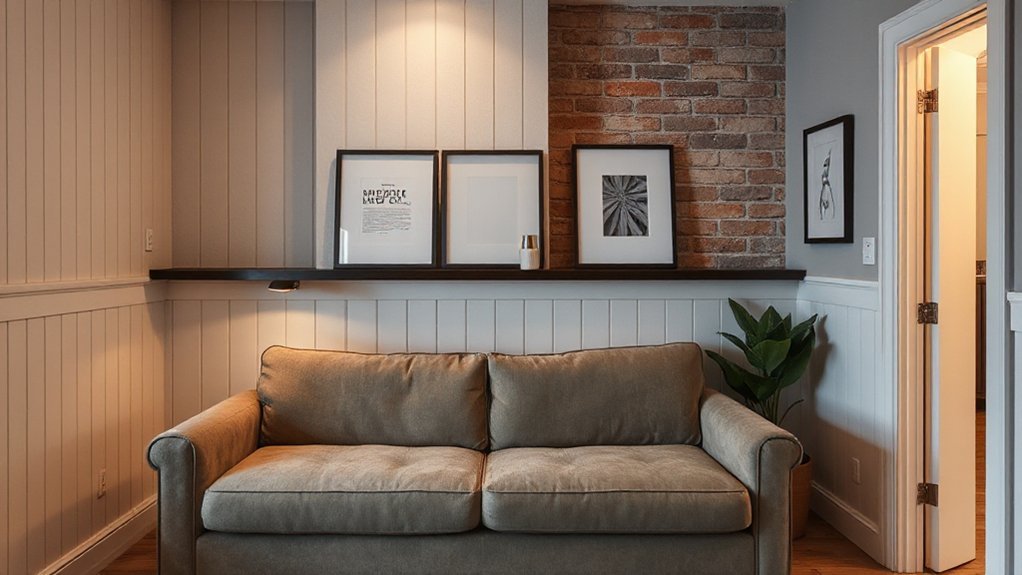
Wall treatments set the room’s tone without adding bulk, so choose paneling, texture, and hung details that complement your hidden-storage approach. You implement wall paneling to create depth without crowding space, and you mix textured finishes for tactile contrast that feels bigger than it is. Keep profiles slim and seams tight to preserve sightlines.
Hung details should be lightweight, minimizing clutter while delivering personality. Focus on cohesion with your hidden-storage plan: align paneling with cabinetry, and repeat textures at key ratios for balance. Prioritize durability, easy maintenance, and subtle color variation to avoid visual heaviness.
- Wall paneling choice aligns with cabinetry for seamless flow
- Textured finishes add interest without bulk
- Lightweight hung details reduce clutter
- Consistent color rhythm enhances perceived space
- Durable, easy-care surfaces support daily living
Flooring Continuity to Unify Tiny Layouts
To unify tiny layouts, prioritize seamless floor shifts that float from room to room.
Keep a uniform tone across spaces so color and material feel continuous, even if textures vary.
Let the grain flow uninterrupted to guide the eye, reinforcing spaciousness and cohesion.
Seamless Floor Transitions
Seamless floor shifts unify tiny layouts by reducing visual breaks and creating a continuous flow from room to room. You’ll minimize clutter by choosing flooring textures that read as one plane, even when rooms differ in purpose. Favor low-contrast transitions and wide planks or sheets to sustain rhythm across spaces. Keep transition zones subtle to preserve an open feel and prevent abrupt stops at doorways or thresholds.
- Use the same or closely matched flooring texture across rooms
- Opt for long, wide planks or sheets to extend sightlines
- Choose minimalistic thresholds or no-threshold designs
- Align grain direction with doorways for continuity
- Treat transitions as design opportunities, not obstacles
This approach strengthens scale, reduces visual fragmentation, and makes compact homes feel broader and more cohesive.
Uniform Tone Across Spaces
When you run flooring across multiple rooms, a uniform tone creates a cohesive rhythm that visually expands tiny layouts. Choose the same core material in a consistent shade, or partner contrasting textures within a restrained palette to maintain continuity.
Avoid abrupt color jumps at doorways; select gradual shifts that blend smoothly. Color harmony matters: align undertones with cabinets, countertops, or upholstery to anchor the space without clutter.
If you must vary boards for practicality, keep grain direction and sheen steady to preserve flow. Visual balance comes from proportional scale rather than loud differentiation, so resist heavy patterns that draw attention away from the room’s footprint.
A single, deliberate tone across spaces strengthens perception of space and fosters calm, intentional design.
Continuous Grain Flow
- grain flow anchors spatial order
- uninterrupted surfaces maximize perceived space
- consistent finish minimizes visual clutter
- careful progressions preserve continuity
- practical, durable materials matter
Window Treatments That Brighten Views and Preserve Privacy
To brighten views while preserving privacy, choose window treatments that balance light control with sightlines. You want options that softly diffuse daylight while keeping your interior out of direct view.
Start with sheer or light-voile panels layered with opaque shades for flexible privacy solutions. Choose roller or cellular shades that lift fully to reveal the outdoor scene and tuck neatly when you want maximum brightness.
Consider reflective or light-colored screens that bounce sun deeper into rooms without glare. Install adjustable blinds paired with vertical or horizontal layouts to tailor privacy without sacrificing openness.
Use window treatments that can be measured precisely to fit small windows, avoiding bulky frames. Prioritize privacy solutions that complement your decor and maintain a bright, airy vibe.
Define Zones Within Open-Plan Layouts Without Walls
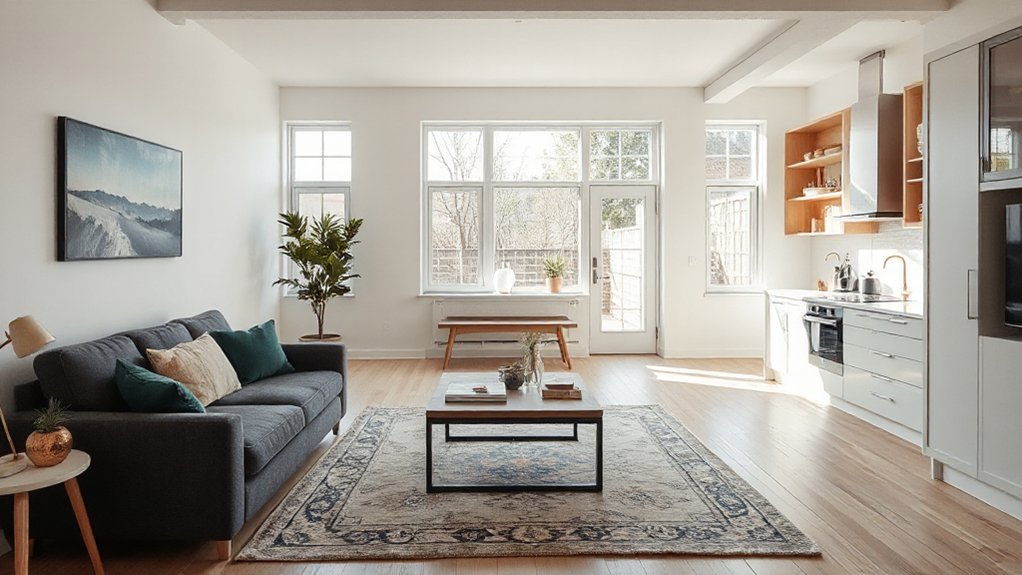
Define zones within an open-plan layout by using deliberate sightlines, furniture placement, and subtle material changes to signal functions without walls. You’ll create distinct areas through how you view the space, not by enclosing it.
Use color contrast and varying textures to cue each function, then anchor flows with furniture placement that promotes easy movement. Let lighting levels differentiate zones; brighter areas feel active, softer tones recede. Keep scale proportional and avoid visual clutter that blurs borders.
The goal is functional clarity without barriers.
- Establish clear sightlines between dining, living, and work zones
- Position sofas and rugs to define the lounge area
- Use contrasting finishes at transition points
- Align lighting to emphasize each zone
- Maintain coherent color palette for unity
Pick Statement Pieces That Complement Small Spaces
Small spaces demand pieces that punch without crowding. Pick statement pieces that still feel cohesive with your room’s scale. Choose items with clean lines, compact footprints, and geometric interest to avoid visual clutter.
Opt for one focal accent per zone—no more than three—so the eye isn’t pulled in every direction. Prioritize materials and colors that echo the rest of the palette to keep harmony intact.
A bold chair, a sculptural lamp, or a striking artwork can serve as focal accents without dominating. Consider multi-functional statement pieces (a chest that doubles as seating, a console with storage) to maximize utility.
Balance is key: let the standout piece sing, while surrounding decor remains restrained and purposeful.
Kitchen and Bath Updates That Feel Bigger
You can make kitchens and baths feel bigger by maximizing cabinet space and smartly organizing essentials.
Layer lighting to brighten tasks and create depth, using a mix of ambient, task, and accent options.
Put practical storage and clean lines at the forefront to keep the space airy and efficient.
Maximizing Cabinet Space
- Adjustable shelving
- Pull-out organizers
- Door-mounted storage
- Clear containers
- Labeled zones
Brightening Lighting Layers
Start with ceiling ambient lighting that’s soft but even, then add recessed or track fixtures to fill shadows without glare. Layer task lighting over counters, sinks, and vanities so you can see details clearly while you work.
Use under-cabinet LEDs to illuminate prep zones without washing the room in brightness. Control is essential: dimmers fine-tune mood, while higher output is reserved for chores.
Choose color temperatures around 2700–3000K for welcoming warmth, and keep fixtures compact to preserve sightlines and improve perceived space. Prioritize consistency in finish and scale for cohesive, bigger-feeling rooms.
Clean Power: Outlets and Tech Organization
To keep power sources tidy and ready, start by outlining every outlet location and planning a centralized charging zone. You’ll reduce cable chaos and make daily use seamless with smart outlets and a dedicated cord hub.
Wireless charging keeps phones accessible without clutter, while outlets with USB-C ports speed up gear.
- Map outlets to major furniture zones for instant access
- Group charging cables behind a single enclosure
- Use wireless charging pads on tables or stands
- Implement smart outlets to control power by room or schedule
- Label cords for quick identification and minimal digging
Keep devices off the floor and away from heat. Regularly review adapters and relocate clutter-prone items to maintain a clean, efficient setup.
Maintenance-Friendly Design for Long-Term Charm
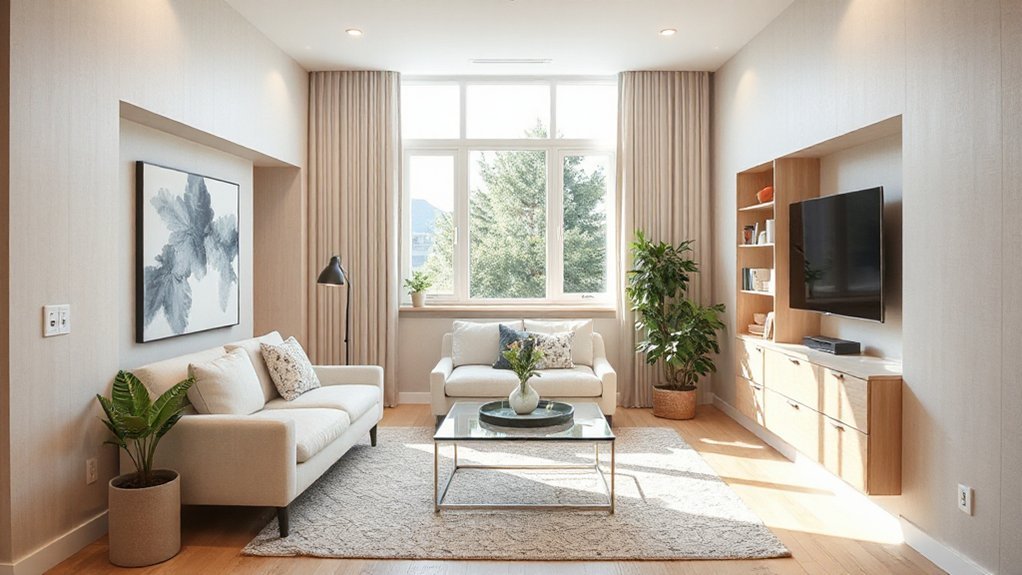
Choosing durable materials, like hard-wearing laminates or solid-surface counters, sets the foundation for long-lasting charm.
Opt for low-maintenance surfaces that resist stains and wear, so you spend less time cleaning and more time enjoying the space.
Use multi-functional storage solutions to keep essentials organized and accessible, supporting a tidy, timeless look.
Durable Materials Choice
What materials stand up to daily use and still look great for years? You want durable materials that resist scratches, stains, and wear, while delivering long lasting surfaces with minimal upkeep. Choose surfaces that hold color and finish, and pick hardware and finishes that age gracefully.
Prioritize practicality without sacrificing style by pairing tough foundations with thoughtful details.
- High-traffic countertops and backsplashes
- Scratch-resistant flooring with sealed wood or ceramic
- Metal accents with durable finishes
- Solid wood cores and long-wiber veneer alternatives
- Low-maintenance upholstery and stain-resistant fabrics
Low-Maintenance Surfaces
Surface textures should feel durable yet forgiving, hiding minor scuffs and dust between cleanups. Opt for matte or softly textured finishes over high-gloss that shows every smear.
Material finishes matter: select sealed laminates, porcelain, quartz, or solid-surface options with built-in resilience and easy wipe-downs.
Avoid high-maintenance textiles on frequently touched areas; instead, pair with easy-clean upholstery and hard-wearing rugs.
Implement consistent protective coatings where needed, and keep a simple cleaning routine.
Prioritize surfaces that tolerate routine misting, gentle scrubs, and occasional refreshes without compromising style or charm.
Multi-Functional Storage Solutions
Smart, space-saving storage can transform a small room from cluttered to calm, so prioritize pieces that multitask without adding maintenance. Multi-functional storage keeps long-term charm by combining form and function, using hidden compartments and modular shelving to adapt as needs change.
Choose designs with clean lines, durable finishes, and easy-access baskets or trays. Prioritize concealed options for a tidy look, while modular shelving allows reconfiguration as your collection grows.
Integrate vertical storage to maximize floor space, and select pieces that double as seating or surfaces for daily tasks. Keep hardware minimal to reduce wear and snag points.
Below are practical ideas to implement now:
- Hidden compartments within coffee tables or ottomans
- Modular shelving that reconfigures easily
- Drawer dividers for small items
- Stackable storage cubes
- Lidded bins with soft-close lids
Quick Weekend Wins to Transform a Small Apartment
If you’re short on time but want a noticeable upgrade, these quick weekend wins will transform a small apartment without chaos or cost.
Start with a fresh focal point: swap a bland wall for a bold, artistic accent in a single zone—think a vivid mural, gallery shelf, or statement frame.
Introduce vintage decor in small doses: a retro rug, a lamp, or a curved chair that nods to the past without overwhelming.
Declutter proactively: remove two items for every new one you add, and store excess gear out of sight.
Light matters: maximize natural light, add a slim mirror to bounce it, and swap heavy drapes for sheer panels.
Finish with a cohesive color cue across textiles and accessories for unified impact.
Frequently Asked Questions
How Can I Maximize Storage Without Crowding Small Rooms?
Maximize storage by choosing vertical, multi-use pieces and clever placements. You should use Creative wall solutions and Hidden storage options, like built-ins, under-bed bins, and fold-down desks, to keep surfaces clear while maintaining flow and roominess.
What Lighting Plan Creates Depth in Tiny Spaces?
Start with ambient illumination to give depth, then layer lighting to sculpt space. You’ll create contrast, highlight features, and feel bigger. Use wall washes, task zones, and subtle accent lights for practical, striking, layered lighting in tiny spaces.
Which Colors Visually Expand a Compact Apartment?
Light colors expand spaces best, using color psychology to calm the room; go with cool whites, pale grays, and soft beiges. Pair with bright accents for contrast. Visual illusions from mirrors and strategic placement amplify perceived openness.
How Do I Zone an Open-Plan Area Effectively?
You can zone an open-plan area effectively by using room division and distinct zoning strategies, like rugs, furniture grouping, and lighting zones; this avoids chopped spaces, helps flow, and keeps the area organized and visually coherent.
What Multipurpose Furniture Saves the Most Space?
Convertible beds save you the most space, especially when paired with fold away desks for a flexible, functional room. You can transform areas quickly, keep clutter minimal, and maintain open sightlines while accommodating sleeping, working, and living needs.
Conclusion
You’ve got the tools to make a small space feel limitless. Start with multipurpose furniture, layer lighting, and a cohesive color palette to expand sightlines. Plan zones for flow, then refresh kitchens and baths to feel bigger without overhauling. Keep outlets and tech organized, and choose maintenance-friendly details for lasting charm. Example: a 350-sq-ft apartment using a murphy bed, wall-mounted shelves, and under-cabinet lighting transformed from cramped to calm in a weekend. Small updates, big impact.
About the Author