Just How Popular Are Modular Houses Here In 2026?
Modular houses — homes built from factory-manufactured sections assembled on-site rather than constructed entirely in situ — have been the subject of housing policy discussion in the UK for the better part of a decade. They have been proposed as the solution to the housing shortage, the antidote to construction skills deficits, and a more sustainable alternative to traditional building methods. Housing ministers have endorsed them. Developers have announced ambitious programmes. Homes England has committed a £2.5 billion scheme targeting 25,000 modular homes by 2026. The Royal Institute of British Architects has called for their wider adoption. Make UK Modular has projected targets of 20,000 modular homes annually.
And yet, in 2026, modular and modern methods of construction still account for only 5–7% of UK housing delivery.
The gap between the enthusiasm of the advocates and the scale of actual production tells a more complicated story — one of genuine promise, real performance advantages, persistent structural barriers, and the chequered history of high-profile failures that has made lenders, planners, and buyers cautious in ways that slower, more incremental progress has not yet fully overcome.
What a Modular House Actually Is
The terminology in this space is used loosely and sometimes interchangeably, which creates confusion. Some distinctions:
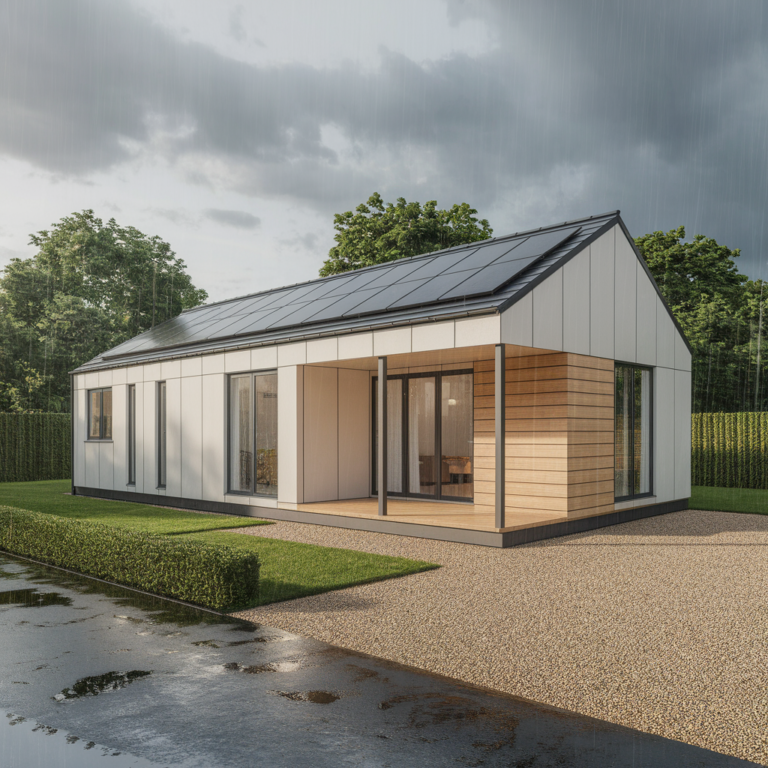
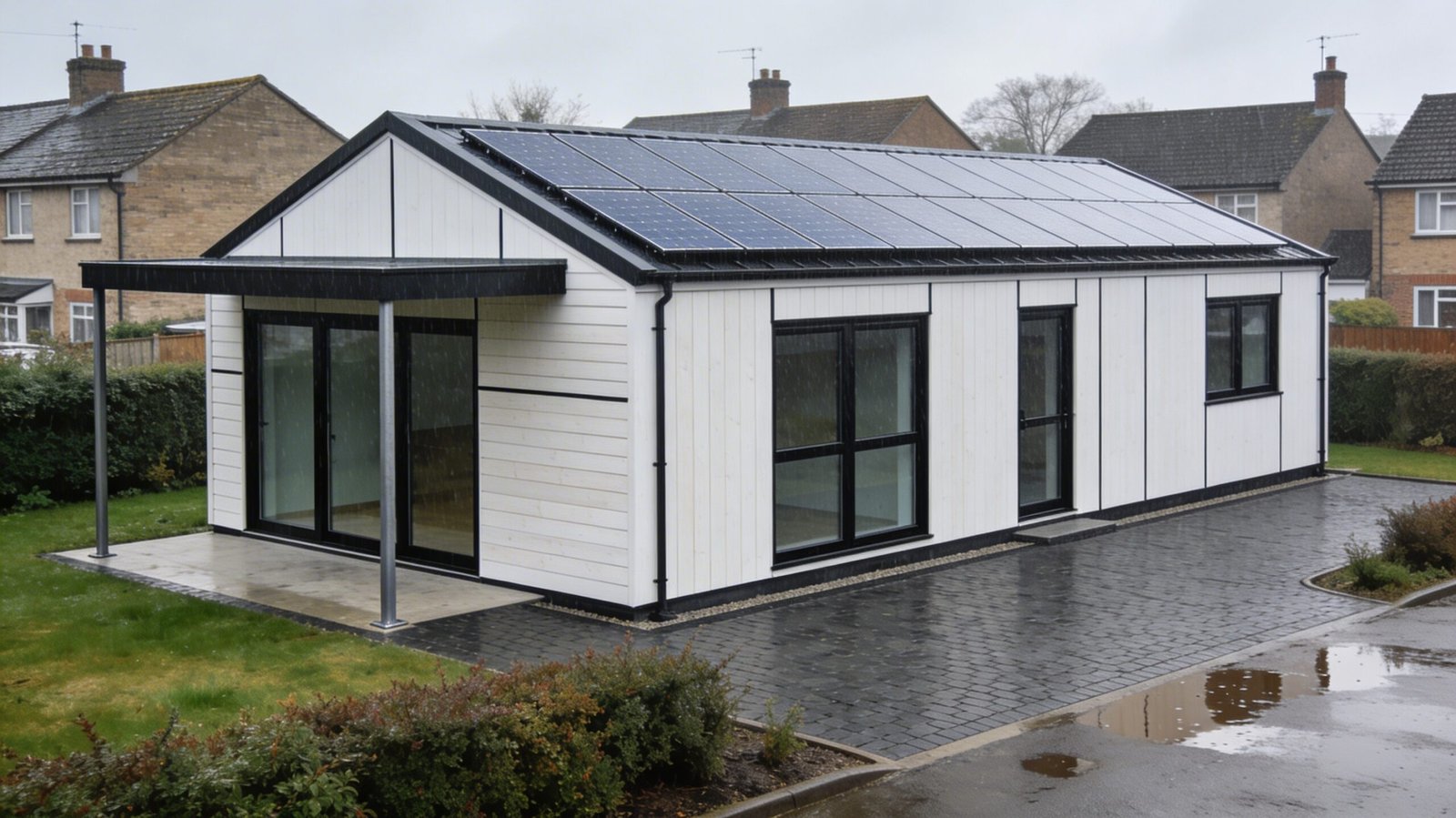
Volumetric modular construction — the most fully offsite approach — involves manufacturing complete three-dimensional modules (rooms or sections of rooms) in a factory, complete with internal finishes, fixtures, and fittings, and assembling them on-site in a matter of days. A house built from volumetric modules might spend four to six weeks in factory manufacture and one to two weeks on-site assembly. This is the category that attracts the most excitement — and the most scepticism.
Panelised systems — which use factory-made structural panels (timber frame, steel frame, or structural insulated panels) assembled on-site — are more widely used and have a longer track record in UK construction. Many timber-frame houses built in the UK over the past forty years are effectively panelised offsite construction, though they are rarely described as “modular.”
Hybrid approaches — which combine a degree of offsite fabrication (typically structural elements) with more traditional on-site finishing — sit between the two categories and represent the fastest-growing part of the Modern Methods of Construction (MMC) spectrum.
The government’s MMC framework, developed by Homes England, categorises modern construction approaches into seven categories — from fully volumetric (Category 1) through various hybrid and component-based approaches to process efficiencies in traditional construction (Category 7). When the government reports MMC adoption figures, the definition is broad enough to include approaches that differ substantially in degree of offsite manufacture.
The Market in Numbers
The UK modular and prefabricated construction market was valued at approximately £10.9 billion in 2025, with forecasts projecting growth to approximately £14.7 billion by 2030 — a compound annual growth rate of around 6–8% depending on the methodology used. The UK accounts for approximately 15% of the global modular construction market and is the leading European market by value.
Over 689 companies are active in the UK modular construction sector across manufacturing, supply chain, and delivery. Legal & General’s modular housing factory near Leeds — one of the most visible UK residential modular projects — added over 10,000 modular units to the UK housing stock by 2025. Laing O’Rourke’s Explore Manufacturing plant, one of the largest offsite construction facilities in the UK at 25,000m², has shifted toward standardised volumetric production.
Scotland’s adoption of MMC is particularly notable: the Housing Emergency Action Plan’s £6.1 billion four-year commitment to affordable housing has mandated MMC for 90% of funded dwellings, and AHSP data shows 90% MMC uptake in affordable housing development. The Scottish Government’s Infrastructure Delivery Pipeline 2026 lists housing, health, and education schemes suitable for offsite delivery.
Despite all of this activity, the 5–7% share of total housing delivery attributed to modular and MMC approaches in the UK represents a significantly smaller proportion than the policy ambitions and investment announcements would suggest. Germany, Sweden, and Japan all have substantially higher proportions of factory-built housing in their total output. Japan, where seismic risk drove early adoption of precision engineering in housing construction, builds approximately 15–20% of its new homes through factory processes. Sweden has achieved similar levels through decades of consistent policy support and industry standardisation.
The Genuine Advantages
The performance advantages of modular construction relative to traditional build are real and well-documented:
Speed: A modular home can be built in a factory in four to eight weeks, with on-site assembly typically taking one to two weeks. The total time from groundworks commencement to occupancy can be 30–70% shorter than an equivalent traditionally built home. Site preparation and factory manufacture can occur simultaneously, eliminating the sequential dependency that extends traditional construction programmes. The Holiday Inn Express in Trafford City, Manchester — built using modular methods — completed nine months from site start to occupancy, six months faster than traditional construction timelines would have allowed.
Labour efficiency: The Construction Industry Training Board (CITB) reports that modular construction typically achieves an 80% reduction in on-site labour relative to traditional construction methods, with the workforce requirement running at less than half of that needed for equivalent traditional housebuilding. In a sector where the CITB estimates that 225,000 additional workers will be needed by 2027, and where skills shortages in bricklaying, carpentry, and plastering are already constraining output, this is a significant structural advantage.
Quality consistency: Factory manufacture in a controlled environment eliminates weather-related delays and defects, provides consistent quality control, and enables precision that on-site conditions cannot reliably replicate. Thermal performance in particular — the airtightness and insulation continuity that determines a home’s energy efficiency — is consistently better achieved in factory conditions than in traditional construction, where installation quality is subject to weather, workforce variability, and the complexity of managing multiple subcontractors simultaneously.
Sustainability: Modular construction generates significantly less construction waste than traditional methods — estimates suggest up to 70% less material waste on modular projects. Factory manufacture allows more precise material management and enables the use of recycled and low-embodied-carbon materials more consistently. The energy efficiency of the finished building is typically superior, with modular homes potentially reducing heating costs by up to £800 per year relative to older traditionally built equivalents. Top Hat, one of the leading UK volumetric modular manufacturers, builds homes meeting the Future Homes Standard 2025, targeting net-zero emissions in operation.
The Barriers Keeping Adoption Below Potential
If the performance advantages are genuine, why does modular construction still represent only 5–7% of UK housing delivery? The barriers are structural, financial, and perceptual — and most of them are real rather than simply the product of conservatism.
The Mortgage Lender Problem
Until relatively recently, obtaining a standard mortgage on a volumetrically manufactured modular home was difficult. Most high-street mortgage lenders required properties to be traditionally constructed to offer standard mortgage products, and modular homes were often categorised with prefabricated concrete construction (which has a poor structural longevity record) in ways that made financing them on standard residential terms difficult.
The Buildoffsite Property Assurance Scheme (BOPAS) — a certification scheme that provides lenders, warranty providers, and insurers with independent assurance about the long-term durability and structural performance of offsite manufactured buildings — has done significant work to address this. BOPAS-accredited modular manufacturers can now access a broader range of mortgage products, and major lenders including Halifax, Nationwide, and Lloyds have developed positions on modular homes that allow BOPAS-accredited products to be mortgaged on standard terms. But the perception that modular homes are harder to mortgage, and the reality that not all modular products are BOPAS accredited, continues to create friction in the market.
The Planning System
Modular factories need volume to operate economically. The capital cost of a factory capable of producing at scale is substantial — Legal & General’s Leeds factory represented an investment of hundreds of millions of pounds — and that factory needs consistent pipeline to remain economically viable. The UK planning system, with its protracted timescales and high appeal rates, creates uncertainty in pipeline that is structurally difficult for high-fixed-cost factory operations to absorb. A developer who cannot reliably predict when planning will be granted on a site cannot reliably fill a factory production schedule.
Traditional construction companies, by contrast, have developed a skill base and supply chain for managing planning uncertainty within their business model — it is baked into their operating assumptions. For modular factory operators, the same uncertainty is more acutely problematic.
The High-Profile Collapses
The modular housing sector has suffered significant high-profile failures that have chilled investor and developer confidence in ways that took years to recover from.
Ilke Homes — the UK’s largest volumetric modular housebuilder by 2022 — went into administration in June 2023 with more than 1,000 planned homes undelivered and £640 million in losses. House by Urban Splash — a joint venture modular housing brand — scaled back dramatically. TopHat’s progress has been more measured than early projections suggested.
These failures were partly the result of the general economic conditions of 2022–2023 (rising interest rates, high construction costs, cooling housing demand) that affected the entire development sector, but they were also partly the result of the specific vulnerabilities of high fixed-cost factory operations when pipeline volumes fall below the break-even threshold. The lesson drawn by investors and developers — that modular manufacturing is operationally fragile at the scale required to be competitive — has not been fully overcome by subsequent progress.
The Transport Constraint
Volumetric modules — complete three-dimensional room-sized units — are large. Moving them from factory to site requires specialist transport, creates restrictions on the size of module that can be moved on public roads, and generates significant logistics costs that erode the cost advantage of factory production. The 5-metre road width limit constrains module dimensions, which in turn constrains the design freedom available to volumetric modular architects. Hybrid approaches that combine factory-produced panels with more on-site assembly avoid this constraint but reduce the efficiency advantage of pure volumetric production.
Who Is Building Modular Homes in 2026
Despite the barriers, the sector continues to develop — and the profile of who is building modular homes has shifted.
Social and affordable housing providers are the most consistent adopters. Local authorities and housing associations, under pressure to deliver affordable housing at scale with constrained capital, have found modular construction’s speed and predictability advantageous. Scotland’s MMC mandate for affordable housing is the most formal expression of this, but equivalent trends are visible across the social housing sector in England.
Institutional investors in build-to-rent have found modular construction’s speed, quality consistency, and energy performance attractive for large-scale residential developments where standardisation is an advantage rather than a constraint.
NHS and public sector estate — hospitals, health centres, emergency accommodation — have adopted modular construction extensively, driven by the same speed, quality, and cost arguments that apply to residential, and aided by the NHS’s £1.3 billion modular construction framework.
Self-builders and custom housebuilders are an emerging but small segment — individuals commissioning a modular home on a serviced plot, often attracted by the energy performance credentials and the predictability of the process relative to traditional self-build.
How Popular Are Modular Houses, Really?
The honest answer in 2026 is: more popular than they were, growing consistently at 6–8% annually, widely adopted in specific sectors (affordable housing, build-to-rent, public sector), and still far below the proportion of new housing that policy ambitions and market growth projections have consistently suggested they should by now represent.
The barriers are diminishing: BOPAS accreditation has improved mortgage access, the planning system’s hostility to MMC is reducing, manufacturing quality has demonstrably improved, and the high-profile failures of 2022–2023 are further in the past. The structural drivers — housing shortage, labour deficit, sustainability requirements, energy performance standards — are all intensifying in ways that strengthen the economic case for modular construction.
But the 5–7% share figure, persistent across multiple years of enthusiastic policy and investment, suggests that the transition from a well-funded and well-regarded niche to mainstream housing delivery method involves more than overcoming individual barriers. It involves changing the operating assumptions of a £120 billion industry that has developed deeply embedded risk-management practices around traditional construction, and convincing a generation of buyers that a factory-built home offers the same permanence, the same mortgage accessibility, and the same resale market depth as a traditionally built one.
That is a task being accomplished — but more slowly than the sector’s advocates, and a succession of housing ministers, have hoped.
About the Author