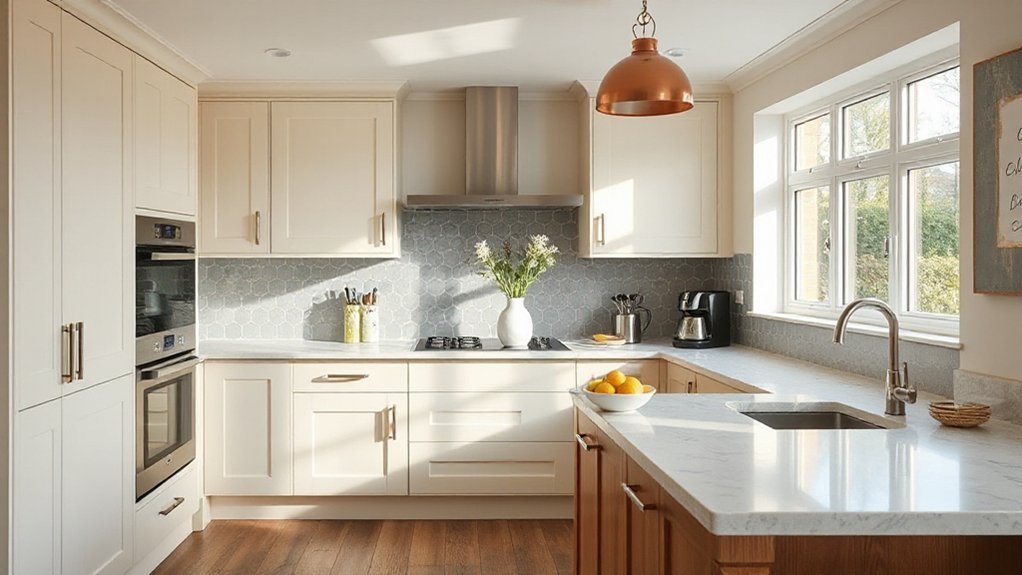
In 2026, UK homeowners prioritise energy efficiency, durable low-maintenance surfaces, and intelligent layouts that streamline cooking, dining, and cleaning. You’ll choose high-efficiency appliances with inverter motors, smart controls, and energy metering, plus layered lighting and tunable LEDs to cut bills. Expect well-defined work zones, practical triangles for appliance placement, and easy-clean surfaces like quartz or porcelain. Budget-friendly upgrades focus on soft-close hardware, refreshed cabinetry, and smart lighting. More details await as you optimize your space.
How to Plan a 2026 UK Kitchen Upgrade
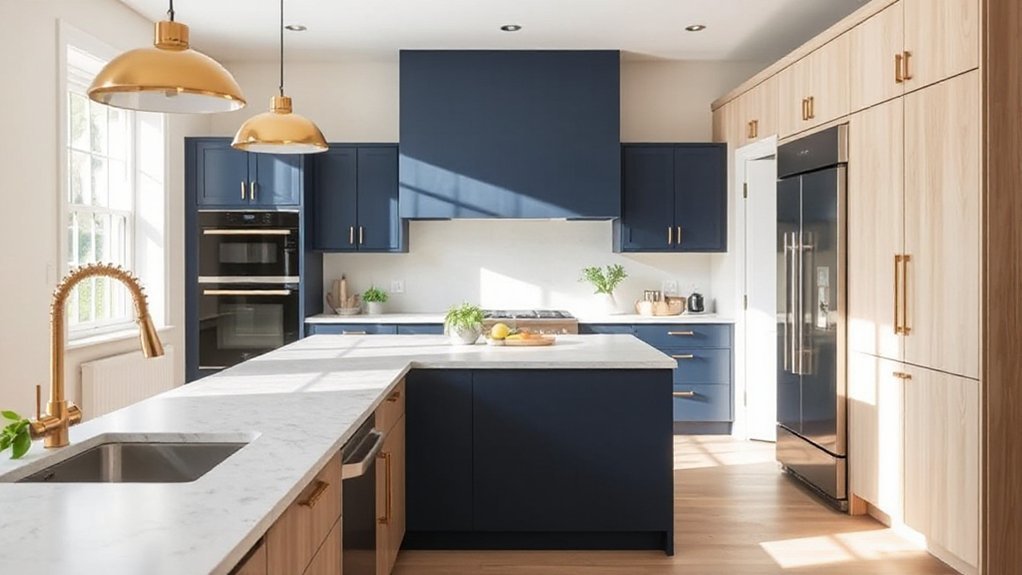
Planning a 2026 UK kitchen upgrade starts with a clear brief and a realistic budget. You’ll define scope, timelines, and constraints, then translate those into a prioritized feature list.
Begin with layout optimization, noting traffic flows, work zones, and storage benchmarks that support efficient use. Assess structural implications early—plumbing, electrics, ventilation—and align them with local regulations.
When selecting cabinetry, balance traditional craftsmanship with durable assemblies, ensuring fit for era-appropriate kitchens while embracing modern reliability. Consider finishes that complement vintage styles, yet resist wear.
Create a budget with contingency and phased milestones, then establish supplier shortlists, order windows, and installation sequencing.
Finally, document decision criteria, supplier warranties, and risk mitigation to maintain progress toward your desired outcome.
Energy-Efficient Appliances That Save Money
Energy-saving kitchen gadgets and smart appliance efficiency are shaping how you plan ongoing costs in 2026. You’ll see measurable benefits from choosing energy-maving devices and prudent settings that optimize performance without sacrificing usability.
This discussion starts with how these technologies translate into lower bills and steadier, year-round efficiency.
Energy-Maving Kitchen Gadgets
Smart kitchen upgrades hinge on energy-maving appliances that deliver reliable performance while cutting running costs. You’ll focus on devices that balance input with output, ensuring minimal waste while maximizing usability.
In practice, choose smart faucets that optimise water flow and monitor usage, reducing both consumption and bill shocks. Pair them with energy-efficient lighting that maintains brightness without increasing load, supporting precise task lighting at your counters.
Look for appliances with high energy-efficiency ratings, variable-speed operation, and smart metering that provides actionable feedback. Prioritise compact, well-insulated units and sensors that adapt to occupancy.
Maintainers should verify compatibility with your existing mains and consider future-proof options like demand-responsive controls. By selecting purpose-built gadgets, you achieve meaningful savings without compromising performance.
Smart Appliance Efficiency
Look for appliances with high energy-efficiency classifications, responsive sensors, and inverter-driven motors that adapt power to demand. When evaluating Smart appliances, factor in standby draws, programmability, and firmware updates that sustain efficiency over time.
Kitchen automation features—smart plugs, intelligent timers, and integration with home hubs—can reduce peak usage and enable coordinated cooling and heating cycles. Pair energy-saving modes with load scheduling to maximise savings.
Confirm diagnostics and remote monitoring are accessible, so you act quickly on anomalies. Prioritise proven performance, robust warranties, and demonstrable long-term cost reductions.
Smart Layouts for Cooking, Dining, and Living
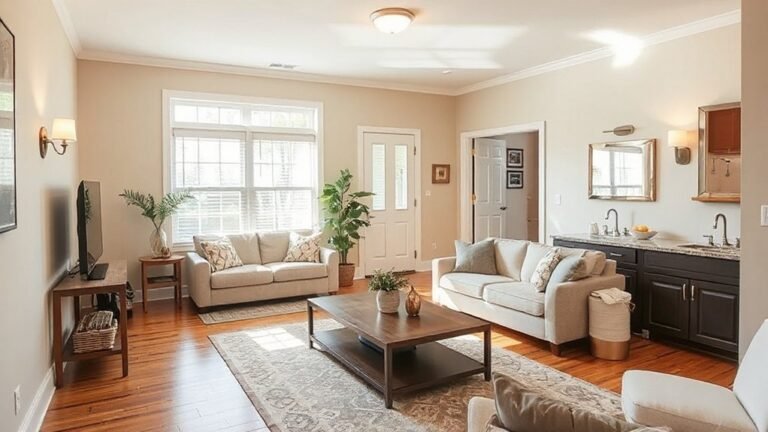
When designing kitchen, dining, and living zones as a cohesive whole, prioritize flows that minimize steps and maximize function. You should map distinct zones: cooking, prep, cleanup, dining, and casual seating, then align them along a central corridor to reduce travel.
In practice, implement a practical triangle with appliance placement and work surfaces within easy reach, ensuring the cook’s path remains unobstructed.
Consider integrated storage that supports efficient routines: tall pantry, pull-out drawers, and corner solutions to declutter counters.
Choose a kitchen layout that permits seamless progression between preparation and plating, while allowing dining and living areas to share sightlines and acoustics.
Prioritize durable surfaces, ventilation alignment, and service access to maintain long-term performance.
Lighting That Sets Mood and Reduces Bills
Mood-enhancing lighting isn’t just about mood; it also supports task precision and energy efficiency.
You’ll want energy-smart illumination choices and layered lighting design that balance ambience with control, so you can shift warmth and brightness without wasting power.
Start by outlining a system that combines dimmable LEDs, zoned controls, and color temperature options to support both daily use and low-bill scenarios.
Mood-Enhancing Lighting
Could mood-boosting lighting cut your energy bills while improving everyday living? In this section, you balance ambience with efficiency by selecting tunable, high-CRI luminaires that deliver an ambient glow without waste.
Focus on color temperature to set distinct zones—cooler temperatures for tasks, warmer tones for relaxation—while maintaining consistent brightness and glare control.
Implement layered lighting that combines ambient, task, and accent layers, reducing overreliance on single fixtures.
Use dimming and smart controls to adapt output to time of day and activity, preserving comfort and reducing consumption.
Prioritize quality optics and spectral output to preserve accuracy of colors and textures.
- Tunable fixtures
- High-CRI lamps
- Dimmable controls
- Zonal layering and presets
Energy-Smart Illumination Choices
Energy-smart illumination blends mood with efficiency by prioritizing tunable, high-CRI luminaires, dimmable controls, and layered lighting. You’ll optimize task, ambient, and accent layers to match usage patterns while minimizing energy draw.
Choose tunable white variants to shift from cool, alert mornings to warm, relaxing evenings without swapping fixtures. High-CRI lamps render true colors, aiding food prep and render of vintage fixtures in a flattering, practical light.
Dimmer strategies reduce peak loads and extend lamp life, especially in long cooking sessions. A mix of recessed downlights, under-cabinet strips, and accent wall lighting delivers precise illumination control.
Pair with rustic accents to maintain harmony, and consider smart controls for scheduling, scene recalls, and occupancy-based adjustments. This approach lowers bills while preserving kitchen ambiance.
Layered Lighting Design Tips
Layered lighting combines function and atmosphere to shape how your kitchen feels while guaranteeing costs are kept in check. You’ll balance ambient glow with focused task lighting to create zones that suit prep, cooking, and entertaining.
Choose linear LED layers for even ceiling wash, and add under-cabinet strips to eliminate shadows on countertops. Dimmer controls let you shift from bright work mode to low-key ambience, lowering energy use without sacrificing visibility.
Use color temperature strategically: cooler whites for work areas, warmer tones for dining touches, preserving a cohesive feel. Incorporate smart timers to make certain lights auto-shut when rooms are unused.
Finally, integrate glare-free luminaires and diffusers to maintain clarity across surfaces while reducing eye strain.
- Layer ambient glow with task lighting for efficiency
- Use dimmers and zoning to save energy
- Under-cabinet LEDs for precise countertop visibility
- Opt for glare-free fixtures and controlled diffusion
Low-Maintenance Surfaces That Look Premium
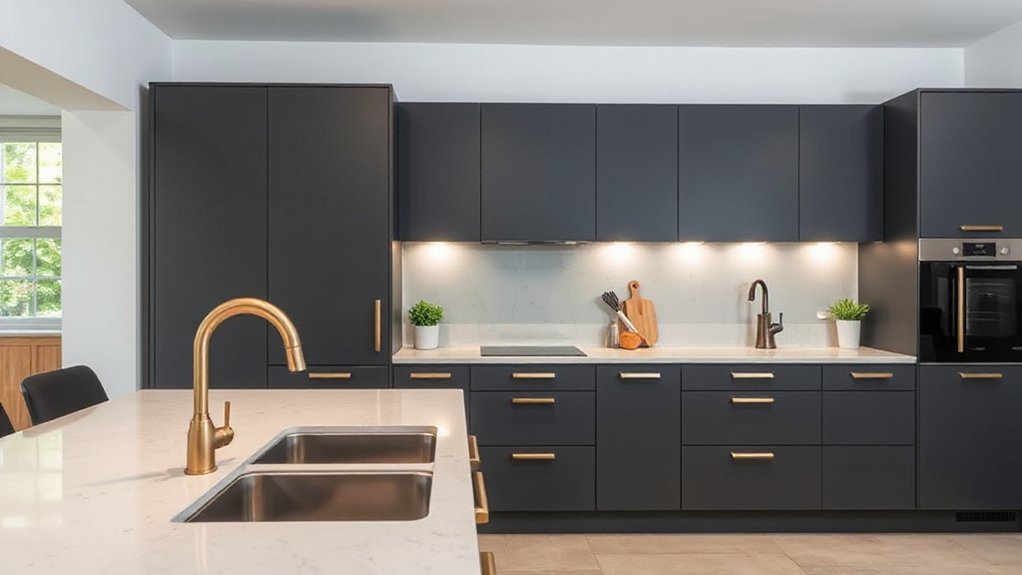
Quartz composites and solid-surface blends deliver consistent colour, seamless joins, and easy wipe-down routines, reducing upkeep without compromising design intent.
For a timeless look, opt for matte finishes that minimize fingerprints and glare, enhancing perceived depth under varied lighting.
Luxury countertops can be engineered to mimic natural stone while offering superior stain resistance and longer warranty coverage.
In practical terms, select non-porous or densely sealed options with low porosity to simplify cleaning regimes.
Guarantee compatibility with existing cabinetry and sinks, and verify that surface seams align to maintain a premium, uninterrupted appearance.
Hidden Storage Ideas to Maximise Space
Hidden storage can dramatically expand usable kitchen space without sacrificing aesthetics, so prioritize solutions that integrate seamlessly with existing layouts. You’ll exploit every inch by focusing on concealed storage that remains accessible yet discreet, preserving a clean visual line.
Implement hidden compartments and pull-out organizers within cabinetry to reduce clutter while enhancing function. Consider toe-kick drawers under fixed appliances and hinge-recessed lids for bins to maintain flow.
Use the inside of cabinet doors for slim, multi-pocket racks, and install split-depth shelving to maximize vertical space without crowding. Guarantee hardware is low-profile to sustain a seamless look.
Regularly audit contents to keep concealed storage efficient and hassle-free.
- Toe-kick drawers with smart dividers
- Hinge-recessed cabinet lids
- Door-mounted slim racks
- Split-depth internal shelving
Durable Materials for British Wear and Tear
When you choose durable surfaces, you prioritize longevity against UK wear and tear with long-lasting, practical options.
Consider materials that withstand daily use while maintaining appearance, balancing resilience with ease of maintenance.
This discussion highlights evidence-based picks that perform in real kitchens and support sustained value.
Long-Lasting Surface Choices
Durable surfaces matter most when UK homes face daily kitchen use and climate-impacted wear, so choosing materials with proven longevity is essential. You’ll prioritise surface durability and material longevity, ensuring resilience under heat, moisture, and impact.
Opt for non-porous, scratch-resistant options that resist staining and thermal cycling, reducing maintenance and downtime.
- Quartz composites offer consistent hardness, low porosity, and easy cleaning
- Aged steel formulations deliver high durability with contemporary aesthetics
- Solid surface blends provide repairability and seamless integration
- Porcelain slabs combine hardness with moisture resistance for busy interiors
Practical Materials for UK
Consider composite stones, dense laminates, and engineered glass for predictable resilience, supported by warranted surface care. Eco friendly countertops appeal due to lower lifecycle emissions, but verify finish durability and sealing requirements.
For splash zones, Recycled backsplash materials offer sustainability without compromising hygiene when properly sealed and maintained. Align selection with maintenance routines, frequency of use, and replacement cycles to sustain aesthetic value and functional reliability in busy UK kitchens.
Zoning and Workflow for Busy Households
Efficient zoning and workflow design are essential for busy households, where the kitchen must support rapid, simultaneous tasks without bottlenecks. You’ll benefit from clearly defined work zones, minimizing cross-traffic and handoffs.
Prioritize open shelving for frequently used items to speed access while maintaining a tidy counter organisation strategy.
Place prep near refrigeration and storage, cooking near heat sources, and cleanup adjacent to dishwashing — creating a logical, linear flow.
Use consistent countertop heights and accessible surfaces to reduce motion fatigue during peak periods.
Implement one‑foot traffic clearances and silent appliances to maintain focus.
Consider seasonal task cycles to reallocate zones without full remodels, keeping disruption minimal while preserving efficiency.
Regularly review usage patterns to refine zoning and maintain peak performance.
Open shelving, Counter organisation.
Tech That Streamlines Daily Kitchen Tasks
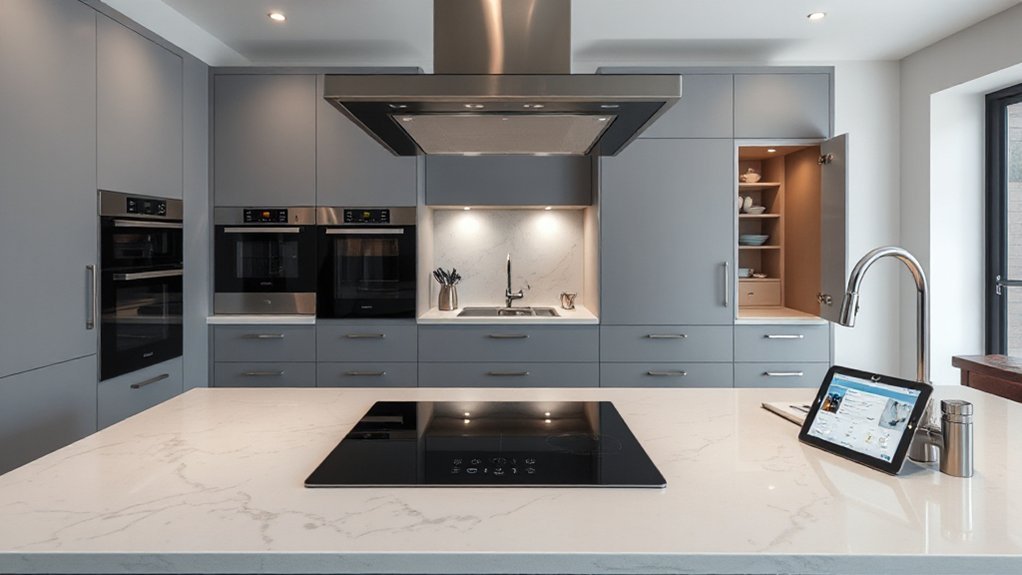
Are you leveraging smart tech to cut kitchen busywork without compromising space or flow? Integrated sensors, automation, and voice interfaces now tailor routines without clutter. Smart technology automates repetitive steps—think precision heating, timed ventilation, and pantry inventory alerts—to reduce trip hazards and decision fatigue.
In practice, you’ll streamline tasks from prep to cleanup, freeing you to supervise rather than micromanage. High-ergonomics design remains essential: appliance placement aligns with natural reach zones, reducing strain and motion.
Dynamic lighting adapts to task needs, improving accuracy and safety. Data-driven insights reveal usage patterns, enabling you to optimise schedules and energy use.
Budget-Friendly Upgrades That Boost Value
Smart upgrades don’t have to break the bank; you can add value quickly with targeted, budget-friendly choices. In this section, focus on practical, high-impact updates that deliver value boosting returns without major upheaval.
You’ll optimize function, durability, and aesthetics through cost-conscious selections and precise execution.
- Replace hinges and drawer slides with soft-close, improving usability and perceived quality
- Refresh cabinetry with a durable, neutral paint or veneer to modernise without a full remodel
- Upgrade lighting to layered, energy-efficient LEDs for better task visibility and ambience
- Install a high-contrast, durable countertop edge or splash to elevate perceived quality and longevity
Frequently Asked Questions
What Is the Average UK Kitchen Renovation Cost in 2026?
The average UK kitchen renovation cost in 2026 sits around £12,000 to £18,000, depending on scope. You’ll optimize value with precise kitchen design and careful appliance selection, balancing mid-range fixtures and labor for durable, efficient upgrades.
Which UK Planning Permissions Are Needed for a Kitchen Upgrade?
You’ll typically need to consult Building Regulations compliance and submit Planning applications for structural or layout changes. Guarantee alterations respect fire safety, ventilation, and energy standards; verify if permitted development applies, otherwise apply for planning permission where required.
How Long Does a Typical UK Kitchen Remodel Take?
You’ll typically complete a UK kitchen remodel in 4–12 weeks, depending on scope, electrician and plumber routing, and appliance integration options. Kitchen design trends influence pacing; you’ll appreciate streamlined timelines as you plan efficient appliance integration options, minimizing disruption.
Are UK Grants or Incentives Available for Kitchen Upgrades?
Yes, you can access funding options and renovation grants, though eligibility varies by scheme. You’ll assess eligibility, apply through eligible bodies, and guarantee expenditures align with grant criteria while documenting costs and compliance for successful funding.
What Resale Value Uplift Do Upgrades Typically Add in 2026?
You’ll see roughly a 5–15% resale uplift from kitchen upgrades in 2026, with higher returns for eco friendly materials and cutting-edge kitchen design trends that emphasize durability. You’ll value sustained appeal and strong demand in your market.
Conclusion
So, you chart the path, pocketbook balanced with precision, and watch your kitchen become a disciplined engine. Picture streamlined workflows as a well-tuned orchestra, each note—appliance, surface, light—in sync with your rhythms. You’ll savor low-maintenance beauty that withstands British weather and busy mornings, while smart layouts and energy-smart tech trim bills like a craftsman’s chisel. In 2026, your upgrade isn’t vanity; it’s a durable, efficient compass guiding daily life toward calmer, more productive horizons.
About the Author