Reclaimed wood flooring is timber that has been salvaged from a previous use — a demolished building, a dismantled structure, an industrial facility, a ship, a railway, a wine barrel, or any one of dozens of other sources — cleaned, prepared, and installed as flooring in a new context. The wood is not new. It has a history. And that history, in most cases, is precisely what makes it valuable.
It is one of the oldest forms of material reuse in construction and, in an era when sustainability credentials matter to buyers and specifiers in a way they have never previously, one of the most relevant. It is also one of the most misunderstood product categories in the flooring market — marketed as everything from genuinely salvaged Victorian boards to newly manufactured timber that has been artificially distressed to look old. Understanding what reclaimed wood flooring actually is, what distinguishes it from its imitators, and what its genuine advantages and limitations are, is the foundation of a good purchasing decision.
The Origin of Reclaimed Wood: Where Does It Come From?
The source of reclaimed timber determines much of its character, its quality, its likely species, and its available dimensions. The most significant sources in the UK market include:
Demolition and Renovation
The most common source of reclaimed floorboards in the UK is the residential and commercial building stock. Victorian and Edwardian properties, being demolished or comprehensively renovated, yield large quantities of original pine, pitch pine, and — in grander properties — oak and hardwood floors. Pre-war and interwar industrial buildings, warehouses, and institutional properties (schools, hospitals, factories) contain similarly significant quantities of old-growth timber.
These boards are often substantially wider and thicker than modern equivalents, cut from old-growth trees that grew slowly over centuries to produce tight-grained, dense timber. Pitch pine, in particular — the material most commonly used in Victorian school and church flooring — is no longer commercially harvested and is essentially unobtainable as new timber. The reclaimed market is the only source.
Industrial and Agricultural Structures
Barn timbers, factory roof trusses, railway sleepers, mill beams, warehouse joists, and agricultural outbuildings yield structural timbers that are often converted into wide plank flooring. These timbers were typically cut from the largest available trees — sometimes 300–500 years old — and have dimensions simply unavailable from modern commercial forestry.
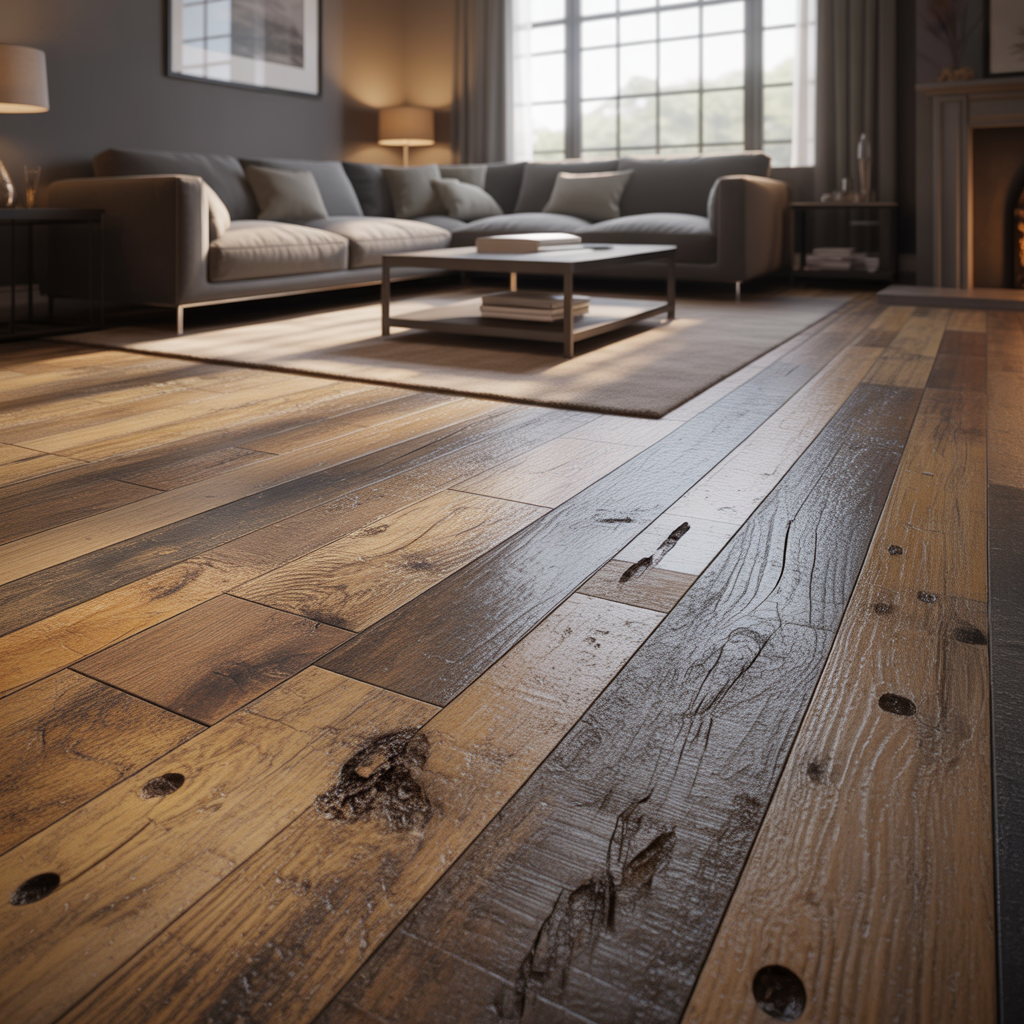
The character of industrial reclaimed timber is distinctive: the marks of its previous function (bolt holes, saw marks, chainsaw cuts, paint stains, bark inclusions) are typically retained as part of the aesthetic rather than machined away. This is the most characterful and variable category of reclaimed flooring, and the one where the gap between skilled restoration and poor processing is most apparent.
Engineered Floors and Decking Disassembly
Gymnasia, school halls, sports courts, and dance floors — typically laid in maple or oak — are a significant source of quality reclaimed hardwood. These floors were maintained professionally throughout their working lives and, when buildings are repurposed, yield quantities of well-graded, consistently dimensioned hardwood in good physical condition.
Overseas and Imported Reclaimed Timber
The global reclaimed timber market includes materials from European barns and farmhouses, American grain stores and tobacco barns, French wine barrel staves, tropical sources where old plantation timber is harvested from submerged or buried sources, and many others. Species unavailable from UK demolition sources — American walnut, longleaf yellow pine, antique French oak, and teak from demolished ships and buildings — are available through specialist importers.
How Reclaimed Wood Flooring Is Processed
Raw salvaged timber is not flooring. The journey from a pile of dirty, nail-ridden, dimensionally irregular boards to a functional floor covering involves substantial processing that varies enormously in quality and thoroughness — and which has a direct bearing on both the installed performance and the appearance of the finished floor.
Sorting and Grading
Salvaged timber is sorted by species, condition, and dimension. Boards with significant structural defects — severe cracking, rot, insect damage, or delamination — are separated from usable material. The remainder is graded by character level: from relatively clear and uniform boards at the top of the range through to heavily characterful material with abundant knots, splits, staining, and mark retention.
The grade is a matter of taste and application rather than quality in the conventional sense. A heavily characterful board is not a lower-quality product than a clear one — it is a different product with different aesthetic applications.
De-nailing
Every nail, screw, staple, and bolt must be removed before machining can begin. This is labour-intensive work — typically done by hand — and its thoroughness determines whether metal inclusions damage the processing machinery and, ultimately, end up in the finished floor. Reclaimed timber from a well-run processor will be comprehensively de-nailed. Poorly processed material may contain hidden metal that damages tools, floors, and in worst cases creates a hazard during installation.
Kiln Drying
Salvaged timber is rarely at an appropriate moisture content for use as flooring when it arrives from the demolition site. Most reclaimed wood is kiln-dried after de-nailing to bring it to a stable moisture content appropriate for flooring use — typically 8–12% for UK interior conditions. Kiln drying also eliminates any residual insect infestation in the timber.
Timber that has not been properly kiln-dried before installation will move — expanding or contracting — as it adjusts to the building’s humidity, causing gaps or buckling depending on the direction of movement. Always confirm that reclaimed flooring has been kiln-dried to an appropriate moisture content and verify this with a moisture meter before installation.
Machining: Planning, Tongue and Groove, and Grading
After drying, boards are planed to create a consistent thickness and flat surface, and tongues and grooves are machined to allow boards to fit together. This stage determines the dimensional consistency of the final product.
Reclaimed boards are inherently variable in their original dimensions. A processor who machines them to consistent dimensions — accepting more material loss from the thinner boards — produces a floor that installs consistently and performs reliably. A processor who retains maximum thickness at the expense of dimensional consistency produces a floor that is harder to install and may require more hand-finishing on site.
Face Character Retention
A central decision in reclaimed timber processing is how much surface character to retain and how much to machine away. Old paint, saw marks, surface checking, beetle flight holes (inactive), original finish remnants, and the patination of decades of use can all be retained at varying levels depending on the intended aesthetic.
Most specialist reclaimed flooring suppliers offer a spectrum: from “cleaned and smooth” where the surface is planed flat and finished conventionally, through “brushed and lightly dressed” where surface character is cleaned but retained, to “as salvaged” finishes where the original surface marks are a deliberate feature of the product. The choice depends entirely on the design intent.
Reclaimed vs New Wood Flooring: The Key Differences
Timber Quality and Density
Old-growth timber — the material that most genuinely old reclaimed flooring is cut from — is denser and harder than most commercially available new timber. The difference is a function of growth rate: trees grown in managed commercial forests are optimised for fast growth, producing timber with wider annual rings and lower density. Trees that grew slowly over many centuries in old-growth forests produced much tighter annual rings and correspondingly denser, harder, more dimensionally stable timber.
This is not marketing — it is measurable. Reclaimed pitch pine from Victorian schools has a Janka hardness rating significantly higher than new-growth pine available today. Reclaimed oak beams from medieval structures are measurably denser than new-sawn oak from modern forestry. The material itself is genuinely different.
Dimensions
Modern commercial forestry is managed primarily for efficient yield from trees of moderate age. The wide, thick boards that are routinely available in reclaimed timber — 200mm, 250mm, or even 300mm-wide single boards of consistent grain and character — are essentially unavailable from new timber at comparable cost. Large-section beams, character-width planks, and dimensionally generous flooring boards are the natural yield of large old-growth trees, and old-growth trees are no longer commercially harvested in most markets.
For buyers who want genuinely wide plank flooring, reclaimed is not just one option among several — for certain dimensions and species, it is the only option.
Appearance and Character
Reclaimed wood carries marks, colour variation, patination, and character that no new timber or artificially distressed product can fully replicate. The surface of a Victorian pitch pine floor, properly restored, has a warmth and depth of colour achieved through decades of use, maintenance, and exposure. The bolt holes in a recycled American barn beam convert to distinctive feature points in a floor plank. The variation in colour between timber that was exposed and timber that was covered — the ghost marks of joists, carpets, and furniture — creates a tonal complexity that genuinely new material cannot mimic.
This character is subjective in its appeal — some buyers love it, others prefer the clean consistency of new timber — but it is a genuine and inherent property of the material rather than a manufactured effect.
Environmental Profile
The environmental case for reclaimed timber flooring is straightforward and compelling. Timber that has already been harvested, processed, and used carries none of the deforestation impact, transport emissions, or processing energy of new timber. The carbon sequestered in the wood when the tree was growing has been locked in for the duration of its previous use and continues to be locked in during its second life as flooring.
The processing of reclaimed timber — de-nailing, drying, machining — carries an environmental cost, but it is substantially smaller than the combined impact of growing, harvesting, transporting, and processing new timber from forest to floor. For buyers and specifiers with sustainability requirements — whether for personal conviction or for building certification purposes — reclaimed flooring offers genuine, verifiable environmental credentials that artificial distressing and “eco” branding on new timber products cannot match.
Price
Reclaimed wood flooring occupies a wide price range — from modestly priced reclaimed pine boards salvaged from local demolition work through to premium antique parquet and large-section old-growth hardwoods at prices that exceed the most expensive new timber.
The premium segments of the reclaimed market reflect scarcity (pitch pine, wide antique oak, specific European parquet patterns) and processing quality. Mid-market reclaimed pine and oak from UK demolition sources is often comparably priced to good-quality new timber flooring, with character and environmental credentials as differentiating factors rather than price alone.
Species Commonly Available in Reclaimed Flooring
Pitch Pine
The most distinctively British reclaimed timber, pitch pine was the preferred flooring and structural material for Victorian and Edwardian institutional buildings — schools, churches, hospitals, and factories. It was imported from the American South in large quantities during the nineteenth century and is no longer commercially harvested; the reclaimed market is the only source.
Pitch pine is exceptionally hard and dense (Janka hardness approximately 1,225 lbf), oily by nature (which historically made it self-maintaining and highly resistant to moisture and insect damage), and warm amber to deep reddish-brown in colour with prominent resin pockets and grain. It is the most characterful and arguably the most beautiful of the commonly available reclaimed species.
Reclaimed Oak
Old oak from demolished barns, industrial buildings, and residential properties ranges from tight-grained, dense character floorboards to massive structural sections that convert into wide plank flooring. The colour of antique oak — a result of decades of oxidation and light exposure — is a warm honey-brown to golden tone that new oak takes years to develop naturally and essentially cannot replicate with staining.
Reclaimed Pine
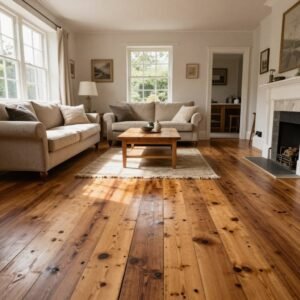
Softwood pine (typically redwood, deal, or Scots pine) constitutes the bulk of standard reclaimed flooring from UK residential demolition. These boards were the standard flooring material for Victorian terraces and Edwardian semis — typically 100–125mm wide, 21–28mm thick, with hand-sawn surfaces and the marks of joists and nails as part of their character.
Reclaimed pine boards, properly cleaned, de-nailed, kiln-dried, and finished, make excellent flooring for period properties. They are softer than hardwood alternatives (Janka hardness approximately 870–1,000 lbf depending on growth density) and will mark more readily, but their softness is part of their character — an old pine floor that shows the marks of generations of family life has a warmth and story that harder, less marked materials do not.
Parquet Blocks
Victorian and interwar solid timber parquet blocks — typically in herringbone or basketweave patterns in oak, pine, teak, or beech — are salvaged in large quantities from period properties during renovation and are widely available as reclaimed flooring. These blocks are the same material as described in the parquet flooring guide: solid timber throughout, genuinely sandenable, and carrying the colour patina and dimensional stability of genuinely old-growth material.
For period property restoration, reclaimed parquet blocks are frequently the most appropriate and authentic choice — they match the material, the pattern, and the character of the original installation in a way that new engineered parquet cannot.
What to Check Before Buying Reclaimed Flooring
Source and provenance: A reputable reclaimed flooring supplier should be able to tell you where the timber came from — at minimum, the type of building and approximate age. Provenance is part of the product’s value and credibility.
Species verification: Not all dark-stained reclaimed timber is pitch pine, and not all light-coloured reclaimed hardwood is oak. Ask for species confirmation and, if the answer is vague, approach a different supplier.
Moisture content: Confirm kiln drying to an appropriate moisture content (typically 8–12% for UK interiors) and measure it yourself with a moisture meter before accepting delivery. Boards delivered above 14% moisture content should not be installed.
De-nailing confirmation: Ask what the de-nailing process involved and whether material was checked with a metal detector. Request assurance about the thoroughness of metal removal, particularly for material being installed where children play or where metal inclusions could damage saw blades during any future cutting work.
Dimensional consistency: Ask for the tolerance on thickness across the batch. More than 2–3mm variation in thickness will require additional subfloor preparation or hand-planing on site. Some dimensional variation is inherent to reclaimed material and should be expected; extreme variation is a sign of inadequate processing.
Quantity calculations: Always order a minimum of 10% more than the calculated floor area to account for cutting waste and to have matching material available for future repairs. Unlike new timber where additional stock can typically be reordered to the same specification, reclaimed timber is a finite and non-repeatable resource — the batch you buy is the only batch that exists.
Reclaimed Flooring in Conservation Areas and Listed Buildings
Reclaimed timber flooring is often the material of choice — and sometimes the material required — for listed building and conservation area applications. Listed building consent for alterations typically requires that new materials used in the building are sympathetic to the historic character, and reclaimed timber flooring from the same era and material type as the original floor is inherently sympathetic in a way that new timber is not.
Before installing any new flooring in a listed building, or where the existing floor itself may be a feature of the listing, obtain advice from a conservation officer. In some cases, the existing floor — even if covered, damaged, or incomplete — is part of the listed building asset and its removal requires specific consent.
Reclaimed Flooring vs Artificially Distressed New Wood
One of the most important distinctions to understand in this market is the difference between genuine reclaimed timber and new timber that has been artificially aged, distressed, or given a “reclaimed effect” through processing.
Artificially distressed new timber has been wire-brushed, hand-scraped, saw-cut, artificially stained, or shot-blasted to replicate the appearance of aged reclaimed material. It is a legitimate product in its own right — the aesthetic is appealing, the dimensional consistency is better than genuine reclaimed material, and the price is typically lower. But it is not reclaimed timber. It has the appearance of age without the properties of age, and its environmental credentials are those of a newly manufactured product rather than a genuinely recycled one.
When a supplier describes a product as “reclaimed” or “antique,” ask specifically whether the timber has been salvaged from a previous structure or whether it is new timber that has been processed to look old. The question is a reasonable one and a reputable supplier will answer it clearly.
A Note on Sustainability Certification
Genuinely reclaimed timber does not carry FSC or PEFC certification — those schemes certify the management of living forests, not the reuse of already-harvested material. The environmental credentials of reclaimed timber rest on the fact that no new trees were harvested to produce it, and this can be verified through provenance documentation.
Be cautious of suppliers who describe newly harvested timber as having “reclaimed” credentials because it comes from sustainable certification schemes — FSC certification is valuable for new timber but is not the same as genuinely reclaimed material, and the two should not be conflated.
Reclaimed timber is, in straightforward environmental terms, the most sustainable category of wood flooring available. No additional deforestation, no additional transport from forest to sawmill to processor, no additional manufacturing energy beyond the processing required to convert salvaged material into usable flooring. For buyers with genuine sustainability requirements, it is the most defensible choice in the flooring market.
About the Author