
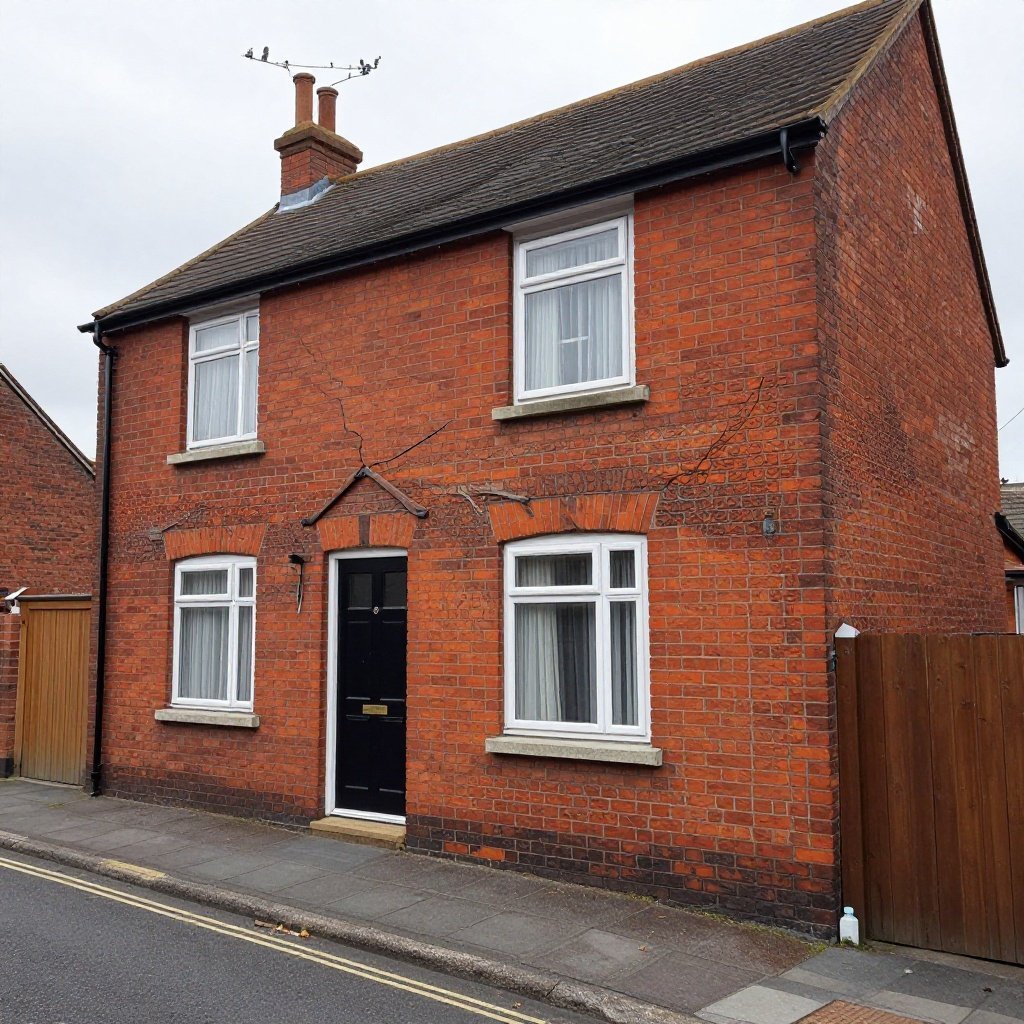
tWhat Is Subsidence And What To Do About It
What is subsidence and why is it one of the most feared words in the property market? It can appear on a survey report as a concern, it shows up in conveyancing searches as a flag, and it manifests in the form of diagonal cracks on a house wall in a way that triggers a disproportionate amount of anxiety relative to what it usually actually means for the property and its owners.
The anxiety is understandable. Subsidence can, in serious cases, compromise the structural integrity of a building. It affects insurance, it can affect value, and it takes time to resolve. But the scale of the problem is frequently misunderstood. The most important fact about subsidence in the UK is one that rarely makes it into alarming newspaper coverage: over 70% of subsidence cases do not require underpinning. Most are resolved by addressing the underlying cause — a tree, a leaking drain — monitoring the structure, and carrying out cosmetic repairs once movement has stabilised.
This guide explains what subsidence actually is, what causes it, how to identify it, what to do when you find it, and what it means for insurance and property value.
What Subsidence Actually Is
Subsidence is the downward movement of a building’s foundations caused by changes in the ground beneath them. The ground shifts, the foundations move with it, and the structure above is pulled or pushed in ways it was not designed to accommodate — resulting in cracking, distortion, and in severe cases, structural instability.
Subsidence is distinct from two related terms that are frequently confused with it:
Settlement is the compression of the ground beneath a building under the weight of the structure itself. Settlement is normal and expected in new buildings in the first years after construction, as the ground adjusts to the load. Cracks caused by settlement are typically minor, horizontal or vertical, and stabilise as the building settles. Settlement is not generally covered by buildings insurance as a separate peril. Cracks from normal settlement that are hairline or under 5mm wide are usually cosmetic and no cause for alarm.
Heave is the upward movement of the ground, typically caused by soil expanding — most commonly when clay soil that was previously dried by tree roots re-wets after a tree is removed. This is why removing a large tree from clay soil can, paradoxically, cause damage to adjacent structures: the soil swells back toward its natural moisture content, pushing foundations upward. Heave can also cause cracking and distortion that resembles subsidence but is structurally the opposite movement. Insurance policies that cover subsidence generally also cover heave.
Understanding which type of ground movement is occurring is important because the treatment is different for each.
What Causes Subsidence
Clay Soil: The Primary Risk Factor
The most significant risk factor for subsidence in the UK is the type of soil beneath the property. Clay soils are prevalent across large parts of England — particularly London and the South East, the Midlands, and parts of the East and South — and clay has a characteristic that makes it particularly prone to causing subsidence: it shrinks when it dries and swells when it wets.
This shrink-swell behaviour is the mechanism behind most UK residential subsidence. In dry summers, clay soil loses moisture and contracts. If the foundations of a building sit on this clay, the contracting soil can pull away from or beneath the foundations, causing differential movement — where one part of the building drops more than another. The diagonal cracks characteristic of subsidence result from this differential movement: the structure is being racked out of square as one section drops relative to another.
The British Geological Survey (BGS) maintains the GeoSure dataset, which maps the shrink-swell susceptibility of UK soils and is available for property searches. In higher-risk postcodes, subsidence is a genuinely elevated risk, particularly after hot, dry summers.
The climate dimension is growing. Subsidence in the UK is episodic — it spikes dramatically after hot, dry summers when clay soil moisture deficits are at their greatest. The summers of 1976, 2003, 2018, and 2022 all produced significant spikes in subsidence insurance claims. The first half of 2025 alone saw insurers pay out £153 million across approximately 9,000 households, following the warmest spring on record — with an average payout per claim of £17,264. As UK summers become warmer and drier under climate change, the frequency and severity of subsidence events is expected to increase.
Trees and Vegetation
Trees near buildings on clay soils are the most common single cause of residential subsidence in the UK. Large, moisture-demanding species — oak, poplar, elm, willow, and plane — absorb enormous quantities of water from the surrounding soil through their roots. On clay soils, this extraction of moisture causes the clay immediately around the root zone to shrink significantly during dry periods.
The risk is most acute when:
- A large, mature tree is within a distance of its mature height from the building’s foundations (for a 15-metre oak, this means within 15 metres of the house)
- The tree is on clay soil
- The foundations are shallow (Victorian and Edwardian properties often have foundations as shallow as 450–600mm, whereas modern buildings have deeper and more robust foundations)
The ABI publishes guidance on the recommended distances between different tree species and residential foundations. A willow tree, which has an aggressive root system, should ideally be no closer to a house than 40 metres. An oak, no closer than 15–20 metres.
Leaking Drains and Water Mains
Water leaking from underground drainage or water mains pipes can cause subsidence in two ways: by washing away fine soil particles around the pipe (erosion of the supporting ground), or by softening the soil to the point where it can no longer adequately support the foundations above.
This mechanism is particularly relevant in older properties where drainage systems are ageing and where the pipe materials (often clay pipes with push-fit joints rather than modern sealed systems) are more vulnerable to root infiltration and joint separation.
A drain survey — a CCTV camera inspection of the underground drainage — is one of the first investigations carried out when subsidence is suspected and trees are not an obvious cause.
Mining and Industrial Activity
In areas with a history of coal mining, limestone quarrying, salt extraction, or other underground industrial activity, the collapse of underground voids can cause surface subsidence. The Coal Authority maintains a public database of recorded coal mining activity and subsidence claims, and a CON29M mining search is a standard part of conveyancing in affected areas.
How To Identify Subsidence: The Signs
The signs of subsidence are sometimes confused with the normal cracking and movement that older buildings experience as a matter of course. Not all cracks are subsidence, and most cracks in older buildings are not.
The Crack Characteristics That Suggest Subsidence
Diagonal cracks, wider at the top than at the bottom. The diagonal crack tapering from wider at the top to narrower at the base is the classic subsidence crack. It results from the racking movement as one part of the structure drops relative to another. This pattern is distinct from settlement cracks (typically vertical or horizontal and uniform width) and from shrinkage cracks in plaster (typically a spider-web pattern, very fine, and not through the masonry itself).
Width greater than 3mm. The ABI identifies cracks wider than 3mm — roughly the width of a £1 coin on its edge — as warranting investigation. Hairline cracks under 1mm are almost always cosmetic. Cracks between 1mm and 3mm may be worth monitoring. Importantly though, cracks over 3mm, particularly with the diagonal pattern, should be investigated by a professional.
Cracks visible both inside and outside. A crack that passes through the full thickness of the wall — visible from both the interior and exterior — is more significant than a crack in plaster or render alone.
Sudden appearance. Subsidence cracks tend to appear relatively suddenly rather than developing gradually over many years. A wall that has been stable for decades and develops diagonal cracking after a hot, dry summer is exhibiting a pattern consistent with clay soil shrinkage.
Other Signs
Doors and windows sticking or jamming. As the structure distorts, the door and window openings rack out of square. Doors that previously opened and closed freely begin to stick at the top corner (for a door in a part of the building that has dropped at the foundation). This can also be caused by other factors (wood swelling in damp, door settling on hinges) but in combination with cracking is more significant.
Uneven floors. Floors that were level becoming noticeably sloped. In ground floor rooms of affected properties, a marble placed on the floor will roll in a direction that was not previously apparent.
Wallpaper wrinkling or tearing at joints. Where the structure is being pulled in different directions, wallpaper at wall-to-wall or wall-to-ceiling junctions may crack or wrinkle. This is distinct from wallpaper bubbling due to damp.
Gaps between skirting and floor. As floor levels change relative to the walls, gaps open up that were not previously present.
What To Do If You Suspect Subsidence
Step 1: Do Not Panic — And Do Not Start Any Repairs
The instinct to fill cracks or repair damage immediately is understandable but counterproductive if subsidence is suspected. If active movement is occurring, any repairs made before the cause is identified and addressed will simply crack again, wasting money. More importantly, insurers require early notification and will typically void a claim if unauthorised repairs have been made.
Step 2: Contact Your Insurer Promptly
Buildings insurance policies that include subsidence cover — which is standard in most UK residential policies — require you to notify the insurer as soon as you have reasonable grounds to suspect subsidence. Do not delay this notification while waiting to see if things get worse. Early notification is required by most policies and protects your right to claim.
The ABI’s guidance is explicit: contact your insurer as soon as you notice signs that may indicate subsidence. They will advise on next steps, and where appropriate will appoint a specialist engineer or loss adjuster to investigate.
Step 3: The Insurer’s Investigation Process
Once notified, a typical insurer-managed subsidence investigation follows a broadly standard process:
Initial inspection: A structural engineer appointed by the insurer visits the property, examines the cracking and distortion, and forms an initial view of whether the movement is consistent with subsidence and what the probable cause might be.
Drain survey: A CCTV drain survey is typically commissioned to rule out or confirm leaking drainage as a contributing factor.
Monitoring: In many cases, the building is monitored over a period — typically 6–12 months — before any structural repairs are undertaken. This is because subsidence caused by clay soil shrinkage during a dry summer may partially recover as soil moisture levels are restored in autumn and winter. Monitoring confirms whether movement is continuing, has stabilised, or has partially recovered before the appropriate treatment is determined.
Tree investigation: Where a tree is suspected, the insurer may commission a tree specialist assessment and, depending on ownership and results, may require or arrange for the tree to be removed or managed. If the tree is on public land or owned by a third party (including the local authority), the claim and the remedy can become significantly more complex.
Repair: Once the cause has been addressed and movement has stabilised, the structural repairs and cosmetic making-good are carried out at the insurer’s expense (subject to the excess). Most subsidence claims take between one and two years to resolve fully — an important expectation to set early in the process.
Step 4: Understand the Excess
Buildings insurance policies covering subsidence carry a significantly higher excess than standard claims. The ABI standard is approximately £1,000, but policies with specific subsidence history or higher-risk properties may carry excesses of £2,500 or even £5,000. Confirm your policy excess before proceeding with any claim.
The Treatments: What Actually Gets Done
Tree Removal or Management
Where a tree is identified as the cause, the primary treatment is addressing the tree — either removal or significant management (crown reduction) to reduce its moisture demand. Although, where the tree is on the claimant’s property, this is relatively straightforward. Where the tree belongs to a neighbour or the local authority, the process involves negotiation, legal notice, and sometimes litigation.
After tree removal on clay soil, the soil moisture typically increases over the following years as the root system dies and the clay re-expands. This re-expansion can cause heave — upward movement — particularly in the period immediately following removal. Monitoring is required during the re-wetting period.
Drain Repair
Where leaking drainage is identified as a contributory cause, the defective pipe sections are repaired or replaced. This is often done by relining (inserting a flexible liner inside the existing pipe and curing it in place) rather than full excavation and replacement.
Underpinning
Underpinning — deepening or strengthening the foundations — is the most significant and most feared treatment, and it is much less commonly required than most homeowners fear. Over 70% of subsidence cases in the UK are resolved without underpinning.
When underpinning is required, the options in 2026 are more varied than the traditional mass concrete underpinning (excavating beneath the existing foundations and filling with concrete) that represents most people’s mental image of the process:
Mass concrete underpinning: The traditional approach. The ground beneath the existing foundation is excavated in segments and filled with concrete, effectively deepening the foundation to reach more stable ground below the problem layer. Disruptive but effective. Cost typically £10,000–£30,000+ for a standard house.
Resin injection: A less invasive modern alternative. Expanding polyurethane resin is injected through small-diameter holes drilled into the ground at foundation level. The resin expands and compresses the surrounding soil, filling voids and stabilising the ground without excavation. Significantly less disruptive than mass concrete underpinning, quicker, and in suitable ground conditions equally effective. Increasingly specified by engineers where ground conditions allow.
Piling: Concrete or steel piles are driven or drilled into stable ground below the problem layer, and the existing foundations are tied to the piles with concrete beams. Used where very deep stable ground is required and where mass concrete or resin would not reach the problem adequately.
Subsidence and Property Value
Subsidence has a material effect on property value, but the quantum of that effect depends critically on whether the subsidence has been resolved and documented.
Unresolved, ongoing subsidence: A property with active subsidence is very difficult to sell and to mortgage. Most mortgage lenders will not advance against a property with known active subsidence without a structural engineer’s report confirming stability. The value impact of unresolved active subsidence can be 20% or more of the property’s value, and in severe cases the property may be effectively unmarketable.
Resolved subsidence with documented completion: A property where subsidence was identified, the cause was addressed, the movement has stabilised, repairs were carried out under insurance to an engineer’s specification, and a completion certificate with a transferable guarantee was issued is in a substantially better position. The value discount for well-documented, historically resolved subsidence is typically 5–15%, reducing further with time since resolution. Many properties with resolved subsidence are successfully sold, mortgaged, and insured.
Insurance implications: Homes with a subsidence history pay higher insurance premiums. The median combined home insurance premium for properties with subsidence history is approximately £507 per year — higher than the standard market but not uninsurable. Excesses on subsidence claims are typically higher for properties with prior claims history.
Buying a Property With Subsidence History
If a conveyancing search or a survey reveals a subsidence history, the appropriate response is not necessarily to walk away. The questions to ask and investigate are:
- What was the cause, and has it been fully addressed?
- Was the repair carried out under insurance by a qualified contractor to an engineer’s specification?
- Is there a completion certificate and a transferable structural guarantee?
- When was the last monitored movement, and has the property been stable since?
- What is the BGS shrink-swell rating for the postcode?
- Are there large trees close to the property that represent an ongoing risk?
A specialist building surveyor — not just a valuation survey — is essential for any property where subsidence is flagged. The surveyor’s report will assess the current structural condition, the adequacy of any previous repair, and the ongoing risk factors. This investment of £500–£800 for a full structural survey is an essential cost for a purchase of this nature.
The property market is not unaware of subsidence history, and the price usually reflects it — which means that a property with well-documented, resolved subsidence that is correctly priced can represent genuine value for a buyer who has done proper due diligence.
About the Author