There is a moment in almost every renovation when you stand in a salvage yard, or scroll through a reclaimed materials listing, and feel something shift in your thinking about what the finished project could be. A pile of old scaffold boards. A Victorian cast-iron fireplace, still blackened and chipped, still magnificent. A stack of Welsh slate reclaimed from a demolished mill roof. Reclaimed railway sleepers, heavy with creosote and decades of use, smelling of something that no amount of “railway sleeper effect” garden timber from a DIY shed will ever replicate.
The reclaimed materials market has grown significantly over the past decade — driven partly by sustainability consciousness, partly by the design culture’s appetite for authenticity that new materials cannot provide, and partly by something more fundamental: the recognition that materials built to last for a century or more are simply better than many of the materials built to last for twenty years. The oak floor that served a Victorian warehouse for 150 years, reclaimed, refinished, and relaid in your living room, will outlast most new engineered flooring by generations. The fireplace cast in the 1880s was made at a time when cast iron was made to endure, not to a price point.
This guide covers the most common and most rewarding reclaimed material choices for a UK home renovation — reclaimed wood flooring, antique fireplaces, reclaimed roofing slate, garden rockery stone, and railway sleepers — with practical advice on sourcing, assessing, and using each one.
Reclaimed Wood Flooring
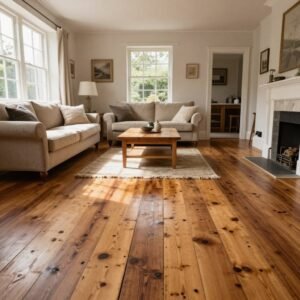
Reclaimed wood flooring is arguably the most transformative interior renovation choice available in the reclaimed materials market. A well-chosen reclaimed floor provides something that no new floor can offer: the patina of age — the slight irregularities in thickness, the colour variation that comes from decades of exposure to light, the nail holes and saw marks and minor repairs that record the material’s history — combined with structural integrity that has already been proven over many decades.
What’s Available and Where It Comes From
The most commonly available reclaimed wood flooring in the UK comes from:
Pitch pine: Salvaged from Victorian industrial buildings, warehouses, mills, and schools. Pitch pine is an exceptionally hard, resinous timber that takes on a deep amber to reddish-brown colour with age. It is almost impossible to source new (the old-growth forests that produced it no longer exist at commercial scale), which means reclaimed pitch pine flooring is genuinely irreplaceable. It is typically found as wide boards — 150–200mm or wider — and has the hardness to withstand significant foot traffic and decades of further service.
Antique oak: From medieval buildings, barns, and timber-framed structures. Antique oak is characterised by extreme width (boards of 300–400mm are not uncommon), significant colour variation from white to deep tan to near-black depending on exposure, and a character that reflects centuries of life. It is the most premium and most expensive of the reclaimed floor options.
Elm, ash, and chestnut: Less commonly available than oak and pitch pine but highly prized when found. Elm’s distinctive interlocked grain produces a floor unlike any other wood species. Ash is pale and has a striking grain. These tend to appear from specific demolitions or estate clearances rather than in regular supply.
Scaffold boards: Not traditionally a flooring material, but increasingly used in contemporary interiors for their rough, wide, heavily marked character. Old scaffold boards (genuine ones — thick, wide, with the wear marks of decades on construction sites) have a different visual quality from new scaffold board effect products. They require more preparation and finishing to be used as flooring but the results can be extraordinary in the right interior context.
Practical Considerations
Thickness variation: Reclaimed boards were typically sawn to different standards from modern flooring. Antique boards often vary in thickness across a single load, and between boards from different sources. This requires careful preparation — ideally machine planing to a consistent thickness — before laying, and professional installation is strongly advisable for large areas.
Moisture content: Wood flooring must be acclimatised to the moisture conditions of the room before installation. Reclaimed wood has typically reached a stable equilibrium over many years, but it still needs to acclimatise to your specific building. Allow several weeks of acclimatisation in the room where it will be laid before installation begins.
Structural inspection: Check for signs of active insect infestation (fresh bore holes, frass) before bringing reclaimed timber into your home. Historic exit holes from longhorn beetle or woodworm that are clearly old — dusty, darkened — are typically not a concern; active infestation requires treatment.
Underfloor heating compatibility: Reclaimed solid wood boards are generally not recommended over underfloor heating, as the thermal cycling causes more significant expansion and contraction than modern engineered products are designed to tolerate. Where underfloor heating is present, reclaimed engineered boards (a reclaimed hardwood veneer on a stable engineered core) are a better solution.
Sourcing
The best sources for reclaimed wood flooring are specialist salvage merchants — companies that handle large quantities from specific demolitions and can often trace the provenance of a load. The Salvage Association maintains a directory; Salvo (salvo.co.uk) is the long-established UK salvage market listings site. LASSCO (London Architectural Salvage and Supply Company) handles premium stock. Local auction houses that deal in architectural salvage are worth monitoring. Prices for pitch pine flooring typically run from £30–£80 per square metre depending on quality, width, and availability; antique oak from £60–£150+.
Reclaimed Antique Fireplaces
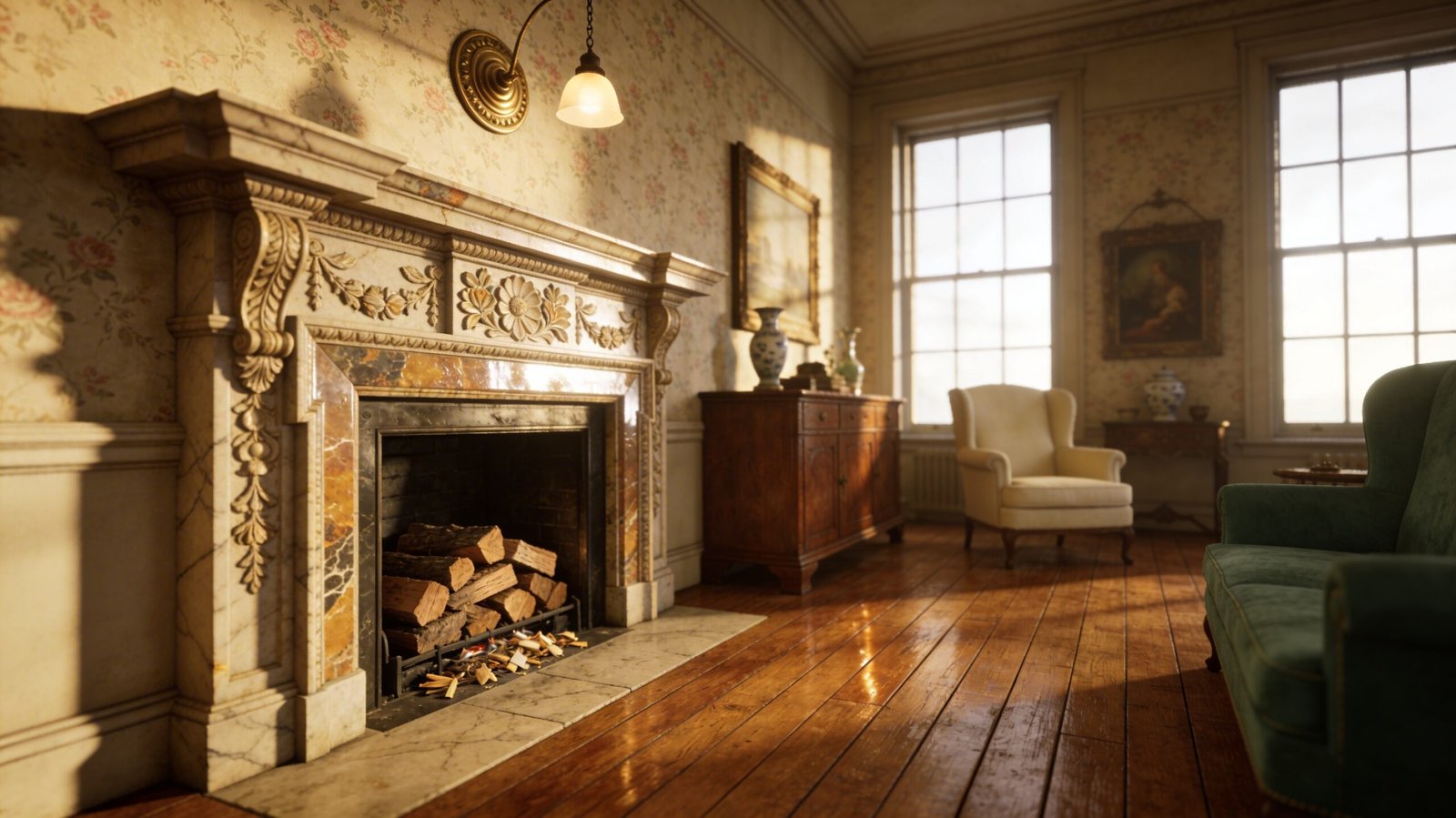
It’s often said that reclaimed antique fireplaces are one of the most impactful single changes you can make to a period room — and one of the most important purchases to make carefully, because the range in quality, authenticity, and value is enormous.
The Main Types Available
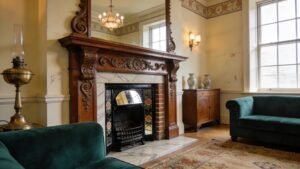
Victorian and Edwardian cast-iron register grates and combination fireplaces: The most widely available type of antique fireplace for the typical UK terraced or semi-detached Victorian property. A register grate combines the cast-iron fire surround, grate, and often decorative tiled side panels in a single unit that fits into the chimney breast opening. These were mass-produced in foundries across the North of England from the 1860s through to the 1930s, meaning that quality and design vary considerably. Original tiles are often lost or damaged; full original sets with intact tiles are significantly more valuable than examples where the tiles have been replaced.
Georgian marble and stone chimneypieces: The grandest type of antique fireplace — a carved surround in marble, limestone, or statuary stone, typically with an inset cast-iron grate. These are rare, expensive (£3,000–£30,000+ for genuine Georgian examples), and require a period interior to justify their scale and formality. They are an investment as well as an architectural choice.
Edwardian and Arts and Crafts wooden overmantel fireplaces: Painted or stained wooden surrounds with decorative overmantel mirrors, shelving, and tilework that reflect the Arts and Crafts design movement of the late Victorian and Edwardian periods. These can be found at moderate prices (£300–£1,500) in good condition and suit the interiors of Edwardian houses where they were originally installed.
Cast-iron bedroom fireplaces: Smaller, more delicate versions of the register grate, designed for first-floor bedrooms. Often with ornate castings and decorated with lily, sunflower, or classical motifs. These are among the most affordable antique fireplace types, frequently available for £100–£400 in original condition.
What to Look For When Buying
Completeness: The most important factor in value and usability. Check whether the original registration plate (the iron plate that adjusts the flue opening) is present and functional. Check whether original tiles are intact — and if tiles are present, whether they are original to the piece or later replacements. Count the side tiles, the throat tiles, the cheek tiles.
Condition of the casting: Cast iron cracks and cannot be welded effectively (brazing is possible but visible). Examine the major structural castings for cracks, particularly around the top of the firebox opening. Hairline cracks in decorative panels are common and manageable; structural cracks compromise the piece.
Fireback condition: The fireback — the cast-iron plate at the back of the firebox — is a consumable item that deteriorates through repeated firing. A cracked fireback needs replacement before the fireplace is used; replacements are available but need to be sized correctly.
Chimney suitability: Before purchasing any antique fireplace for use (rather than decorative installation only), have your chimney assessed by a HETAS-registered engineer or a qualified chimney sweep. An open fire in a solid-fuel appliance requires a chimney that meets Building Regulations and COSHH standards for carbon monoxide ventilation.
Fitting an Antique Fireplace
Fitting a Victorian register grate requires:
- A compatible chimney breast opening (standard Victorian openings are typically 36 inches wide × 36 inches high)
- A structurally sound chimney that has been swept
- Appropriate installation by a competent tradesperson
- Building Regulations notification for installation of a new combustion appliance
The aesthetic result of fitting an appropriate period fireplace in a Victorian room — particularly where the original had been removed and replaced with a tiled or blocked opening — is one of the most dramatic transformations in period property renovation.
Reclaimed Roofing Slate
Welsh natural slate is one of Britain’s great building materials, and the reclaimed market for it is the best source of genuinely matching material for repairs and extensions to properties with existing natural slate roofs. New natural slate is available — from Wales, from Spain, from Brazil — but matching the specific colour, texture, and weathering of an existing Victorian or Edwardian slate roof is very difficult with new material. Reclaimed Welsh slate from a similar era and region can produce a virtually invisible repair.
Why Reclaimed Slate is Often Better Than New
A Welsh slate roof laid in 1880 on a typical terrace used slate that may have been quarried from Penrhyn, Dinorwig, or Ffestiniog — each with a slightly different colour and texture. The quarry waste heaps and reclamation sources available today include material from the same quarries, in some cases from the same vein, weathered to the same degree as the surrounding roof. The match between reclaimed and existing is fundamentally better than the match between new and existing in most cases.
Reclaimed Welsh slate also demonstrates proven longevity. A slate that was laid in the 1880s and has been removed from a sound roof is demonstrably capable of lasting 140+ years. Not all slates in a reclaimed load will have this longevity — some will be delaminating or “foxed” (reddish-brown staining from pyrite oxidation that indicates structural degradation) — but the good ones are proven.
Assessing Reclaimed Slates
Before buying a load of reclaimed roofing slate, assess:
Thickness: Consistent thickness within a load. Very thin slates are fragile and more likely to fracture during installation.
Evidence of delamination: Check the edges and corners of slates for signs of splitting along the grain. Genuine Welsh slate cleaves cleanly; delaminating slate splinters and flakes.
Fox marks: Light, brownish staining from pyrite oxidation. A few fox marks are cosmetic; extensive foxing indicates a slate that will continue to degrade and should not be used structurally.
Nail holes: Old nail holes are not a problem — reslating uses new holes. But slates with multiple nail hole sets (indicating multiple previous installations) are thinner in the nail zone and more prone to splitting.
Roofing slates are typically sold by the thousand or by the square (100 square feet of coverage). Reclaimed Welsh slate runs approximately £400–£700 per thousand for clean, decent-quality stock — broadly comparable to or slightly below new Welsh slate, with the quality and matching advantage.
Reclaimed Stone for Garden Rockeries
A natural stone rockery constructed from reclaimed stone has a different visual quality from a rockery made from freshly quarried stone or from the bagged decorative stone available from garden centres. The moss, lichen, and patina on reclaimed stone — the product of decades or centuries of weathering — creates an immediate naturalistic quality that takes many years to develop on new stone.
Types of Reclaimed Stone for Rockeries
Limestone and carboniferous stone: The most common source of reclaimed rockery stone is demolition of old stone walls, farmsteads, dry stone walls, and agricultural buildings in limestone belt areas (Yorkshire Dales, Cotswolds, Derbyshire, parts of Wales). This material typically arrives with established lichen colonies on the weathered faces, giving an instant aged appearance.
Sandstone boulders: Reclaimed from demolished gateposts, garden features, or agricultural structures. Sandstone’s warmer colours — ochre, rust, buff — suit a different palette from the cooler grey-green of limestone.
Granite: Hard, dense, and resistant to weathering. Reclaimed granite from demolished walls, quarry faces, or coastal sea defences. Its durability makes it a long-term investment in a garden.
Practical Considerations
The weight of natural stone for rockeries is the primary logistical consideration. Individual pieces suitable for a medium rockery feature may weigh 50–500 kilograms. Delivery by grab lorry or flatbed, and movement around the garden using a sack truck, rollers, or a telehandler for larger pieces, needs to be planned before ordering.
For a naturalistic rockery, the key design principle is burying a substantial proportion of each rock — ideally one third to one half — below ground level. This creates the appearance of rocks emerging from the earth rather than rocks sitting on top of it, which is the difference between a convincing rockery and a pile of stones. Reclaimed stone, which already has weathering on all faces, benefits from this approach particularly — the buried portion is irrelevant aesthetically, and the proportionally large exposed surface carries its patina effectively.
Reclaimed Railway Sleepers for Raised Garden Beds
Railway sleepers have become one of the most widely used hard landscaping materials in UK gardens over the past twenty years, and the reclaimed versions — authentic, heavy, deeply weathered, impregnated with creosote from decades of track use — produce results that new sleepers and “sleeper effect” products simply cannot match.
Reclaimed vs New vs Treated
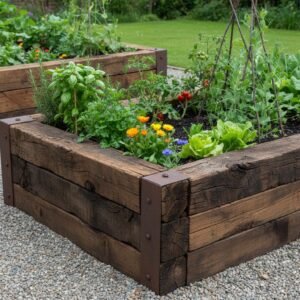
Genuine reclaimed railway sleepers from British and European rail networks are typically 250mm × 150mm × 2,600mm (though dimensions vary between eras and networks), made from hardwood (usually oak, sometimes jarrah, occasionally tropical hardwoods) or softwood (pine, fir). Their surface carries the marks of their service: creosote staining, bolt holes, rail fixing hardware marks, plate marks, weathering. The weight is substantial — a full-sized oak sleeper may weigh 90–120 kilograms.
New hardwood sleepers are untreated or pressure-treated timber, typically pine or oak, cut to similar dimensions. They lack the weathering, the colour, and the character of genuine reclaimed sleepers but are immediately available in consistent dimensions without the contamination concerns.
The creosote question: Genuine old railway sleepers that were in active service before the 1990s are impregnated with creosote — a preservative derived from coal tar. Creosote is now classified as a hazardous substance and its use as a wood preservative is restricted in the EU and UK. Reclaimed sleepers with significant creosote content should not be used in direct contact with food-growing areas, should not be used in environments where children play in direct skin contact with the wood, and should be handled with gloves. The creosote binds to the wood over time and the leaching risk decreases with age, but the caution is real and worth observing.
For raised vegetable beds, new oak sleepers or sustainably sourced hardwood are safer choices than creosoted reclaimed sleepers. For ornamental raised beds, structural retaining walls, path edging, and feature steps where direct food-contact contamination is not a concern, reclaimed sleepers are an excellent choice.
Using Reclaimed Sleepers for Raised Beds
The standard approach for raised beds using railway sleepers:
- Single-course beds (one sleeper height, approximately 150–250mm above ground): sufficient for most ornamental planting, very low-maintenance, straightforward to build
- Double-course beds (300–500mm above ground): better for deeper-rooted planting and more comfortable working height, require corner jointing or anchoring
- Triple-course or higher: require significant structural consideration to resist the outward soil pressure of a filled bed
Corner jointing is the critical detail in sleeper raised bed construction. Overlapping (like log cabin corners) is the most common approach and distributes the load well. Steel pin jointing (drilling through the sleepers and driving steel rebar pins) is more secure for beds subject to significant soil pressure. Standard coach screws (M10 × 160mm or longer) can also be used to tie courses together.
Reclaimed sleepers are available from salvage yards, specialist landscape suppliers, and reclaimed timber merchants. A full-sized reclaimed oak sleeper currently runs approximately £35–£65 depending on condition and source, with price premiums for particularly weathered, wide, or clean specimens.
The Sourcing Strategy
The key to working with reclaimed materials across all of these categories is to source early and think in terms of design flexibility rather than rigid specification. Unlike new materials, which are available to order in any quantity at consistent specification, reclaimed materials are what they are — limited in quantity, variable in quality within a load, unrepeatable in the specific combination of patina and character that makes them valuable.
This means:
Source before you finalise the design. If you find a load of 200mm pitch pine boards, your floor plan may need to accommodate that board width. If you find an 1890s register grate with intact original tiles, your chimney breast opening needs to be the right size. The design follows the materials rather than the materials being specified to match the design — or at least, the best reclaimed projects work this way.
Buy more than you need. Unlike new materials where accurate quantities prevent waste, with reclaimed materials a 10–15% overage is insurance against the off-cuts, the boards that prove unsuitable on closer inspection, the tiles that are cracked on the reverse. You will not be able to buy a matching top-up later.
Document the provenance where possible. Knowing that your floorboards came from a specific Victorian mill, or that your fireplace was salvaged from a particular house, adds a layer of narrative to the materials that is part of their value. Ask the merchant where the material came from; reputable sources will be able to tell you.
The result of using reclaimed materials well — a home where the floors, the fireplaces, the garden features carry genuine history — is something that cannot be created with new materials at any price. The age is real. The character is earned. The materials have already survived longer than most of what surrounds them, which is a kind of reassurance in itself.
About the Author