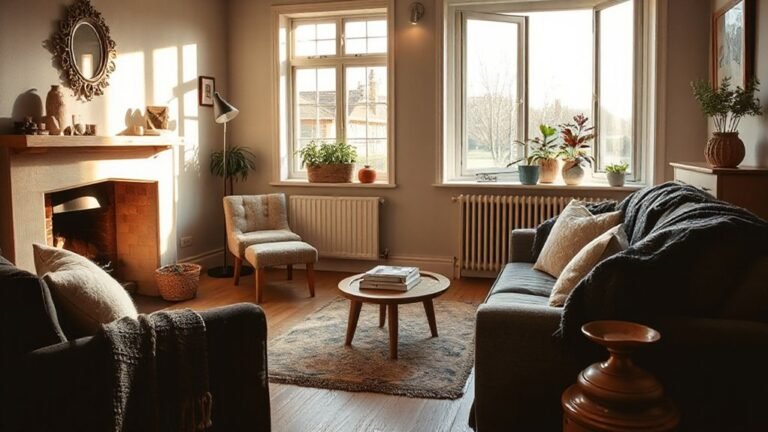

You can transform a long, narrow UK plot into cohesive outdoor rooms by applying scalable, style-driven design with layered vertical planting and low-maintenance materials. Map sightlines, create modular planting zones, and use durable surfaces to widen perceived space. Employ privacy screens, green corridors, and strategic seating to reduce clutter. Maximize light with tiered canopies, reflective surfaces, and vertical supports for climbers. Ready for more practical steps and a precise road map? Continue and you’ll uncover detailed guidance.
Plan a Narrow UK Plot: 6 Design Rules of Thumb
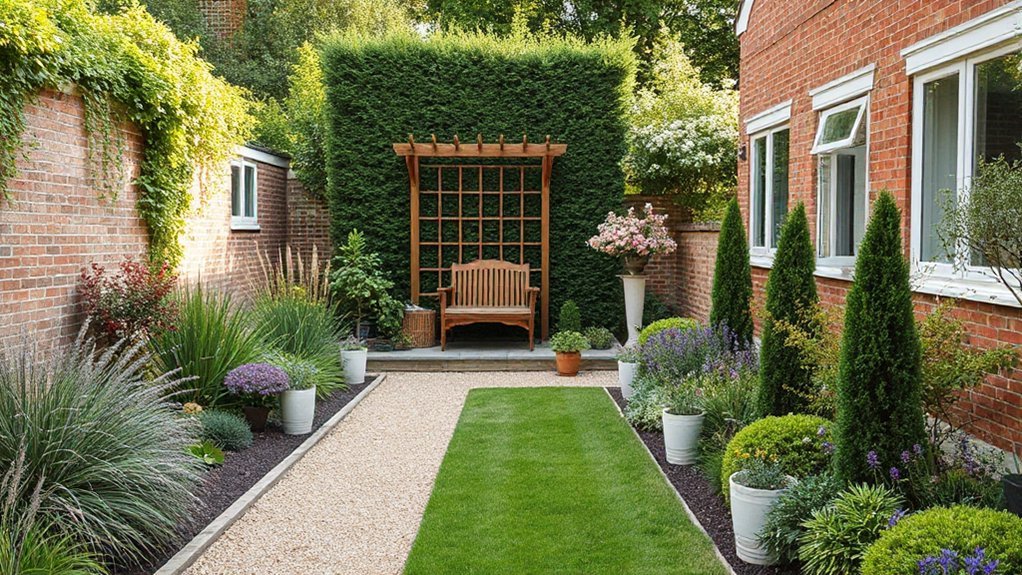
When planning a narrow UK plot, start with six practical rules of thumb that translate constraint into opportunity. You map sightlines, then zone with clear, linear pathways that optimize space without sacrificing flow.
Prioritize verticals: plant layering adds depth while keeping ground coverage efficient. Choose compact, pollinator-friendly species that flourish in partial shade and sun, aligning foliage height with eye level to avoid tunnel effects.
Consider soil health as your foundation; test, amend, and mulch to sustain moisture and nutrients through long seasons.
Create contiguous, Rhythm-driven corridors to guide movement and light, using multisensory cues—texture, scent, color—to amplify perceived width.
Build in scalable modules, so tweaks stay cost-efficient.
Finally, document permissions and maintenance cadence to preserve design intent over time.
Define Your Garden Identity: Styles That Scale on Narrow Plots
Ever wondered how to seal your narrow plot’s personality without sacrificing function? Define your garden identity by selecting scalable styles that respect dimensions while delivering impact. Start with a core concept—modern, rustic, or sculptural—and extend it through repeatable elements: linear paths, vertical emphasis, and durable materials.
Use Garden art strategically to punctuate moments of interest without crowding sightlines or function. For color and texture, prefer a restrained palette that harmonizes with your architecture and surroundings, then layer seasonal planting for year‑round interest.
Consider modular furniture and compact seating that unlocks flexibility without overwhelming space. Finally, document your rules of play: scale guidelines, focal points, and maintenance routines. A cohesive identity thrives on disciplined repetition and purposeful variation.
Create an Instant Welcome: Narrow-Plot Front Entry and Approach
A welcoming front entry on a narrow UK plot starts with a clear, purpose-driven route that says “you belong here.” Begin with a defined approach path that aligns with your garden identity from the previous topic.
Then reinforce it with a compact but impactful entry sequence: low-height hedges or edging to frame the threshold, a single focal point at the verge, and durable surface materials that withstand foot traffic without visually narrowing the space.
You channel control through sightlines, material choice, and proportional cues, delivering immediate legibility.
Integrate garden art as a subtle welcome cue and seasonal blooms to reinforce seasonal rhythm without clutter.
Maintain convenience with accessible lighting and a seamless shift to the main garden, ensuring a confident, lasting first impression.
Zone for Privacy, Seating, and Green Corridors
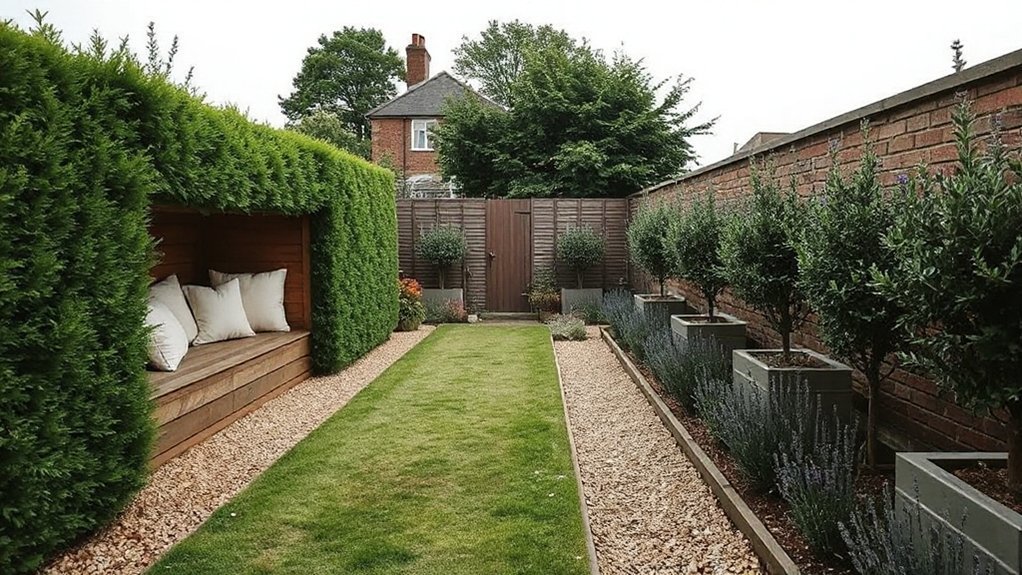
You’ll craft a privacy-forward nook and a seamless green corridor that guides movement and sightlines along the plot.
Prioritize compact seating and screening options that double as focal points, while green corridors stitch together zones for coherence and microclimate control.
This approach aligns Privacy-Focused Nook Ideas with Green Corridor Sequences to create a strategic, legible flow across the long, narrow plot.
Privacy-Focused Nook Ideas
To carve a private retreat in a long, narrow UK plot, start with a dedicated seating zone that’s shielded from view by layered screens, evergreen structure, and carefully placed shrubs.
You design a zone that reads as a calm, private microclimate, where sightlines are controlled and acoustic privacy is reinforced by soft ground textures.
Use linear plantings to guide the eye, and introduce garden art as focal accents that complement the structure without clutter.
Incorporate compact evergreen walls to maintain year-round enclosure while preserving light.
Integrate wildlife habitats through bird-friendly lower layers and pollinator-friendly edging, ensuring minimal maintenance.
Finally, select furniture with durable finishes and precise dimensions to maintain the strategic balance between openness and seclusion.
Green Corridor Sequences
The strategy centers on zoning: a narrow, plant-overshaded corridor that invites pause, then shifts into intimate nooks and a core seating strip. Prioritize sightlines, durable materials, and microclimates to sustain urban wildlife and support sustainable gardening practices.
Deploy modular planters, stepping-stones, and permeable borders to reduce runoff and maintain accessibility. Pair evergreen structure with seasonal interest to keep year-round privacy.
- Define clear sightlines and changeover points
- Use multi-layer planting for year-round cover
- Install permeable, durable surfaces
- Integrate wildlife-friendly features and composting zones
Maximize Light: Tiered Planting and Reflective Surfaces
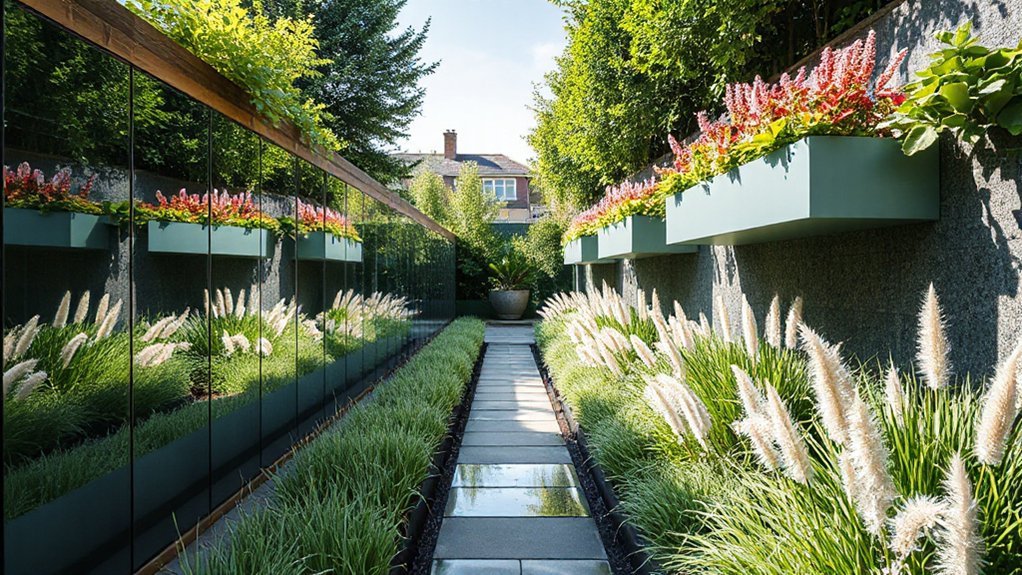
Maximize light where it counts by layering your planting and using reflective surfaces to bounce sun into every corner. Tiered planting creates a stepped canopy that chases shadows to the far end of your plot, while compact deciduous trees open windows for winter sun.
Use verticals—trellises, lattice screens, and narrow berms—to push light deeper without sacrificing space. Reflective surfaces, such as light-colored walls, glassy pavers, and aluminum edges, amplify brightness and reduce glare.
Position water features to mirror light paths and distribute movement without dominating sightlines. Choose plants with bright foliage and pale blooms to enhance luminance at height and ground level.
Design with wildlife habitats in mind, ensuring layers still support pollinators and small critters while you optimize daylight. Precision, efficiency, and strategic contrasts drive your light-forward makeover.
Weave Winding Paths to Expand Space
Use winding pathways to reduce perceived width and draw attention toward focal points, not fence lines. Curved borders soften edges, reduce hard shadows, and invite exploration.
Materials should contrast with surroundings to emphasize flow, while edging maintains crisp definition. Plant scale aligns with path width, ensuring accessibility and maintenance ease.
Elevation changes add depth without overwhelming space. Integrate subtle seating nooks along the route for pauses, yet avoid clutter.
- Winding pathways emphasize continuity
- Curved borders soften edges
- Material contrast guides attention
- Strategic plant placement supports flow
Create Seating Nooks: Tiny Rooms Along the Line
To transform a long, narrow plot into a series of intimate, usable spaces, create seating nooks that feel like tiny rooms along the line. You design each nook as a defined zone: background screening, a focal point, a compact seating cluster, and a durable edge.
Choose weatherproof Garden furniture sized for intimate scale, with low backs to preserve sightlines and a sense of enclosure. Position seating parallel to paths, so the line-reading experience remains uninterrupted yet cocooned.
Integrate Water features at intervals to punctuate transitions and add sensory depth without overwhelming narrow width. Use materials and colors that repeat subtly for cohesion, avoiding visual clutter.
Plan access in and out of each nook, ensuring maintenance is straightforward and zones stay clearly legible.
Use Height to Your Advantage: Trees, Shrubs, and Vertical Planters
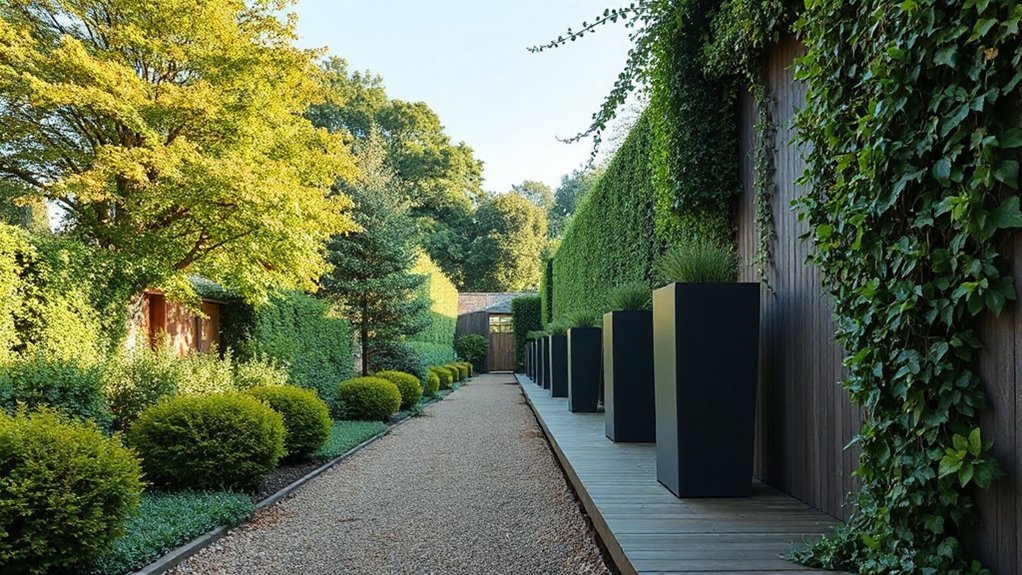
You’ll leverage height with vertical planting tricks that maximize space without crowding your line.
Tall feature synergy guides how trees, shrubs, and vertical planters create layered structure and focal points along the length.
A canopy and wall garden strategy ties these elements into a cohesive, scalable framework for long, narrow plots.
Vertical Planting Tricks
Vertical planting maximizes a narrow plot by stacking height where space is scarce. You target vertical layers to create structure, texture, and microclimates that boost usability without expanding ground area. Implement sturdy trellises, framed lattices, and wall-mounted planters to support climbers, perpetuals, and vertical-shelf combinations.
Choose drought-tolerant species for upper levels and shade-tolerant varieties beneath, preserving balance and light penetration. Consider container gardening for flexible placement and soil control, while anchoring planters to secure frames to windy UK sites.
Create wildlife-friendly edges with nectar-rich blooms and berrying shrubs, inviting pollinators and small birds. Use smart irrigation to sustain height zones and reduce maintenance.
- Structural poles and cable systems maximize reach
- Variable planter depths optimize root zones
- Repeating color accents unify verticals
- Accessible maintenance at every level
Tall Feature Synergy
Tall features reveal the plot’s ceiling by pairing trees, shrubs, and vertical planters to create layered silhouettes and microclimates. You sculpt three vertical bands: a dominant foreground tree, mid-height shrubs for density, and slim vertical planters that draw the eye upward. This hierarchy guides sightlines, improves shade distribution, and buffers noise from adjacent streets.
Choose species with complementary textures and seasonal interest to maintain year-round depth. Position a garden sculpture as a focal anchor at midline, ensuring it doesn’t obstruct pathways. Prune with precision to maintain airflow, preventing stagnant corners.
When aligned with existing architectural lines, tall features boost perceived space without overwhelming scale. Maintain soil health, irrigation efficiency, and root protection to sustain a tall feature that remains cohesive and functional.
Canopy/Wall Garden Strategy
Trees, shrubs, and vertical planters can sculpt a canopy and wall garden that presses up against and defines a narrow UK plot, using height to expand perceived space and bring texture to flat facades. You leverage a canopy structure to soften edges while forcing eye lines upward, creating multi-layer interest.
Focus on wall garden integration by tying climbers, trained trees, and modular planters into a cohesive vertical rhythm. Choose structural supports with durable finishes to maintain form through seasons and wind. Align plant selection with light exposure and moisture, optimizing growth cadence and canopy density. Implement this strategy with precision.
- Define vertical hierarchy with staggered heights
- Use durable supports and concealed fixings
- Pair evergreen backbone with seasonal accents
- Schedule regular pruning and refresh cycles
Choose a Cohesive Material Palette for a Unified Look
To create a cohesive look on a long, narrow UK plot, choose a unified material palette that repeats a few core textures and finishes across zones. You’ll link spaces with consistent substrate choices, aligning pavements, decking, and edging in a deliberate sequence.
Prioritize material combinations that tolerate UK weather—slip resistance, UV stability, and low maintenance. Pair natural stone with rendered surfaces or composite decking to maintain visual rhythm while reducing contrast shifts.
Color coordination matters: pick a restrained scheme of neutrals enriched by one accent hue to echo planting and furniture tones. Avoid overly busy patterns; textures should read as one sequence rather than a mosaic.
Document samples, test lighting, and guarantee joints align to strengthen the sense of continuity throughout the plot.
Budget-Friendly Planting Schemes for UK Climates
A practical planting plan for a long, narrow UK plot prioritizes cost-effective, high-impact choices that withstand local weather. You’ll leverage low-cost perennials, repeatable blocks, and layered textures to maximize impact with minimal upkeep.
Favor compact, drought-tolerant varieties and native species that support wildlife habitats while aligning with container gardening where space is tight. Use hard-wearing evergreen fillers for year-round structure, then seasonally rotate color accents to maintain interest without breaking the budget.
Plan for soil improvement upfront to reduce ongoing costs and improve establishment. Balance sun and shade pockets with versatile companions that thrive together, ensuring resilience across UK seasons.
- Repetition of a few hardy perennials
- Native understory species for wildlife habitats
- Compact evergreen backbone
- Seasonal container accents for flexibility
Privacy Without Enclosure: Screenings That Feel Open
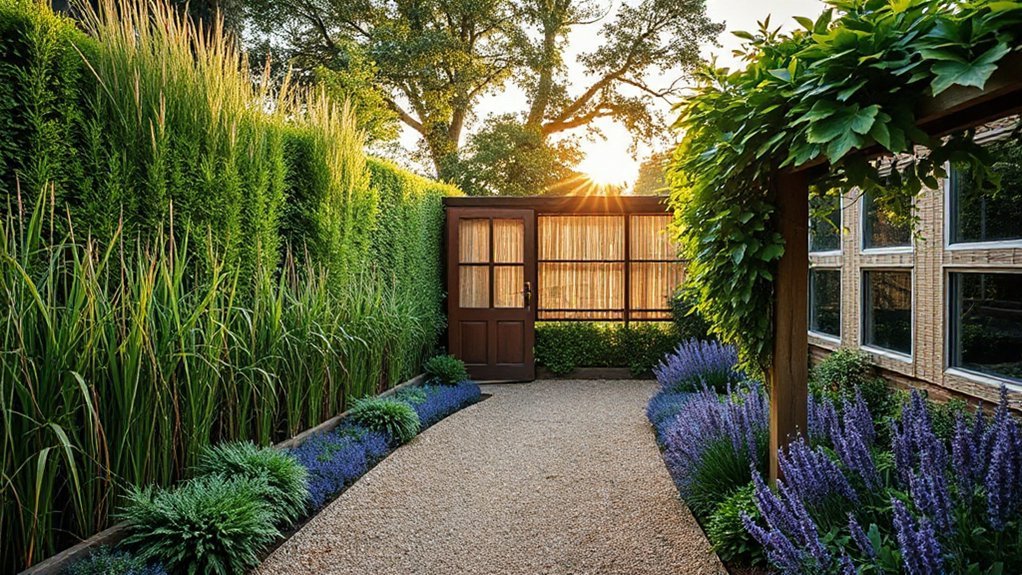
For long, narrow UK plots, you can create privacy without a solid enclosure by using layered screenings that read as open spaces rather than walls. You’ll deploy a stepped sequence of materials—tall grasses, slatted screens, and low hedges—to filter sightlines while preserving air and light.
Opt for varied textures and heights to convey depth, not density, so the space remains legible and navigable. Integrate planting into the screens with evergreen backbone plants and seasonal accents that soften edges without concealing the layout.
This approach delivers garden privacy while maintaining an inviting feel, avoiding a boxed impression. Consider repeat motifs and consistent color palettes to unify zones.
The result is open screening that respects privacy, drives rhythm, and preserves the garden’s sense of flow.
Maintenance-Smart Design for Low-Upkeep Yards
Effortless upkeep starts with a design that minimizes ongoing labor while maximizing long-term performance. You’ll deploy durable materials, modular planting zones, and integrated drainage to reduce maintenance cycles while preserving function and form.
Prioritize scalable systems that tolerate UK weather without constant intervention, and select low-fuss textures that resist wear. Eco-friendly solutions guide material choices, irrigation efficiency, and soil health, cutting waste and water use.
Wildlife-friendly features can be discreet, supportive, and low-effort when cleverly integrated into pathways and borders. Shape your yard with strategic sightlines, avoiding clutter and frequent pruning.
Plan for automated lawn care where appropriate, and use mulches to suppress weeds.
- Durable hardscape-first layout
- Drought-tolerant planting palette
- Modular, low-maintenance components
- Quiet, climate-resilient irrigation
From Sketch to Finish: A Narrow Plot Roadmap
You map the route by zones: access, service, display, and retreat, then align each with a precise timeline.
Begin with a compact skeleton plan—dimensions, sightlines, and drainage—so subsequent choices stay scalable.
With routines tested, execute in phases, preserving flexibility for micro-adjustments.
Choose Garden art as focal punctuation, installed where weight, sun, and wind conditions cohere, not afterthoughts.
Integrate Wildlife habitats early, leveraging hedges, native grasses, and quiet refuges to attract pollinators and birds without crowding pathways.
Measure impact with metrics: space utilization, accessibility, and maintenance load, then refine until the finish feels inevitable.
Frequently Asked Questions
How to Choose Plants for Year-Round Interest on a Narrow Plot?
Choose compact, varied perennials and evergreen shrubs with year-round structure, rotate container planting for seasonal interest, and layer textures. You’ll pair bold foliage with blooms, use color accents, and schedule maintenance to sustain visual rhythm year-round.
What Drainage Considerations Are Essential for Long UK Plots?
You need solid drainage, prioritizing soil improvement and proper drainage installation. Assess gradient, implement perforated pipes or French drains, and guarantee soil supports sustainable moisture levels. Regularly test, adjust profile, and plan for seasonal shifts and load-bearing paths.
Can Water Features Work Without Crowding the Space?
Water features can work without crowding space, if you plan precise Water feature placement and keep lines clean like a sleek riff on architecture. You’ll manage Water feature maintenance efficiently, ensuring flow, safety, and visual rhythm throughout your slender plot.
Which Compact Tree Species Suit Small UK Gardens?
Compact tree options include dwarf willow, columnar pear, and small maple; they fit tight plots. You’ll leverage container gardening and vertical planting to maximize canopy without crowding, while maintaining structure and seasonal color.
How to Budget for a Full-Width Planting Plan?
To budget a full-width planting plan, you’ll map zones, estimate planting density, and pad for contingencies; set aside for garden furniture and outdoor lighting, then stage phased purchases to maximize impact while staying under total costs.
Conclusion
You’ll finish with a finely tuned, functional fantasy. Focus, frame, and funnel—form follows footprint, yet flair fuels function. Plan paths, plant palettes, and pleat privacy with purposeful perspective. Maintain margins, maximize light, and magnetic, low‑maintenance materials mingle with modular, scalable moments. Think strategically, staggered silhouettes, smart soils, and sympathetic shadows. You’ll seal a streamlined sanctuary: chic, compact, and forever cultivated, becoming your go‑to garden strategy—simply sensational, sustainably styled, snugly spectacular.
About the Author