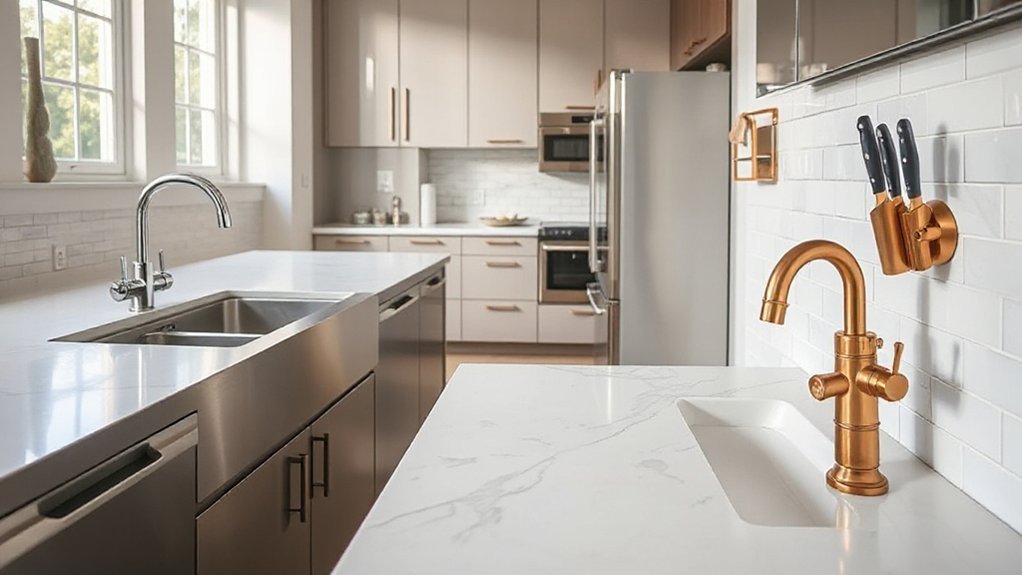
Mixing metals isn’t about matching every piece perfectly; it’s about balancing warmth and shine to create a cohesive feel. You’ll want dominant metals in key spots—sinks, backsplashes, or faucets—while sprinkling secondary tones in hardware and accents. Consider undertones and lighting, then test how finishes look under real conditions before committing. The right mix elevates durability without sacrificing harmony, but a misstep can read as clutter. Ready to map your metal plan with precision and purpose?
Key Takeaways
- Coordinate finishes by aligning undertones across fixtures, hardware, and lighting for a unified look.
- Assess corrosion risk based on exposure; seal brushed brass and stainless steel to tolerate humidity.
- Use a dominant finish for large fixtures, then layer complementary tones in hardware and accents.
- Place dominant metals near sinks and stoves, echoing them in cabinetry hardware and lighting for cohesion.
- Test under real lighting and document samples to ensure consistent gleam, warmth, and compatibility.
Three Rules for Safe, Stylish Metal Pairing
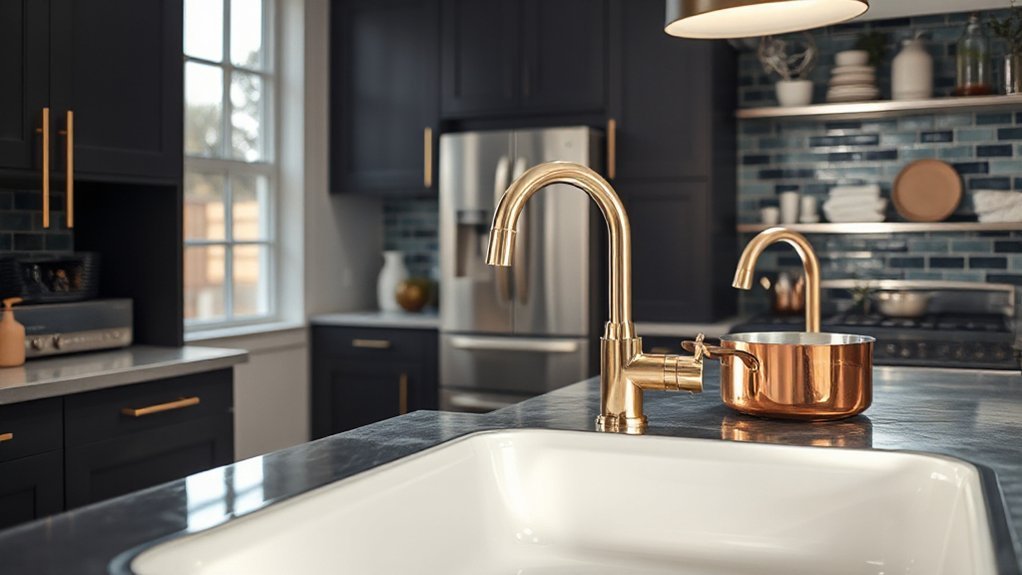
Mixing metals in kitchens and bathrooms works best when you start with three simple rules: coordinate finishes, consider corrosion risk, and balance contrast with cohesion.
You’ll evaluate metal accent pieces first, choosing finishes that share undertones to create a unified feel. Next, assess exposure and moisture to gauge corrosion risk; brushed brass and stainless steel often tolerate humidity when properly sealed, but avoid high-salt environments for copper.
Finally, balance contrast with cohesion by pairing a dominant metal with one or two supporting accents, ensuring lighting contrast highlights key details without competing for attention. Opt for consistent hardware profiles across textures, and align edge details with cabinet hardware, faucets, and lighting fixtures.
This disciplined approach preserves form and function while delivering intentional, lasting style.
Where to Place Mixed-Metal Finishes for Cohesion
To create cohesion, place mixed-metal finishes where your eye naturally lands first and then anchor around those focal points. You’ll balance contrast by repeating metals in related places, ensuring a quiet rhythm across rooms. Start with the main work zones and mirror accents in adjacent spaces to create harmony without shouting.
- Position dominant finishes near sinks, stove backsplashes, or primary hardware, then echo similar tones in cabinetry hardware and lighting to guide the gaze.
- Cluster a secondary metal in small doses—drawer pulls, faucet finishes, or towel bars—so contrast remains deliberate, not random.
- Tie color temperature and sheen across surfaces, favoring consistent warmth or coolness to reinforce cohesive flow and practical, daily functionality.
Finishes Guide: Brass, Nickel, Chrome, Black, and More
In this finishes guide, you’ll map finishes like brass, nickel, chrome, and black to the room’s lighting and cabinet tones. Use a clear pairing framework to coordinate metal tones and keep the visual weight balanced across fixtures, hardware, and accessories.
We’ll cover practical tips for metal tone coordination and how to mix finishes without clash.
Finishes Pairing Guide
When pairing finishes like brass, nickel, chrome, and black, start by considering the overall style and lighting of the space. You’ll balance metal texture with how light bounces off surfaces, shaping perceived warmth or crispness.
Focus on the alignment of finishes at key touchpoints to avoid visual clashing. Then decide which metals will lead and which will support.
1) Visual anchor: choose one dominant finish, letting others act as accents to guide the eye.
2) Contrast and harmony: pair warm tones with cool ones, ensuring lighting effects highlight textures rather than mask them.
3) Cohesion check: test hardware placement from multiple angles, confirming consistent gleam and reflections across faucet, fixtures, and cabinetry edges.
Metal Tone Coordination
As you build on your finishes plan, metal tone coordination means choosing how brass, nickel, chrome, black, and other tones play together under your lighting. Start with a dominant metal for large fixtures, then layer secondary tones in hardware, faucets, and decorative accents.
Aim for consistent warmth or coolness across finishes to avoid jarring contrasts. Consider the room’s color palette and the light source; warm bulbs enhance brass and golds, while cool LEDs suit chrome and nickel.
Mix finishes in a controlled rhythm: one dominant, one secondary, and one accent. Plan for longevity by selecting Sustainable metals where possible, and note where Vintage accents can add character without overcrowding the palette.
Document samples, test under real lighting, and revise before purchase.
Common Mistakes and How to Fix Them
Common mistakes often stem from assuming metals will behave the same way in every bathroom or kitchen setting. To fix this, start by understanding each metal’s compatibility, finish, and mounting requirements.
You’ll avoid costly errors by evaluating exposure, cleaning needs, and hardware compatibility before purchase. Pay attention to metal corrosion risks and how finishes age under moisture, heat, and cleaners. Budget considerations matter: choose durable finishes that last longer, even if upfront costs are higher.
- Assess environmental exposure and cleaning products to prevent prematurely worn surfaces.
- Match mounting hardware to the substrate and finish to minimize corrosion and loosening.
- Plan for a cohesive look by outlining a simple rule for mixing tones without overcomplicating maintenance.
Maintenance and Upgrade Paths for Mixed-Metal Spaces
Maintaining mixed-metal spaces requires a proactive, goal-oriented approach: establish a routine that protects finishes, prevents galvanic reactions, and guides thoughtful upgrades.
Start with metal cleaning protocols that match each surface’s finish and cumulative exposure. Use non-abrasive cleaners on brass, stainless, and nickel, and avoid acidic products on sensitive coatings.
Implement regular inspection checks for dulling, pitting, or discoloration, recording issues and times.
For corrosion prevention, segregate dissimilar metals when possible, apply compatible sealants to joints, and maintain consistent humidity levels to slow oxidation.
Upgrade paths should favor coordinated hardware updates, avoiding mismatched tones or incompatible coatings.
When replacing components, choose finishes with corrosion resistance suitable to the environment, document warranties, and plan phased updates to minimize downtime and labor costs.
Real-World Color and Material Pairings to Try
Real-world color and material pairings come alive once you test them in space. You’ll see how reflective metals interact with fabric-like textures and matte finishes, guiding your final choices with practical accuracy.
When pairing, pick a dominant metal and support with contrasting or complementary hues, then measure under lighting to confirm tone. Think how vintage accents can warm a steel countertop or brass fixtures, while industrial textures add tactile depth to walls and cabinetry.
Draft a small-scale mock-up in a drawer or sample board to avoid surprises before committing.
1) Brushed steel with warm oak and a matte charcoal backdrop
2) Brass fixtures against cool gray cabinets and concrete-look tile
3) Copper accents paired with blackened steel and creamy marble
Frequently Asked Questions
How Do Lighting Choices Affect Mixed-Metal Spaces?
Lighting choices shape mood, contrast, and cohesion in mixed-metal spaces. You’ll want color coordination between finishes and light warmth to unify metals.
Use lighting fixtures with a neutral or matching metal tone, or mix warmth and cool tones deliberately for depth.
Position fixtures to highlight contrasting finishes, not overwhelm them.
Choose bulbs around 2700–3000K for warmth, or 3500K for a balanced look.
Make certain color rendering is strong so metals shine accurately.
Can Metals Influence Perceived Room Temperature or Mood?
Metals can dramatically shift perceived temperature and mood. You’ll feel the chill of brushed steel or the warmth of brass, influencing comfort and ambiance.
In metal psychology, cool tones heighten alertness, while warmer tones soothe, nudging you toward calmer moods.
You’ll notice mood enhancement when you pair metals with lighting and textiles to balance heat or coolness.
Use strategic contrasts to fine-tune comfort, ensuring practical comfort and precise, actionable space design.
Are There Budget-Friendly Ways to Update Existing Finishes?
Yes—there are budget-friendly ways to update existing finishes. You can try budget swaps like swapping hardware, fixtures, and accent pieces, or apply finish coatings such as oil-rubbed, matte black, or brass-look spray paints for a cohesive look.
Focus on consistency across metals to avoid chaos. Plan a quick refresh by replacing cabinet pulls, door handles, and light fixtures, then seal with a clear topcoat for durability.
Finish coatings let you customize without replacing larger items.
How to Prevent Fingerprint and Tarnish Visibility on Metals?
Fingerprint resistance and tarnish prevention come down to choosing finishes with protective coatings, and adopting simple routines.
Clean regularly with a soft microfiber and a pH-neutral cleaner, then dry thoroughly to avoid water spots.
Wipe spills promptly, especially acidic ones.
Apply a thin wax or sealant as recommended by manufacturers, and use inert cleaners for delicate surfaces.
Avoid abrasive pads.
These steps keep metal surfaces clearer, brighter, and easier to maintain over time.
Do Metals Impact Resale Value or Appraisal in Homes?
Yes, metals can impact resale value or appraisal. When metal corrosion appears, buyers see maintenance risk and potential costly repairs, which lowers resale value.
Conversely, well-maintained metals or corrosion-free finishes boost appeal and can support a higher appraisal.
Focus on proactive care—address hotspots, seal finishes, and use corrosion-resistant alloys where possible.
Document maintenance for buyers, as a history of upkeep reassures appraisers and can preserve value.
Conclusion
You’ll walk away with a practical, balanced approach: pick a dominant metal for the big moments, add supporting tones in smaller details, and test under your lighting to confirm warmth and cohesion. Keep undertones aligned, watch corrosion risks, and maintain a simple rhythm across fixtures. When in doubt, rotate a single accent through hardware, lighting, and plumbing. Realistically, a well-planned mix lasts longer than a flashy swap—much like a careful, vintage pocket watch in a modern kitchen. Anachronism: a brass pocket watch.
About the Author