
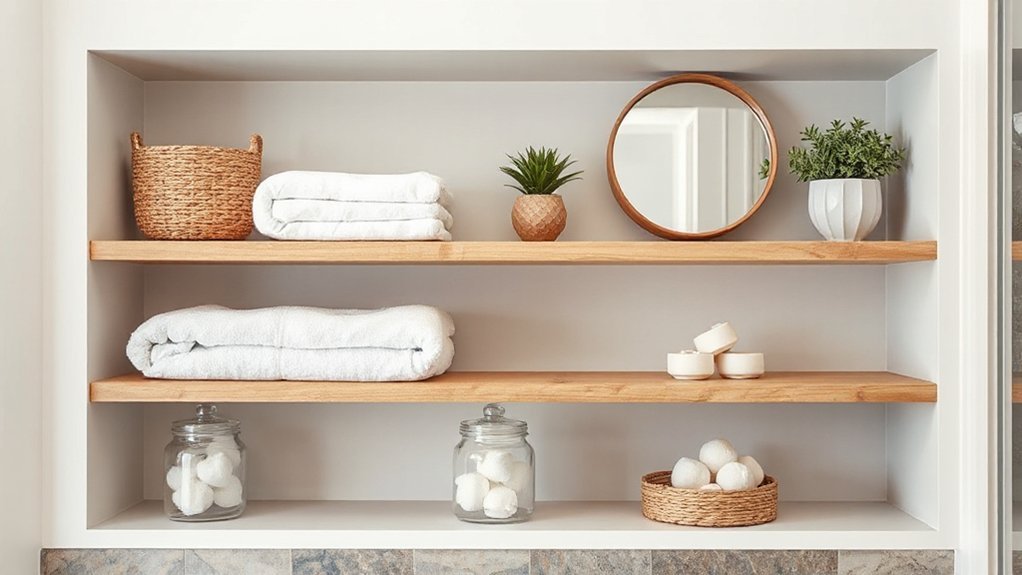
Open bathroom shelves demand a deliberate system: group like items, layer by use, and keep daily essentials at eye level for instant access, then unify with uniform containers and discreet labels. Balance texture by pairing matte towels with glossy accessories, and introduce greenery that tolerates humidity. Maintain spacing and material cohesion, and schedule periodic reassessment to preserve both function and form—because the right arrangement evolves with your routines and fixtures, not just your impulses.
Key Takeaways
- Define storage goals and organize by usage: daily, seasonal, and backup items in dedicated zones for easy access.
- Use uniform containers, labels, and finishes to create visual unity across open shelves.
- Layer items by frequency and height: daily at eye level, secondary tools nearby, seasonal items on top.
- Incorporate moisture-tolerant finishes, proper seals, and wipe-down routines to maintain longevity.
- Add decorative yet functional elements (plants, textiles, personal mementos) with careful spacing and breathable airflow.
Set Clear Storage Goals for Your Bathroom Shelves
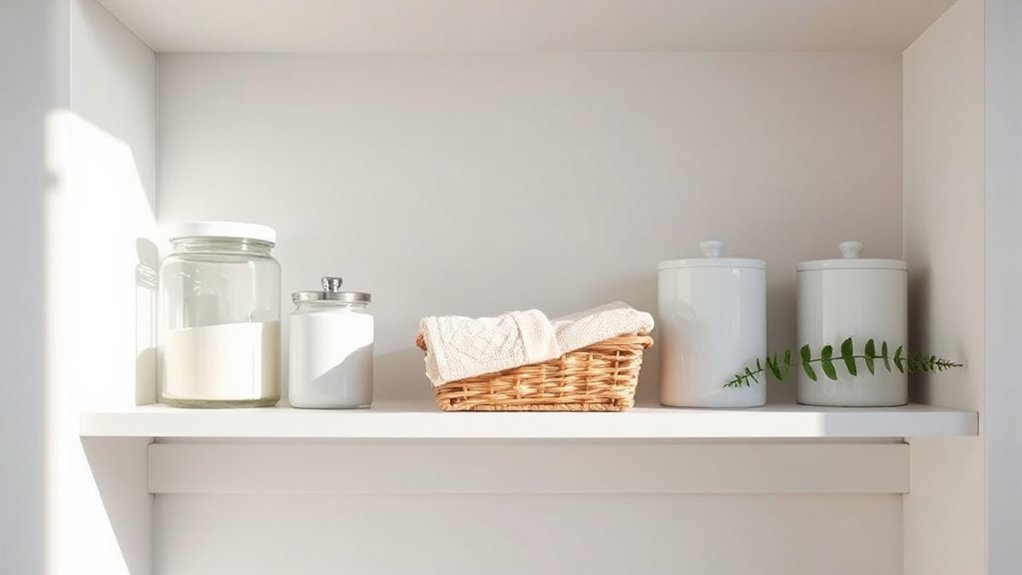
To set your bathroom shelves up for success, define clear storage goals before you start organizing. You’re establishing targets for accessibility, visibility, and containment.
Identify daily-use items, seasonal products, and backup supplies, and allocate dedicated zones for each category. Prioritize personal hygiene products by frequency and size, ensuring they stay within arm’s reach and are easy to wipe clean.
Index items by function: cleansing, grooming, and care, then assign protective shelves or baskets to reduce clutter. Incorporate decorative accents that enhance perception of order without hindering function, such as uniform containers or lided canisters.
Establish labeling conventions and load limits to maintain balance and prevent overstock. Review goals quarterly, adjusting for changes in routine, products, and user needs.
Choose Moisture-Resistant Finishes, Colors, and Materials
Choosing moisture-resistant finishes, colors, and materials starts with evaluating exposure and care routines. Select options that tolerate humidity, splashes, and frequent cleaning without warping or dulling. You’ll prioritize moisture barriers and waterproof finishes to safeguard substrates while preserving texture and tone.
Opt for low-porosity surfaces and sealed edges to minimize capillary wicking and staining. Color and material choices should resist scratching and fading after regular wipe-downs, yet remain visually calm and coherent with the shelf ecosystem. Test samples under bathroom lighting and humidity cycles to confirm performance before install.
- Choose sealants and finishes with clear moisture-barrier claims and durable wear
- Favor matte or satin sheens that hide watermarks while staying easy to wipe
- Prefer porcelain, engineered stone, and solid-surface composites for longevity
- Match hardware finishes to emphasize a cohesive, water-aware palette
Group and Layer: Build Visual Families for Easy Access
Group similar items into defined zones to streamline retrieval. Layer items by frequency of use and accessibility, creating clear sightlines and pull zones.
This visual family approach reduces search time and supports consistent styling across the open shelf.
Group Like Items
Grouping like items creates clear visual families that streamline routine bathroom tasks. You’ll align products by function, forming cohesive groups that reduce search time and extend maintenance intervals. Position daily-use items at arm height within a single zone, and reserve secondary tools in adjacent shelves to sustain order.
Use consistent containers, label where appropriate, and select materials with uniform finish to reinforce visual unity. Incorporate decorative accents and personal mementos as deliberate punctuation within each group, ensuring they don’t disrupt usability.
This approach supports rapid access, minimizes clutter, and enhances overall perception of the space. Maintain a restrained palette to preserve legibility and balance across the shelf.
- Define functional clusters with purpose-specific containers
- Elevate cohesion using uniform materials and finishes
- Integrate decorative accents without compromising clarity
- Respect personal mementos as intentional focal touches
Layer for Access
Place essentials at the lower third and reserve mid-level for commonly used accessories, leaving top rows for seasonal or infrequent tools. Maintain a consistent depth plan so weights and bulks align within each tier, reducing shift when opening doors.
Integrate Decorative accents within grouped clusters to avoid visual chaos, ensuring safe clearance for toiletries and cords. Add Personal touches sparingly to preserve legibility and balance.
Keep labeling minimal but clear, and adjust heights after routine use to sustain ergonomic access.
Create Visual Families
Visual families organize items by function at the shelf level, creating clear clusters that readers can scan quickly. You’ll group related objects into coherent zones, then layer items to reinforce function and flow.
Position primary items at the eye line and secondary tools nearby but out of the main axis. Use vertical stacking to maximize shelf depth without clutter.
Integrate decorative accents to cue purpose and soften sharp edges, while maintaining legibility. Lighting options should emphasize clusters, not single objects, with dimmable warmth for ambiance during routines.
Keep excess motion to a minimum; each cluster should convey a clear story. Maintain consistent spacing, align edges, and reserve surface for one focal element per group.
- Cohesive zones for quick access
- Clear hierarchy within shelves
- Decorative accents that signal use
- Lighting options to define clusters
Clip, Stow, and Display: Everyday Storage Solutions
To keep a bathroom organized and visually calm, clip, stow, and display essentials where they’re most needed. You’ll implement clear zones: daily-use items within arm’s reach, backups stored in labeled containers, and infrequently used products tucked behind doors or on higher shelves.
Use uniform containers to reduce visual noise and enable quick scanning. Clip items with adjustable or magnetic holders to maximize shelf surface without clutter.
Stow: group related products by function, then align and stack to maintain edge-to-edge balance.
Display: curate a restrained assortment of decorative accents and personal mementos that reinforce color or material cohesion, avoiding overaccumulation.
Prioritize accessibility, airflow, and wipeable finishes; rotate or refresh periodically to preserve a crisp, purposeful aesthetic.
Add Life With Moisture-Resistant Greenery, Textiles, and Textures
You select moisture‑resistant greenery, textiles, and texture layering to elevate open shelf systems without compromising damp environments.
Consider plant choices like sansevieria or pothos, paired with wipeable fabrics and tactile surfaces that withstand humidity.
This approach establishes functional contrast—greenery, textiles, and textures—that adds life while maintaining clean, design‑driven lines.
Moisture-Resistant Greenery Choices
If moisture is a constant in your bathroom, select greenery that thrives in high humidity and has minimal daily care. Choose species with proven tolerance to indoor humidity and low irrigation needs, then plan their placement to optimize light exposure and airflow.
Favor compact varieties that resist mold and have fleshy leaves or waxy coatings for durability. Use containers with adequate drainage to prevent water buildup and root rot.
Monitor daily light levels to ensure steady photosynthesis without overexposure. For consistent results, categorize plants by water requirements and align them with shelf heights and faucet proximity.
Emphasize clean lines, simple pots, and discrete saucers to maintain a cohesive, low-maintenance display.
- Species with high humidity tolerance and low care
- Compact, mold-resistant options for tight shelves
- Drainage-first containers to prevent root rot
- Strategic plant placement for light and airflow
Textiles And Texture Layering
Emphasize fabric layering to create micro-variations in sheen and thickness, ensuring each piece reads as its own material while contributing to the overall field. Introduce textural contrast through matte towels against glossy ceramic backsplashes. Pair ribbed weaves with smooth, flat-weave textiles to emphasize surface diversity.
Maintain cohesion with a limited color palette and consistent scale. This approach yields a refined, functional display where fabric layering and textural contrast reinforce intentional, moisture-aware design without visual clutter.
Maintenance Mindset: Cleaning Routines and Longevity
Regular maintenance underpins long-lasting bathroom gear, so establish a concise cleaning cadence that targets high-touch surfaces and moisture-prone zones. You implement a scheduled routine that prioritizes frequent wipe-downs, timely damp-dusting, and scheduled deep cleaning to sustain finish integrity and shelf stability.
Emphasize mold prevention by controlling humidity, inspecting seals, and using non-abrasive cleaners that preserve coatings. Track tasks and outcomes to reinforce consistency and design longevity, not just cleanliness.
- Maintain a targeted weekly wipe-down to preserve material integrity and tactile quality
- Schedule quarterly deep cleaning to lift residues without caustic impact
- Monitor humidity and airflow, mitigating mold-prone pockets behind items
- Document results to refine cadence and sustain open-shelf aesthetics
Troubleshoot Common Shelf Styling Pitfalls (and Fixes)
Despite good intention, shelf styling often stalls from conflicting heights, uneven spacing, and careless material pairing; the fix is a lean, rule-based approach.
You’ll establish a vertical hierarchy by grouping items in odd-numbered increments (1, 3, 5) and aligning major objects at eye level.
Measure gaps with a simple spacer rule: keep 1 to 2 inches between objects of similar scale, and 3 to 6 inches between contrasting masses.
Prioritize material cohesion—avoid pairing shiny glass with matte plastics unless textures echo elsewhere.
Test shelf stability by loading heavier items closer to the wall studs and lighter accents outward.
Reassess after 24 hours, adjusting for aesthetic balance if a single piece dominates.
Maintain a restrained color palette to prevent visual clutter and preserve shelf stability.
Frequently Asked Questions
How Can You Balance Function and Aesthetics on Small Bathroom Shelves?
Yes—balance function and aesthetics by prioritizing compaction and clarity.
For small bathroom shelves, maximize decor placement efficiency: group like items, vary heights, and keep frequently used products at reachable levels.
Use shelf organization with clear bins and labeled zones to reduce visual clutter.
Choose a cohesive color palette, add a single metallic accent, and leave negative space.
Keep lines clean, materials moisture-friendly, and update periodically to maintain balance between utility and style.
What Are Budget-Friendly Moisture-Resistant Storage Solutions for Shelves?
Budget-friendly moisture-resistant storage solutions include wire baskets, acrylic dividers, and magnetic racks that resist humidity.
You’ll maximize shelf space with stackable bins and labeled containers for decor organization, while silicone-sealed boxes prevent water damage.
Use water-resistant laminate or PVC shelf liners to reduce mold risk.
Opt for low-raise, ventilated cube organizers with hidden mounting.
Add shelf accessories like labeled jars and coasters to keep surfaces dry and stylish.
Keep profiles slim and materials epoxy-coated for durability.
How Often Should You Rotate Decor to Maintain Freshness?
You should rotate decor every four to six weeks to maintain freshness. Seasonal updates help you pace changes without overhauling the space, while decorative accents keep the look intentional and cohesive.
Align rotations with lighting and usage patterns to preserve balance. Track what works and what feels stale, then swap key pieces first—art, vessels, and textiles—before minor accessories.
This keeps your shelves dynamic, functional, and visually precise.
Which Items Should You Avoid Placing on Open Shelves?
Avoid fragile glass, valuable items, and overcrowded configurations on open shelves. You should keep clutter organization in mind by excluding items you don’t regularly use, and opt for sturdy, non-slip containers for small parts.
Decorative accents should stay intentional, not excessive; steer away from items with sharp edges or uneven bases. Prioritize moisture-resistant, easily wipeable materials, and store cleaning products out of sight.
Maintain balance by grouping by function and height for a clean, airy look.
How Do You Safely Anchor Shelves in Moisture-Prone Walls?
You should use wall anchors rated for moisture-prone walls and install a moisture barrier behind the shelf.
Start by locating studs, then drill appropriately sized holes for corrosion-proof anchors.
Use stainless steel or coated hardware, and seal each penetration to prevent vapor ingress.
Tighten fasteners to spec, avoiding overdraw.
Verify load capacity with the shelf and contents, and recheck after a few days.
This keeps shelves stable and moisture-resilient.
Conclusion
You’ve tuned every shelf like a quiet symphony, where restraint is the conductor and texture the motif. Keep groups tight, layers deliberate, and daily items at eye level for instant access. Use moisture-ready materials, uniform containers, and subtle greenery to breathe life without clutter. Periodically reassess, trimming excess while preserving cohesion. When in doubt, trim the chatter: let negative space and cohesive finishes do the heavy lifting. Your bath becomes a curated, calm chorus—functional, elegant, enduring.
About the Author