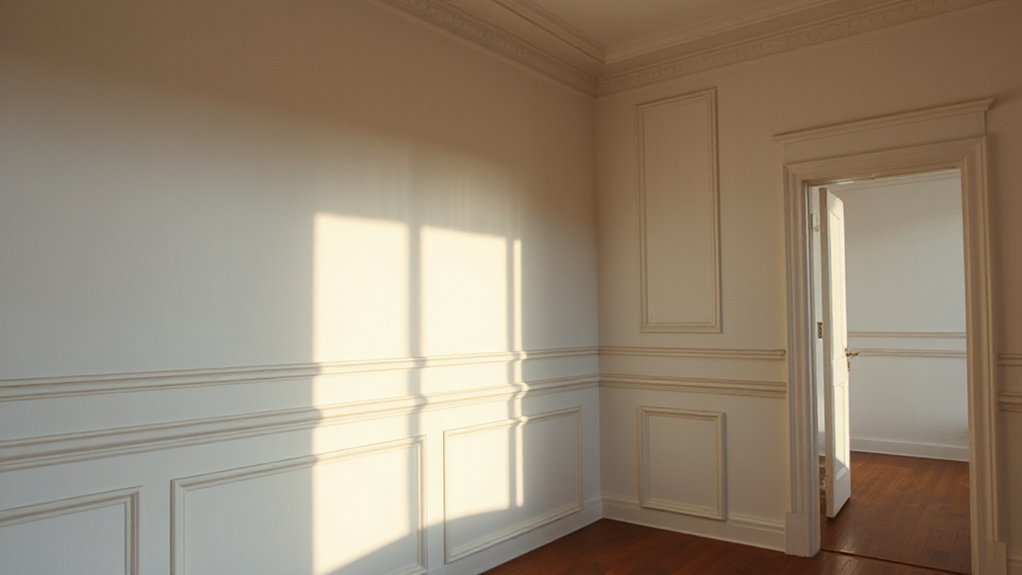
You stand before a wall that promises grandeur, its flat surface suddenly hinting at arches and depth you haven’t built. You’ll learn how paint can fake architectural features with convincing perspective, shading, and edge work, all without real construction. This approach hinges on careful color, testing, and lighting, ensuring the illusion stays reversible and safe. But the method asks you to weigh how far you’ll push perception—and what you’ll do if the illusion falters.
Key Takeaways
- Use perspective, color, and edge treatment to imply depth and mass, with shallow vanishing lines for substantial walls.
- Choose lighter hues for recessed surfaces and pair smooth textures with subtle patterns to suggest material depth.
- Employ reversible faux finishes, stencils, and textured effects that can be removed or dissolved without damage.
- Plan lighting, shadows, gradients, and color shifts to strategically alter perceived space and scale.
- Document steps, test patches for reversibility, ensure full removal on hidden areas, and select substrates and solvents that minimize impact.
Foundations: How Painted Architectural Illusions Work
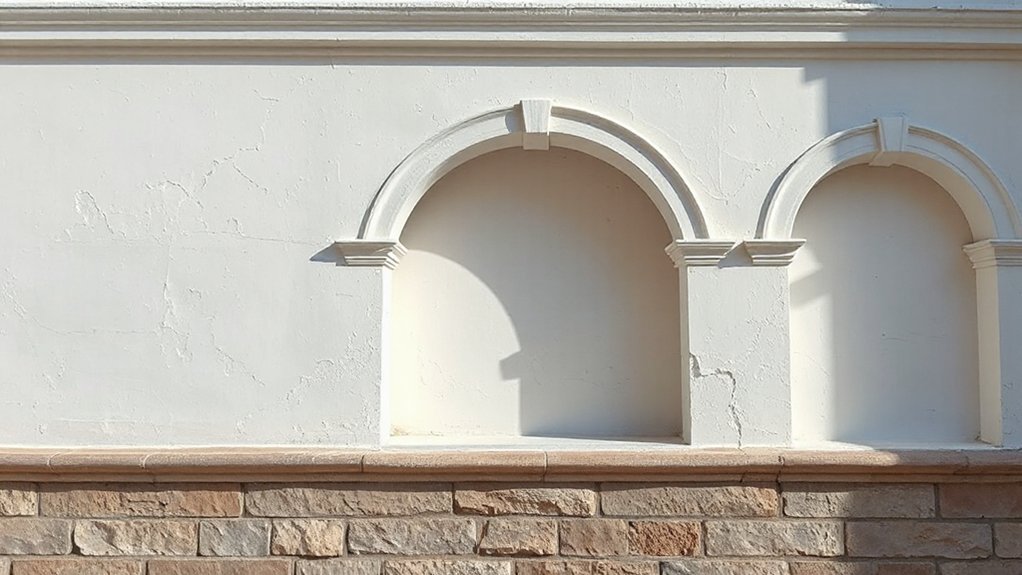
Painted architectural illusions for foundations rely on careful perspective, color, and edge treatment to suggest depth and mass where there’s none. You deploy shallow vanishing lines and verticals to imply substantial walls beneath a surface layer, shaping how viewers read the base.
Color psychology guides you to choose hues that evoke stability—cool, grounded tones—without exaggerating weight. Contrasts are deliberate: edges sharpen where you want definition and soften where you seek ambiguity, guiding perception toward a robust plinth.
Material authenticity matters: you simulate textures and grain with precise brushwork and glaze to reinforce believability, even as the underlying substrate remains simplified. You test reflections and light falloff to maintain convincing mass, ensuring the illusion neither overreaches nor undercuts the room’s architectural logic.
Deciding What to Fake in Your Space
You’ll start by weighing material moodboard choices against the visual goals you want to achieve.
Consider how textures, colors, and patterns convey depth, weight, and credibility, while balancing cost and feasibility.
Weigh the tradeoffs between realism and simplicity to decide what to fake in your space.
Material Moodboard Choices
Material moodboards guide you in deciding which surfaces to fake, balancing what looks authentic with what’s practical. You curate color psychology and material textures to set mood without overcommitting. Your choices anchor the illusion, then stay consistent across spaces.
- Align color psychology with the room’s purpose, selecting hues that read as authentic under typical lighting.
- Pair material textures that mimic real surfaces—grain, sheen, and tactility—while prioritizing durability and ease of maintenance.
- Limit the palette and textures to a curated few, ensuring cohesion and reducing overreliance on painted tricks.
Visual Illusion Tradeoffs
When deciding what to fake in a space, weigh visual impact against maintenance, cost, and realism. You’ll trade immediacy for durability, so assess how long the illusion must endure and how closely it must read from different angles.
Color psychology guides you toward hues that enhance perceived depth, mood, and daylight balance. Yet note that over-saturation can undermine credibility.
Simultaneously, consider the labor required for upkeep; some tricks demand frequent touchups or protective finishes.
Budget constraints push you toward simpler motifs with fewer gradients, but you can still achieve richness through subtle shading and edge fidelity.
Foster artistic collaboration early—sculpt a plan with painters, designers, and clients to align expectations, avoid scope creep, and guarantee durable, convincing outcomes.
Techniques That Create Depth: Faux Columns and Painted Ceilings
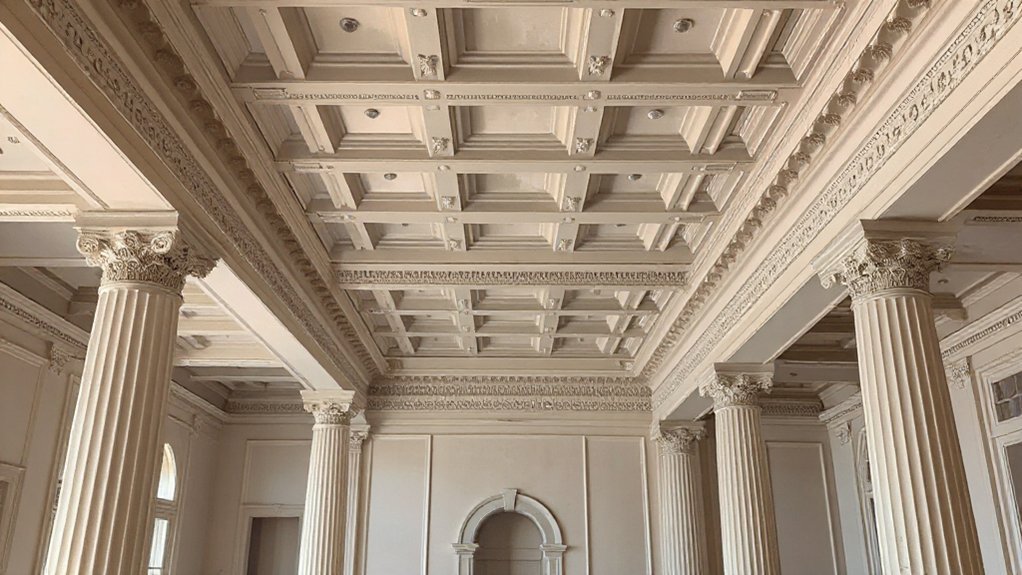
Faux columns and painted ceilings create instant depth by tricking the eye into perceiving vertical planes and architectural detail where none exists. You’ll learn controlled effects that read as real spaces, not flat surfaces, by aligning color, texture, and perspective.
- Color psychology: choose hues that imply height and separation, using slightly lighter tones on recessed surfaces to pull them forward or back as needed.
- Texture contrast: pair smooth field areas with subtly grooved or faux-plaster textures to suggest material depth without overwhelming the surface.
- Visual rhythm: repeat column-like shadows and rail-like crown lines at regular intervals to guide perception and reinforce architectural cadence.
Manipulating Perception: Light, Space, and Psychology
Light can be manipulated to alter perceived size and mood, guiding how you read a space and where you focus your attention. You’ll explore how brightness, contrast, and color temperature create a sense of openness or intimacy, shaping the perceived boundaries of a room.
Psychological triggers—patterns, symmetry, and subtle cues—act as attractors, steering visual navigation and emotional response.
Light Illusion Techniques
Illusion hinges on how light interacts with surfaces, guiding perception to read space as larger, closer, or more intimate than it is. You harness reflections, shadows, and gradients to alter depth without altering geometry.
Technique concentrates on controlled luminance to shape mood, not just visibility. You balance color psychology with surface treatment to cue distance and scale, while preserving artistic realism.
- Use directional lighting to exaggerate contours and suggest architectural depth without physical change.
- Implement soft gradients to blur boundaries, creating a perceived expansion of space.
- Employ high-contrast highlights and cast shadows to anchor realism while manipulating viewer interpretation.
Your goal is precise control of illumination, ensuring convincing effects that remain credible under scrutiny.
Perception of Space
How does perception shape space when light, form, and psychology meet? You, as the observer, interpret depth through luminance contrasts and edge cues. By adjusting paint brightness and sheen, you alter where your eye rests, compressing or expanding perceived volume.
Color psychology informs mood and scale: cool tones recede; warm tones advance, subtly changing room proportions. Surface texture influences shadow play and tactile assumptions, making flat surfaces read as enclosing or expansive.
You can exaggerate a doorway’s height with vertical contrast, or widen a corridor by toning down midtones along parallel planes. Keep reflections controlled; glare reduces perceived size, while soft, matte finishes enhance spacious calm.
In practice, you shape space by guiding attention, not by altering physical measurements.
Psychological Triggers Attractors
Even as you shape space with color and texture, psychological triggers driving attraction rely on how stimuli signal value, safety, and novelty. You’ll leverage perceptual cues to guide mood, pace, and perceived scale, crafting a silent dialogue between surface and viewer.
Color psychology informs where the eye rests, while rhythm and contrast spark an emotional response that reinforces a feature’s plausibility. Use light, shadow, and pattern to cue hierarchy, so viewers infer space and intention without measurement.
Emotional resonance follows intentional composition, not generic decoration.
- Align color and texture with intended psychological effect.
- Pair high-contrast edges with softer fills to modulate attention.
- Test in varying light to ensure consistent emotional response.
Durability, Maintenance, and Ethical Boundaries
Durability and maintenance are central considerations when using paint to simulate architectural features, and ethical boundaries must guide their application. You should assess how long coatings last, exposure to weather, and cleaning requirements, then plan for periodic touch-ups to preserve illusion without degrading underlying structures.
You’ll evaluate substrate compatibility, adhesion, and pigment stability to prevent premature failure. Material authenticity matters: choose finishes that respect real material behavior while acknowledging painted façades, avoiding misleading permanence.
Establish a maintenance schedule that minimizes risk of peeling or color drift, and document repairs for accountability. Ethical considerations demand transparency with stakeholders about reversibility, impact on historic fabric, and potential misrepresentation.
Prioritize reversible methods where feasible, and ensure preservation goals trump novelty when consequences affect public trust or safety.
A Reversible Plan: Implementing Safely and Reversibly
A reversible plan starts with choosing paints and techniques that can be removed or undone without harming the substrate or surrounding fabric. You’ll prioritize products labeled reversible, low‑odor, and compatible with existing finishes, then map a removal protocol.
Color psychology guides your color choice to minimize lasting impact on space perception while remaining removable. Surface texture decisions balance realism with liftable layers, avoiding overly aggressive abrasives that could damage wallpaper or plaster.
- Select fading, matte or satin finishes that peel without scraping, supporting clean reversibility.
- Document steps, test patches, and confirm full removal on a hidden area before full application.
- Use temporary texture techniques (stencils, faux grain) that can be reversed with gentle solvents and minimal substrate impact.
Frequently Asked Questions
How Do I Remove Painted Features Without Damaging Walls?
To remove painted features without damaging walls, start by scoring the edges with a sharp utility knife. Then gently peel or lift with a putty knife.
Use a warm, damp sponge to soften the paint, then scrape and wipe.
If the paint resists, apply a mild solvent test on a hidden area and proceed carefully.
Faux finishes and wall illusions require patience; work in small sections, re-cleaning as you go to avoid friction marks.
Will Painted Fakes Affect Property Resale Value?
Painted fakes can affect resale value, but impact varies. Faux finishes and visual illusions may intrigue buyers who like character, yet overly obvious or dated schemes risk narrowing appeal.
If you plan to sell, curb appeal matters most: make sure finishes look purposeful, well-executed, and easy to repaint.
Your strategy should balance style with versatility, highlighting quality and upkeep. Consider neutral tones or removable accents to preserve broad market interest.
Are There Safety Concerns With Temporary Adhesives or Scaffolding?
Yes, there are safety concerns with temporary adhesives and scaffolding. You should avoid lingering adhesive fumes near living spaces, ventilate well, and wear a respirator if needed.
Inspect scaffolding daily, secure all planks, and follow weight limits to prevent collapse.
If you smell strong adhesive fumes, pause work and evacuate until air quality improves.
Adhere to scaffolding safety protocols, reduce exposure, and document any incidents for future, safer use.
Can a Beginner Achieve Convincing Depth Without Professional Help?
Yes, you can, but results will be limited. You’ll rely on optical illusions and simple artistic techniques to fake depth, not true perspective.
Start with light source cues, value grading, and edge softening to imply recesses.
Use high-contrast accents sparingly, and test from multiple angles.
Practice steadily, adjust proportions, and avoid over-detail.
With patience, you’ll achieve convincing depth, though it won’t replace professional guidance or advanced perspective training.
What Are Cost Comparisons Versus True Architectural Alterations?
Yes, it’s cheaper to fake it with paint than to pursue true architectural alterations, though the gap tightens with scope. You’ll want a precise cost analysis, then compare material costs versus permits, labor, and enduring value.
Paint might save on upfront, but you risk higher long-term maintenance and lower resale impact.
You should budget for rollers, primers, sealants, and finishing coats, and anticipate touch-ups.
Decide whether visual effect or structural integrity matters most.
Conclusion
You’ll discover that paint can quietly reshape perception, offering you space without lasting commitment. When you tread lightly, you invite elegance without permanence, a compromise that honors both mood and memory. If your aim is authenticity with flexibility, lean on reversible, reversible-friendly methods and honest testing. The true artistry isn’t in building new walls, but in softly hinting at them—exquisitely, ethically—so you can fade or refashion the illusion as life, and lighting, evolve.
About the Author