
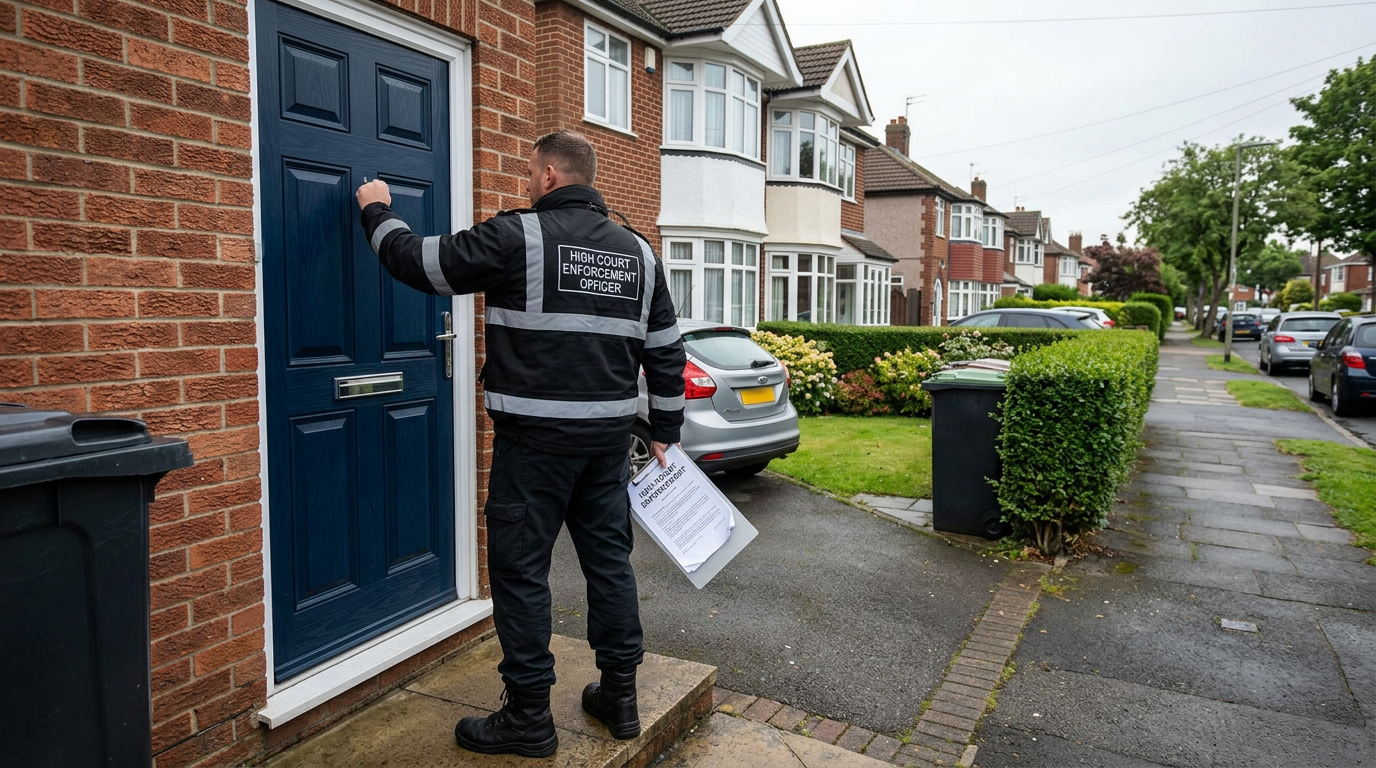
If you have received a notice saying a bailiff for council tax is being instructed to visit your property, you need to know exactly what that means — what they can and cannot do, what your rights are, and what steps you can take before they arrive. Council tax debt is one of the most common reasons enforcement agents are used in the UK, and it is also one of the areas where people’s understanding of the rules is most frequently wrong.
Key Takeaways
- A bailiff for council tax is a certificated enforcement agent — not a court officer, but an agent certified by the County Court to collect specific types of debt on behalf of a local authority.
- Before a bailiff for council tax can visit, your council must have obtained a liability order from the magistrates’ court — a formal court order confirming the debt is owed. You should have received notice of the court hearing.
- You must receive at least seven days’ written notice before the bailiff’s first visit. If you have not received an enforcement notice, the visit may not be lawful.
- A council tax bailiff cannot force entry to your home — they can only enter through an unlocked or opened door. Unlike some other types of enforcement agent, they do not have the power to break in.
- You do not have to let them in — and this is the most important practical point. If you have not let them in before, they cannot force entry on a first visit.
- They can take your vehicle — even if it is parked outside on a public road or on your driveway. They cannot take it from a locked garage.
- If you cannot pay in full, you may be able to negotiate a payment arrangement — contact your council directly, ideally before the bailiff visits, as the council retains the ability to withdraw the warrant.
- Free debt advice is available — Citizens Advice, StepChange, and local debt advice services can help you understand your options before and during enforcement action.
How Council Tax Debt Reaches a Bailiff
Council tax is one of the few debts that can reach enforcement action through a relatively fast legal process, without the need for a full County Court judgment in the way that most other debts require.
The process runs as follows:
Missed payment and reminder: When a council tax payment is missed, the council sends a reminder. If the missed payment is not made — or if a second payment is missed in the same year — the entire year’s council tax bill can become payable immediately under the council’s right to withdraw the instalment arrangement.
Summons to magistrates’ court: If the outstanding amount is not paid, the council applies to the magistrates’ court for a summons, requiring you to attend or respond. You will be notified of the court hearing.
Liability order: If the court is satisfied the debt is owed and unpaid, it issues a liability order — a formal court order that confirms the debt. This is the legal gateway that allows the council to take enforcement action. You should receive notice of the liability order hearing. The court does not automatically investigate whether the debt is disputed or whether you have financial difficulties at this stage.
Instructing a bailiff for council tax: Once the liability order is granted, the council can instruct a certificated enforcement agent (a bailiff for council tax) to collect the debt. The agent issues an enforcement notice — the written seven-day notice required before the first visit.
If you receive a liability order hearing notice, attending or responding is important. Once the liability order is granted, your options narrow. Before this point, you can dispute the debt, apply for an exemption or reduction, or negotiate a payment arrangement directly with the council.
What a Bailiff for Council Tax Can and Cannot Do
Entry to Your Home
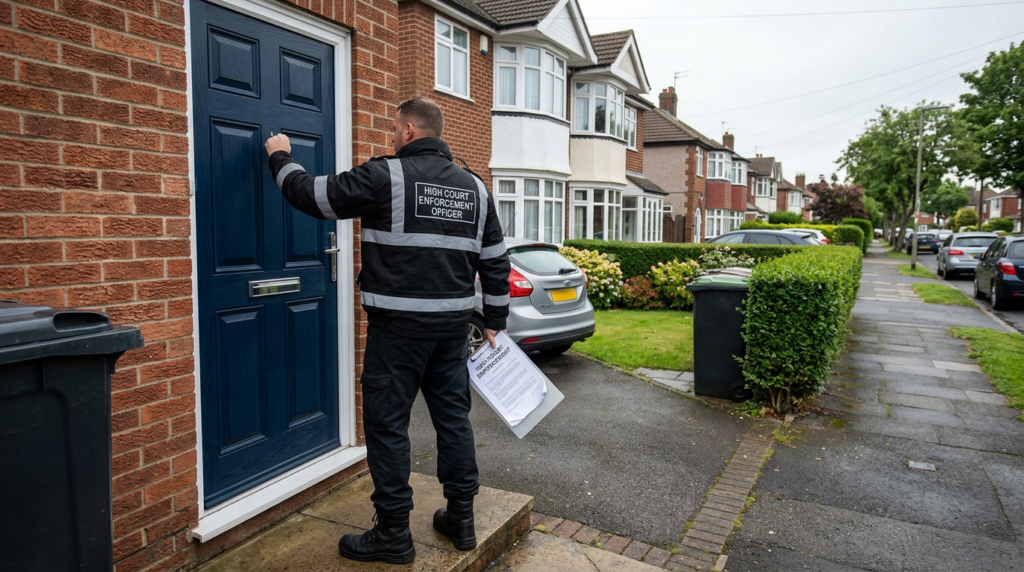
A council tax bailiff — unlike some other types of enforcement agent — does not have the power to force entry to your residential property. This is a critical distinction that many people are unaware of.
They can enter your home only if:
- You open the door and allow them in (including if you open the door and they step in before you can close it)
- They find an unlocked door or window they can enter through
They cannot break down the door, force a lock, or push past you. If you do not open the door, they cannot enter.
However, there is a crucial consequence: if you have previously allowed a bailiff into your home on an earlier visit — or if they have gained lawful entry through any means — they acquire the right to return and force entry on a subsequent visit. This is why the advice from debt organisations is consistent: do not let them in on the first visit if you have any ability to pay at the doorstep or wish to negotiate.
You can pay them on the doorstep without letting them in. Always ask for a receipt.
Goods They Can Take
Once inside (if they gain lawful entry), a council tax bailiff can seize goods to sell at auction to recover the debt. They can take:
- Televisions, games consoles, and other electronics
- Jewellery and valuables
- Vehicles parked on your driveway or on a nearby public road
- Most household items that are not in the protected categories
Goods they cannot take regardless of the circumstances:
- Cooker, fridge, washing machine, and other essential white goods
- Beds and bedding
- Dining table and chairs sufficient for the household
- Clothing
- Tools and equipment necessary for work, up to a value of £1,350
- Items that belong to someone else in the household (though you may need to prove this)
- Pets
Your Vehicle
Vehicles are one of the most significant assets a council tax bailiff can seize — and they can do so even before entering your home. If your car or other vehicle is parked on your driveway, on a public road near your property, or otherwise accessible, the bailiff can clamp it or arrange to have it removed. They cannot take a vehicle from a locked garage.
If your vehicle is essential for work, you may be able to argue that it is a protected tool of trade — but this requires demonstrating that it is genuinely necessary for employment and may not apply to every case. Take advice from a debt organisation on this specific point if your vehicle is critical to your livelihood.
Fees the Bailiff Can Charge
A council tax bailiff is entitled to charge fees at each stage of the enforcement process, in addition to the original debt. These fees were set in the Taking Control of Goods (Fees) Regulations 2014 and are:
- Compliance stage fee: £75 — charged when the enforcement notice is sent (before the first visit)
- Enforcement stage fee: £235 — charged when the bailiff makes the first visit
- Sale stage fee: £110 — charged if goods are removed for sale, plus any costs of sale
These fees are added to your debt automatically at each stage, meaning the total you owe increases as enforcement progresses. Paying the debt promptly — ideally before the enforcement stage — avoids the enforcement fee of £235. Paying before even the compliance fee is charged (i.e., as soon as the liability order is granted and before the notice is sent) avoids all bailiff fees entirely.
What to Do If a Council Tax Bailiff Is Coming
Step 1: Contact Your Council Immediately
The council retains the ability to withdraw the enforcement warrant even after it has been issued to the bailiff. If you contact the council directly and agree a payment arrangement for the outstanding debt, the council may instruct the bailiff to return the warrant — stopping the enforcement process.
This negotiation is easier before the bailiff has made a visit than after. Once the bailiff has attended, fees are already being charged and the bailiff’s firm has a financial stake in continuing the enforcement process. Councils are sometimes more willing to negotiate directly than through the bailiff.
When you speak to the council, be specific about what you can afford to pay and propose a realistic payment arrangement. Ask them explicitly whether they will withdraw the warrant if you commit to the arrangement.
Step 2: Get Free Debt Advice
Citizens Advice, StepChange, and local money advice services provide free, confidential advice on council tax debt and bailiff action. They can:
- Check whether the correct legal process has been followed (liability order, seven-day notice, etc.)
- Advise on whether you may be entitled to a council tax reduction or exemption you have not claimed
- Help you negotiate with the council or the bailiff
- Advise on whether you have grounds to challenge the debt or the enforcement action
- Support you through the process if you are in a vulnerable situation
Do not wait until the bailiff knocks on your door to seek this advice.
Step 3: Know Your Rights on the Doorstep
If the bailiff does visit, you have the right to:
- Ask to see proof of their identity and authority — request they hold it up at the window or push it through the letterbox. You do not have to open the door to see it.
- Verify their certification — you can check the Certificated Bailiff Register at certificatedbailiffs.justice.gov.uk to confirm they hold a valid certificate.
- Pay on the doorstep without letting them in — if you pay the full amount including fees, they must leave. Get a receipt.
- Refuse entry — they cannot force their way in on a first visit. If you choose not to let them in, keep the door closed and communicate through it or in writing.
Step 4: Protect Your Vehicle
If your vehicle is at risk and you cannot pay the debt immediately, consider parking it away from your home address or in a locked garage if one is available. Once a bailiff has clamped or removed a vehicle, recovering it will involve paying the debt in full plus additional charges.
Vulnerable Circumstances
If you or someone in your household is in a vulnerable situation — serious illness, disability, mental health difficulties, recent bereavement, pregnancy, or young children — this is relevant to how the bailiff should conduct themselves and may affect the enforcement process.
Under the National Standards for Enforcement Agents and the Enforcement Conduct Board’s standards, bailiffs are expected to identify vulnerability and respond appropriately — which may mean postponing enforcement action and referring the matter back to the creditor. If you are in a vulnerable situation, communicate this to the bailiff and to the council in writing.
Also, if a bailiff behaves inappropriately toward a vulnerable person — or proceeds with enforcement when it is clearly inappropriate — this is a basis for a formal complaint.
If the Bailiff Has Already Been In
Keep in mind, if you have already let a council tax bailiff into your home, or if they have gained lawful entry, the situation has changed significantly. They can now:
- Return and force entry on a subsequent visit
- Seize any goods they have previously identified and listed (called “taking control of goods” — this is formally recorded and creates a legal obligation on you not to remove those goods)
At this stage, paying the debt in full (including any fees that have accumulated) is the most direct way to stop further enforcement action. If you cannot pay in full, seek debt advice immediately — there may still be options to negotiate a payment arrangement that stops further action.
Making a Complaint
If you believe a council tax bailiff has acted unlawfully or in breach of the rules — by visiting without prior notice, trying to force entry without the right to do so, taking protected goods, behaving aggressively, or misrepresenting their powers — the following complaint routes are available:
- Complain to the bailiff firm directly in the first instance
- Complain to the instructing council, which retains responsibility for the conduct of enforcement agents acting on its behalf
- Complain to the Enforcement Conduct Board (ECB) if the firm is accredited (most are)
- Apply to the court to remove a certificated enforcement agent’s certificate, or to seek compensation, if the breach is serious
Keep records of all contact with the bailiff — dates, times, what was said, and any documentation provided. This evidence supports any complaint.
***This article provides general information only and does not constitute legal or financial advice. Anyone facing council tax enforcement action should seek independent advice from a qualified debt adviser or solicitor.***
About the Author