Looking At The Pros And Cons Of A Modular House In The UK
A modular house is built from factory-manufactured sections — modules — that are assembled on site to form a complete home. The process is different from traditional construction in fundamental ways: most of the work happens in a controlled factory environment rather than on-site in whatever weather conditions prevail, the timeline from groundworks to occupation is significantly shorter, and the quality of thermal performance and airtightness is typically more consistent than what on-site construction routinely achieves.
In the UK, modular homes are growing in number and in profile. Legal & General Modular Homes ( LGMH ), Top Hat, and other manufacturers have added tens of thousands of units to the housing stock. Scotland’s government has mandated Modern Methods of Construction (including modular) for 90% of its publicly funded affordable housing. The government has linked a £2.5 billion Homes England scheme to modular delivery. And the construction industry, facing acute skills shortages and the pressure of a 300,000-home annual delivery target, is looking at factory-built housing as part of the solution.
Despite this momentum, modular homes still represent only 5–7% of UK housing completions. The reasons for this gap — between policy enthusiasm and actual delivery — are partly structural and partly the result of real limitations that prospective buyers, self-builders, and developers need to understand clearly.
This article presents both sides of the modular home proposition honestly, for anyone considering whether a modular home is the right choice for their circumstances.
The Pros
Significantly Faster Build Time
Speed is the most consistently cited advantage of modular construction, and it is genuinely significant. While a traditionally built house typically takes 12–18 months from groundworks to occupation, a modular home can be ready for occupation in as little as 4–6 months. In some cases, where foundations are prepared simultaneously with factory manufacture, the on-site assembly phase is measured in days or weeks rather than months.
The mechanism is simple: factory manufacture and site preparation happen simultaneously rather than sequentially. While the modular units are being built in a controlled environment, the groundworks, foundations, and utility connections are being established on-site. When the modules arrive, the remaining on-site work is primarily assembly and connection rather than primary construction.
For self-builders who are paying rent or mortgage elsewhere while the new house is completed, every month saved in the build programme represents real financial benefit. For developers with project finance costs running against a build programme, the speed advantage directly improves the financial return on the project.
Better and More Consistent Energy Performance
Factory construction in a controlled environment achieves airtightness and insulation continuity that on-site construction routinely fails to replicate. On a traditional building site, insulation is installed by multiple subcontractors working in variable weather conditions, with the specific details of insulation installation (avoiding thermal bridges, maintaining continuity around junctions, ensuring airtightness at penetrations) subject to individual workmanship quality that varies considerably.
In a factory, the same junction detail is assembled in the same way for every unit produced, in dry conditions, under supervision, and verified before the module leaves the factory. The result is measurably better thermal performance: modern modular homes typically achieve airtightness test results of 1–2 m³/m²/h at 50 Pa — significantly better than the industry average for traditional construction, which typically runs at 4–6 m³/m²/h.
Manufacturers such as Top Hat build homes meeting the Future Homes Standard 2025 — targeting a 75–80% reduction in carbon emissions relative to current regulations. For buyers prioritising energy bills and carbon footprint, the modular home’s factory-precision performance is a genuine and measurable advantage.
The practical consequence: modular home occupants typically spend significantly less on heating than occupants of equivalent traditionally built homes. Estimates suggest savings of up to £800 per year, though this figure depends on energy prices, home size, and how the comparison is made.
Less On-Site Disruption and Waste
Traditional construction sites are dusty, noisy, and disruptive for extended periods. The modular construction approach concentrates the intensive construction phase in a factory location rather than the site, with on-site activity limited primarily to groundworks and assembly.
The reduction in construction waste is equally significant. Factory production optimises material usage with precision cutting and just-in-time supply — estimates suggest modular construction generates up to 70% less construction waste than traditional methods. Material waste that is generated in the factory is sorted, recycled, or disposed of at the factory rather than on-site, simplifying the environmental management of the project.
For self-builders on rural or residential sites, the reduced on-site disruption — fewer deliveries, less heavy machinery, shorter intensive activity periods — is both practically and community-relationally valuable.
Labour Efficiency in a Skills-Short Market
The UK construction industry faces a documented skills shortage that is expected to require 225,000 additional workers by 2027 to meet housing targets. Bricklayers, plasterers, carpenters, and roofers are all in short supply, which pushes up the cost of traditional construction and creates delays.
Modular construction reduces on-site labour requirements by approximately 80% relative to traditional methods (per CITB estimates), concentrating the skilled workforce in factory environments where their output is more consistent and their time more efficiently used. The factory environment also allows the employment of workers who may not be suited to the physical demands and weather exposure of on-site construction, broadening the potential labour pool.
For individual self-builders, the reduced dependence on sourcing and managing multiple on-site trades — the most stressful and variable aspect of self-build management — is a significant quality-of-life advantage.
Design Has Improved Significantly
Early modular homes in the UK had a well-founded reputation for design limitations — external appearances that were identifiably “modular,” interior layouts constrained by module dimensions, and overall aesthetics that communicated their manufacturing origin in ways that many buyers found unappealing.
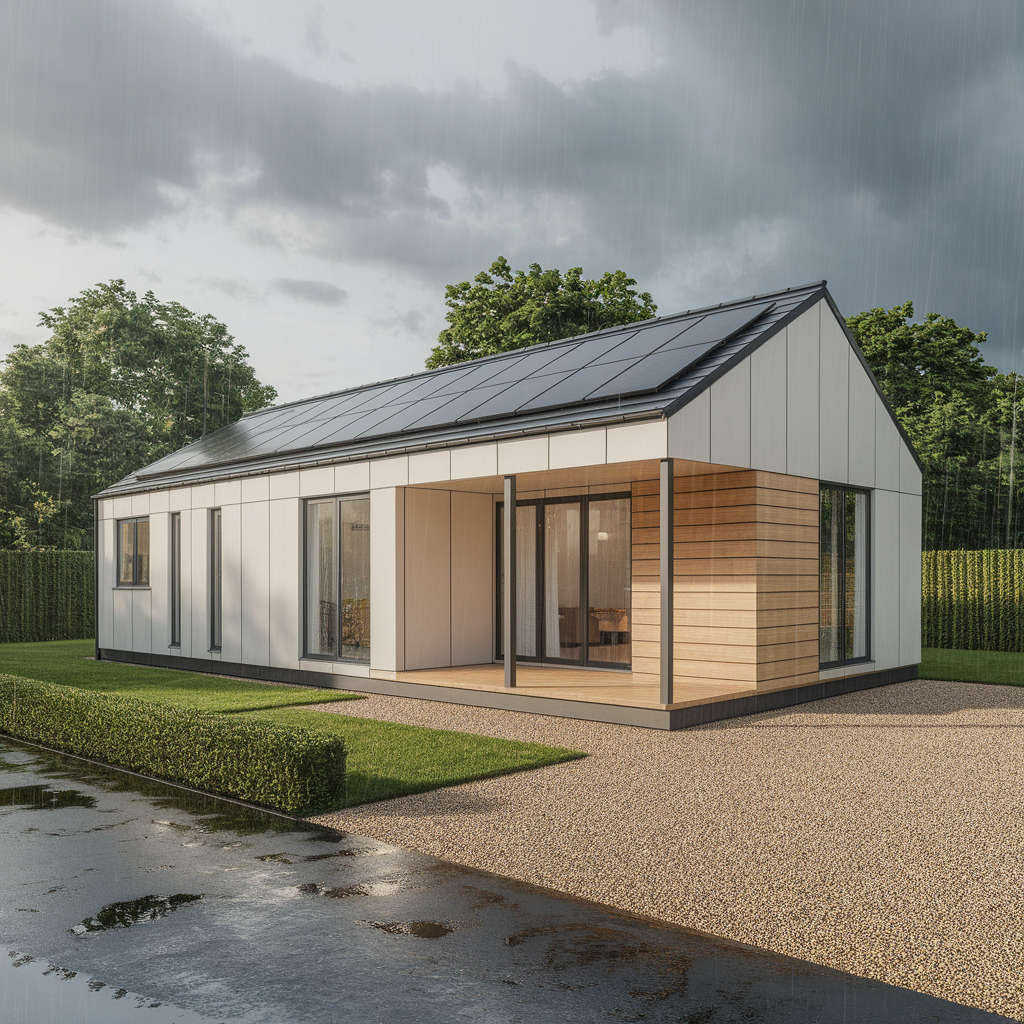
This has changed substantially. Modern modular homes from established manufacturers offer contemporary designs, extensive external finish options (brick slips, render, timber cladding), a range of layout configurations, and interiors that are functionally and aesthetically indistinguishable from traditionally built equivalents. RIBA-accredited architects work with modular manufacturers to produce designs that achieve planning approval in residential contexts where traditionally built designs succeed.
The design constraint is not eliminated — there are architectural ambitions and specific site conditions that modular cannot accommodate as readily as bespoke traditional construction — but for the majority of housing types and planning contexts, design is no longer a decisive limitation.
The Cons
Higher Upfront Costs in Some Contexts
Modular construction’s cost advantage varies significantly by context, and in some circumstances modular homes cost more per square metre than equivalent traditionally built homes. The factory infrastructure cost — which must be recovered across a manufacturer’s entire production volume — means that small-scale modular projects (a single self-build home, for example) may not benefit from the economies of scale that make modular competitive on large developments.
Industry estimates suggest modular construction can reduce costs by approximately 20% on large-scale, high-volume projects. On small projects, or where the specific site conditions (access, ground conditions, distance from the manufacturing facility) add costs, the comparison may be less favourable or even negative.
For self-builders comparing a modular home to a traditionally built alternative, it is essential to get comparable quotes for both approaches for the specific site and specification — general claims about modular being cheaper or more expensive are less reliable than a site-specific comparison.
Transport Logistics and Site Constraints
Volumetric modular units — complete three-dimensional modules typically the size of a room — are large objects that must be transported from factory to site by specialist haulage. This creates constraints that do not exist for traditional construction materials:
- The size of individual modules is limited by road transport regulations (primarily the 5-metre width limit for loads without special orders)
- Access to the site must accommodate the specialist heavy transport required for module delivery
- A crane is required for module placement, which adds cost and requires adequate clearance on and around the site
- Sites with restricted access — narrow lanes, low bridges, overhead power lines — may be impractical or significantly more expensive to serve with volumetric modular construction
These constraints are more significant for rural self-build plots than for urban or suburban development sites with good road access. Hybrid approaches — which use factory-manufactured panels rather than complete volumetric modules — avoid the transport constraint but sacrifice some of the speed advantage of full volumetric construction.
Mortgage and Finance Availability
Obtaining a standard mortgage on a modular home is more straightforward than it was five years ago, but it remains more complex than for a traditionally built home. Key issues:
BOPAS accreditation: The Buildoffsite Property Assurance Scheme (BOPAS) provides independent assurance to lenders and insurers about the long-term durability and structural performance of offsite manufactured buildings. BOPAS-accredited modular homes can be mortgaged through a range of high-street lenders, including Halifax, Nationwide, and Lloyds. Non-BOPAS-accredited modular homes face significantly more limited mortgage product availability.
Lender familiarity: Despite improving availability, not all mortgage lenders have a developed position on modular homes, and buyers may need to work with a specialist mortgage broker rather than approaching lenders directly.
Resale market depth: There is less established price data for modular homes in most UK locations than for traditionally built equivalents, which can make mortgage valuations more complex and which may affect the ease of resale in the future.
For self-builders financing a modular build, it is essential to confirm mortgage availability in principle before committing to a modular approach — and specifically to confirm that the manufacturer is BOPAS-accredited.
Planning Permission Is Not Automatic
Planning permission for a modular home is granted through exactly the same process as for a traditionally built home — the planning authority evaluates the application on its merits, and the method of construction is generally not in itself a planning consideration. A well-designed modular home that respects its context can achieve planning permission in the same way as a traditionally built design.
However, modular construction involves some planning-specific constraints:
- Standard modular designs may not be the right fit for specific planning contexts — particularly conservation areas, listed building settings, green belt sites, or areas with specific design guides — where the planning authority may require a more individually tailored design response
- The external appearance of some modular systems — particularly those with distinctive external detailing that communicates their modular origin — may not achieve planning approval in sensitive locations
For self-builders with plots in sensitive planning contexts, commissioning a bespoke modular design (working with an architect and a flexible modular manufacturer) is likely to be necessary, which adds cost and complexity relative to purchasing a manufacturer’s standard design.
The Manufacturer Risk
A modular home build is dependent on the manufacturer in ways that traditional construction is not. The collapse of Ilke Homes in June 2023 — at the time the UK’s largest volumetric modular housebuilder — left over 1,000 planned homes undelivered and significant losses for those with contracts in progress. House by Urban Splash experienced similar difficulties.
When commissioning a modular home from a manufacturer, the financial health and operational stability of that manufacturer is a material risk factor in a way that has no equivalent in traditional construction (where the insolvency of a single subcontractor can typically be managed). Prospective buyers should:
- Research the manufacturer’s financial position and trading history
- Ensure that any deposit or stage payments are protected (through escrow arrangements, performance bonds, or insurance)
- Confirm that the manufacturer holds appropriate warranties and that these would survive manufacturer insolvency
- Check that the BOPAS certification is current and that the manufacturer remains accredited
Limited Scope for Bespoke Customisation
While modular home design has improved significantly, the factory production process is most efficient and most cost-effective when it is producing standardised or near-standardised units. The further a modular design departs from the manufacturer’s standard range, the more it costs and the more of the efficiency advantage of factory production is eroded.
Buyers who have highly specific design requirements — unusual room configurations, non-standard ceiling heights, specific architectural details — may find that traditional bespoke construction is actually the more appropriate and cost-effective route. The design constraints of modular construction are less severe than they were, but they are not entirely absent.
Who Is a Modular Home Most Suitable For?
The balance of pros and cons suggests that modular homes are most clearly advantageous for:
Large-scale residential development: Developers building 20 or more homes on a single site benefit most from the speed, labour efficiency, and quality consistency of modular construction. The economics of modular are most favourable at scale.
Social and affordable housing providers: Where consistent, high-quality, energy-efficient homes need to be delivered quickly and at manageable cost, the modular proposition is compelling. Scotland’s 90% MMC mandate for funded affordable housing reflects exactly this assessment.
Self-builders with straightforward sites and standard design requirements: Good road access, a clear planning context, and acceptance of a manufacturer’s standard or near-standard design range allow a self-builder to realise the speed, energy performance, and labour management benefits of modular without encountering the most difficult constraints.
Build-to-rent investors: Large-scale residential letting portfolios benefit from the consistent quality, energy performance, and reduced maintenance requirements of modular construction.
Modular homes are less clearly suited for: buyers with specific bespoke design requirements; sites with access constraints or complex ground conditions; planning-sensitive contexts requiring highly tailored design responses; and self-builders who cannot secure BOPAS-backed financing from the outset.
The Honest Summary
A modular home in 2026 is a genuinely credible choice for the right circumstances. The performance advantages — speed, energy efficiency, quality consistency, reduced site disruption — are real and documented. The limitations — transport constraints, mortgage complexity, manufacturer risk, design standardisation — are also real and should be understood before committing.
The growth of the modular sector, the improving availability of mortgage products for accredited manufacturers, and the strengthening government policy support all suggest that the advantages will become more accessible over time. But the 5–7% market share that modular homes currently represent is a reminder that the transition to a modular-dominated housing market is slower and more complex than its advocates have consistently predicted.
For the right buyer, on the right site, with the right manufacturer: a modular home is an excellent choice. For everyone else, the traditional route remains the lower-risk, more familiar, and still highly customisable alternative.
About the Author