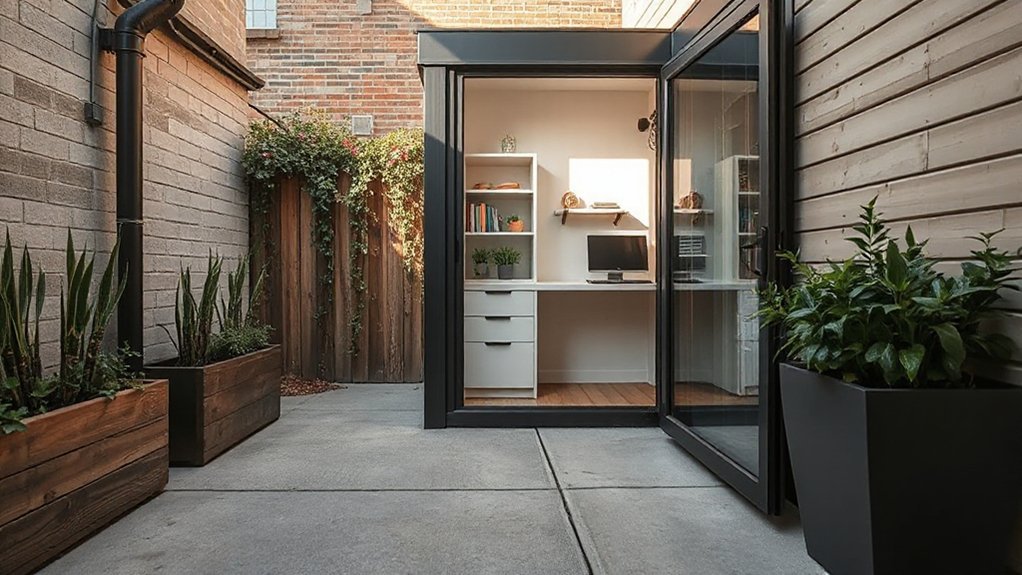
Maximize a tiny outdoor niche by prioritizing a compact, weatherproof garden office with smart layout and durable, low-maintenance materials. Assess your space for sun, shade, drainage, and access, then define footprint, budget, and comfort targets before choosing modules like vertical storage, built-in benches, and modular desks. Use zoning to separate work, storage, and pathways, layer daylight with strategic windows, and add noise-quieting finishes. Expect clear sightlines, efficient cable management, and a calm, professional ambiance—plus tips that uncover more optimization as you proceed.
Why a Compact Garden Office Works
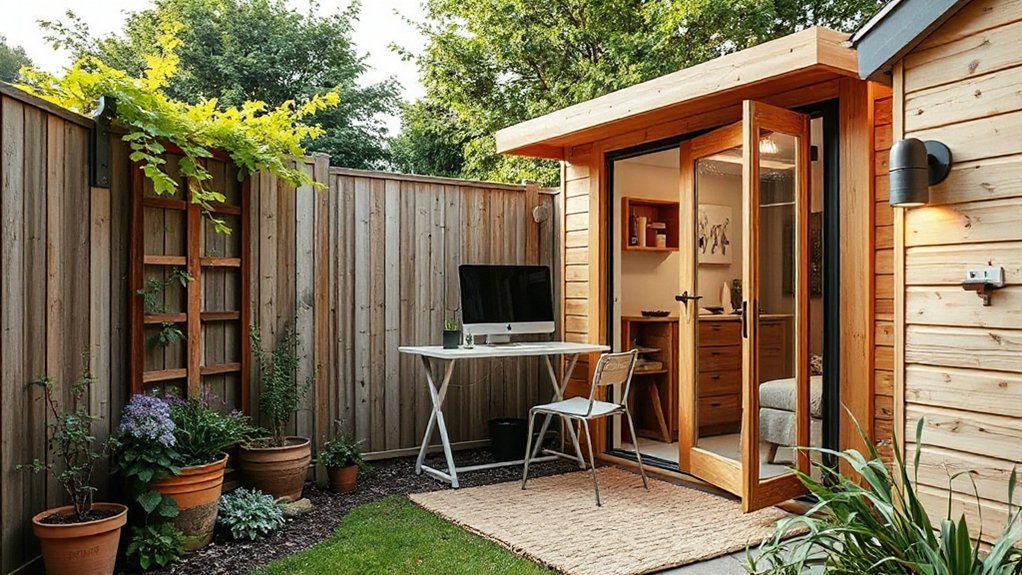
A compact garden office delivers practicality without sacrificing functionality. You gain efficient use of limited footprint through a design that prioritizes core tasks while minimizing wasted space. Silhouettes stay clean, panels align with structural supports, and you’ll find integrated storage that reduces clutter without encroaching on work zones.
The layout supports focused work sessions, enabling you to maintain consistent posture and reduce distraction. Choose garden office decor elements that enhance acoustics, lighting, and thermal comfort without overpowering the room—these choices preserve a calm, professional atmosphere.
Ergonomic seating remains essential; select a chair with adjustable height, lumbar support, and tilt tension to sustain posture during longer blocks. A compact unit therefore delivers productivity, resilience, and a refined, unobtrusive presence.
Assess Your Tiny Outdoor Space: What You Have to Work With
To get the most from a garden office, you first map what you’ve actually got in your tiny outdoor space. You’ll assess access, shade, wind, and drainage, then catalog existing features that affect layout and usability. This baseline informs material choice, maintenance needs, and potential ambits for upgrades.
Prioritize elements that influence workflow: stable surface, nearby power, and secure storage. Identify bottlenecks and opportunities, such as narrow paths or vertical constraints, to maximize efficiency without overreaching.
Your assessment should drive a focused plan that minimizes risk and maximizes potential.
- Outdoor furniture placement considerations to optimize flow and accessibility
- Garden decor elements that enhance ambiance without obstructing use
- Structural and environmental constraints to guide durable, scalable choices
Define Your Goals Before Layout: Footprint, Budget, and Comfort
Define your goals upfront to anchor every layout decision. You’ll determine footprint, budget, and comfort, then translate them into a practical plan.
Start with footprint: measure available area, note setbacks, and identify access points. This informs structure size, orientation to sun, and potential utility drops.
Next, set a budget aligned with expected usage and durability, prioritizing essential systems before amenities.
Establish comfort targets—acoustic privacy, thermal control, and ergonomic workflow—so the design supports focused work without overcrowding.
Apply design principles to balance form and function, ensuring material choices enhance outdoor aesthetics while withstanding weather.
Document requirements in a single scope: space functions, cost caps, and performance benchmarks.
Clear goals enable efficient selections, reduce changes, and deliver a cohesive, durable garden office.
Layout Strategies for Small Yards
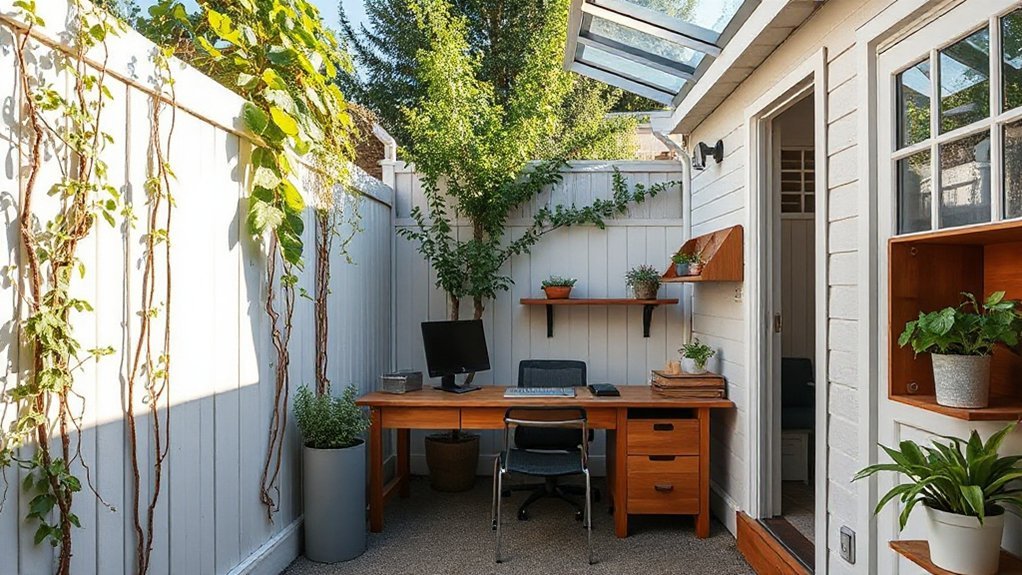
Small yards demand deliberate zoning and edge-to-edge efficiency; start by sketching a compact grid of work zones, storage, and access paths that minimizes wasted space. You’ll prioritize vertical elements, built-in benches, and modular furniture to keep pathways clear and adaptable, while aligning shading and solar exposure to optimize comfort without extending the footprint.
In urban landscaping, precision planning guarantees functionality meets aesthetics, with circulation loops that reduce steps during daily tasks. Water conservation is integral: use drought-tolerant plantings, permeable surfaces, and a compact rain garden to manage runoff.
Maintain clear sight lines from the office to utilities and entry points for safety and efficiency.
- Precisely map zones for work, storage, and passage
- Use modular, multi-purpose elements to save space
- Integrate permeable surfaces and rain capture for water efficiency
Weatherproofing Essentials for All Seasons
As you design a garden office for year-round use, weatherproofing becomes a practical extension of the space you’ve planned for small yards. Start with a continuous envelope: seal joints, upgrade flashing, and choose tight-fitting doors and double-pane glazing to minimize heat loss and drafts.
Use insulated wall panels and a radiant floor or efficient retrofit underfloor solution to stabilize interior temperatures with minimal HVAC load. Select exterior color schemes that reflect heat load and UV exposure, aiding long-term durability.
For seasonal plant care, plan gutter guards and drainage to prevent overwash near the foundation, and guarantee vegetation doesn’t block vents. Prioritize venting strategies to control condensation.
Maintain a durable, low-maintenance surface finish and verify warranty coverage on weatherproofing components.
Budget-Friendly Garden Office Ideas That Still Look Good
Smart budget doesn’t have to mean sacrificing style in a garden office. You can achieve a polished look by prioritizing compact, modular layouts and high-impact finishes that read as premium without the price tag. Focus on interior decor cues that maximize perceived space, such as light colors, mirrored or glass accents, and concealed storage to reduce visual clutter.
Ergonomic design remains critical: position workstation and seating to support neutral spines, adjustable chairs, and monitor arms that decrease strain. Use cost-conscious materials with durable performance and clean lines to convey professionalism.
- Optimize layout with modular components that adapt to your space
- Select ergonomic accessories and compact furniture for efficient work zones
- Choose lighting and color schemes that enhance concentration and perceived room size
Materials That Stand Up to Weather and Wear
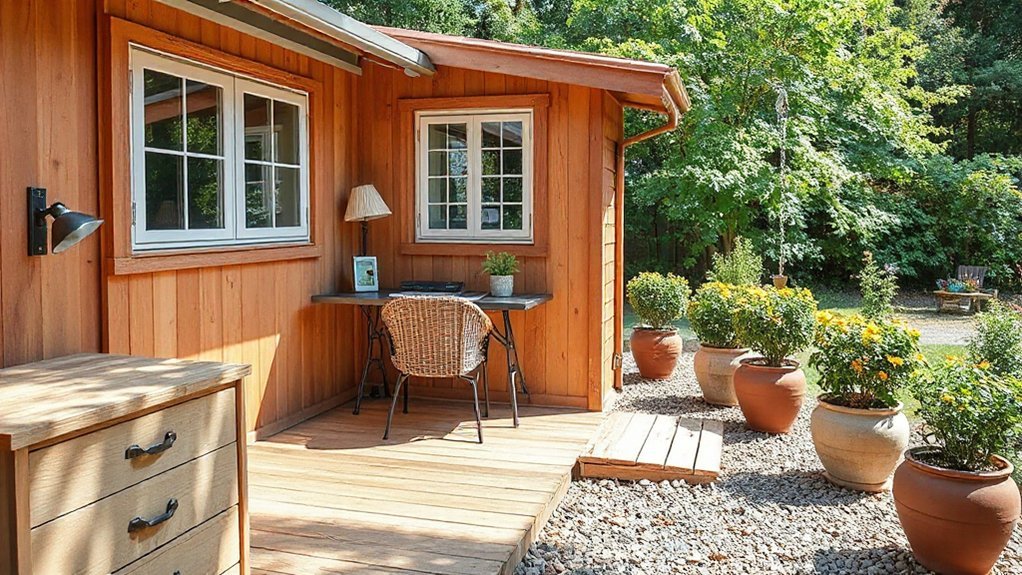
You’ll want weather-resistant materials that resist moisture, UV, and temperature swings without warping.
Choose durable, low-maintenance options that keep upkeep minimal while preserving structural integrity.
This sets you up for a garden office that stays reliable year after year.
Weather-Resistant Materials
Choosing weather-resistant materials is essential for a garden office’s longevity, since these substrates are designed to withstand moisture, temperature fluctuations, UV exposure, and wind-driven debris. You’ll select substrates that resist rot, warping, and corrosion while maintaining structural integrity under seasonal changes.
Prioritize materials with proven durability in outdoor environments, and verify finishes cope with repeated cleaning and abrasion. Consider how each option interacts with outdoor lighting and landscaping design, ensuring visual harmony and functional performance.
Balance cost against life cycle, maintenance needs, and installation requirements to minimize long-term downtime.
- Treated timber or composite decking with weather-grade finishes
- Powder-coated metal elements and corrosion-resistant hardware
- High-density outdoor-grade polymer cladding and sealants
Durable, Low-Maintenance Options
Favor powder-coated aluminum, weatherproof composites, and sealed concrete for framing, decking, and surfaces; these hold fast under rain, sun, and humidity.
For garden furniture, select rust-resistant metal or solid, treated timber with proper seals, ensuring long service life with minimal refinishing.
Outdoor lighting should use integrated LED fixtures, moisture-sealed housings, and warm, glare-free outputs to reduce maintenance needs.
Plan for modular components, sheltered connections, and easy-clean finishes to streamline seasonal care without sacrificing performance or aesthetics.
Sound Dampening for Quiet Focus
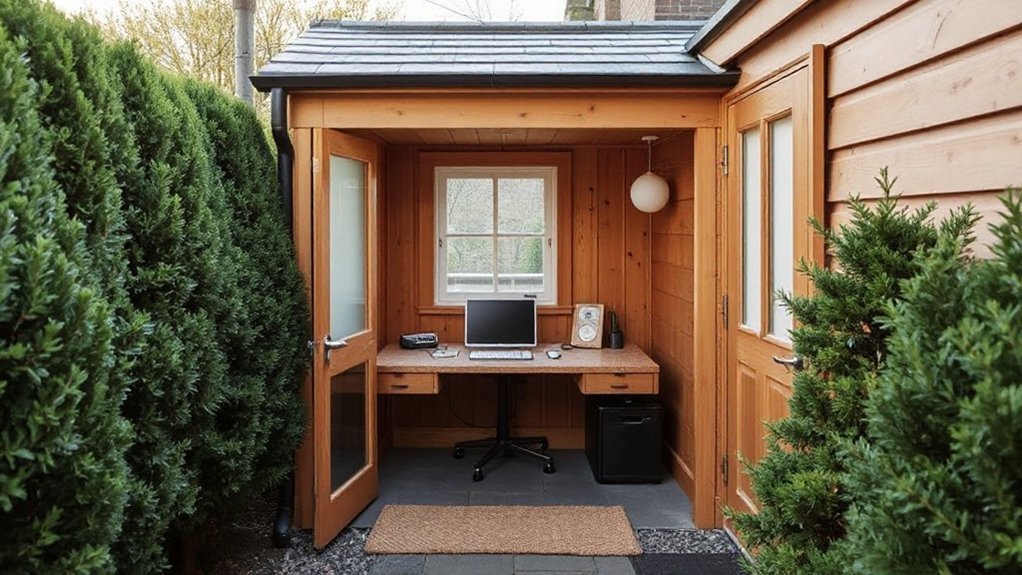
Sound dampening is essential for creating a focused garden office, as quiet surroundings directly influence concentration and workflow. You’ll implement proven soundcontrol strategies to minimize distractions without sacrificing space or daylight.
Start with soundproofing techniques that seal gaps at doors, windows, and panels to reduce external bleed. Next, choose acoustic paneling for strategic absorption in critical zones like walls facing common noise sources.
Consider continuous ceiling and floor treatments to avoid flutter echoes and narrow frequency resonances. Finally, integrate vibration isolation for equipment or furniture that transmits impact noise.
- Seal gaps and add door sweeps to curb air and sound leakage
- Install acoustic panels on primary noise-facing walls
- Use resilient mounts for HVAC and heavy gear to dampen vibrations
Lighting for Daylight and After Dark
To maximize daylight, align windows and skylights to capture sun when it’s highest. Use light shelves to bounce illumination deeper into the workspace.
For nighttime work, implement layered lighting—task, ambient, and accent—with dimmable LEDs and color temperatures that reduce eye strain while preserving plant essentiality.
Consider smart controls and daylight sensors to adjust output automatically, maintaining consistent performance from dawn to dusk.
Daylight Enhancing Techniques
Daylight can dramatically shape a garden office’s ambiance and energy use, so effective lighting strategies must address both daylighting and after-dark requirements. You optimize daylight with selective window placement and shading, preserving natural lighting while controlling glare. Use translucent screens or adjustable louvers to diffuse sun angles without sacrificing view, and align desks to face favorable daylight without reflections on screens.
Pair daylighting with energy-efficient task lighting to maintain consistent brightness throughout the workday. Dimmer controls and occupancy sensors further reduce waste, especially during partial sun. Natural lighting remains central to productivity and comfort when window placement maximizes view access and minimizes heat gain.
- Optimize window placement to capture consistent daylight across seasons
- Employ shading and diffusion to reduce glare without sacrificing visibility
- Integrate dimmable, task-focused lighting for after-dark efficiency
Nighttime Ambience Solutions
Nighttime ambience hinges on harmonizing daylight-aware design with after-dark clarity and warmth. You balance task lighting for focus with ambient glow to prevent harsh contrasts, using dimmable fixtures and color temperatures around 2700–3000K.
Prioritize outdoor lighting that minimizes glare on screens while guiding safe circulation paths to the garden office entrance. Integrate shielded, low-profile luminaires to preserve night skies and conserve energy.
Employ layering: wall-mounted accents, pathway lights, and overhead pendants with smart controls. Select weather-rated, UV-stable finishes and opt for motion-activated options where appropriate to reduce unnecessary illumination.
Document lighting levels with a simple lux plan to verify nighttime ambience supports productivity without fatigue, ensuring outdoor lighting complements daylight design and overall architectural harmony.
Smart Storage to Keep the Studio Clutter-Free
Smart storage is essential for a garden studio, where every square foot counts and clutter can sabotage workflow. You implement a system that combines verticality, modular components, and labeled containers to sustain efficient operations. Prioritize accessibility for frequently used tools, and conceal seasonal items in high cabinets to maximize floor space. Track inventory with a simple label scheme and review weekly to prevent overage.
This approach supports clutter control by defining zones, standardizing storage sizes, and minimizing motion waste. Regularly purge outdated materials and adapt to changing project needs.
- Use wall-mounted cabinets and pegboards to keep surfaces clear
- Employ clear, stackable bins with concise labels for quick retrieval
- Create a dedicated tool drawer with defined compartments for fast access
Insulation Tactics That Don’t Add Clutter
You’ll explore passive insulation options that work without adding bulk, so your garden office stays sleek while staying warm. We’ll weigh space-saving material choices and how their performance pairs with your building’s envelope, ensuring minimal intrusion.
Finally, we’ll consider integrated thermal systems that blend with design, providing efficient comfort without extra clutter.
Passive Insulation Options
- Utilize dense interior finishes to absorb and slowly release heat, enhancing thermal mass without extra bulk.
- Craft airtight junctions around doors, windows, and penetrations to prevent drafts and leakage.
- Align glazing and shading to balance solar gain, reducing seasonal heating and cooling demands.
These options support a lean, efficient garden office while maintaining a clean, uncluttered footprint.
Space-Saving Materials Choices
Could you maximize insulation without encroaching on square footage? Space-saving materials choices focus on high-performance, compact solutions that minimize bulk while preserving thermal effectiveness.
Use rigid foam sheathing with continuous, tight seams to reduce air gaps, paired with airtight membranes for decisive vapor control.
Favor multi-functional elements: integrated sill plates, insulated panels, and pre-fabricated wall systems that streamline installation and reduce waste.
Select low-profile insulation options behind finished surfaces to keep interior dimensions stable.
For outdoor integration, coordinate with garden furniture and plant selection to maintain sightlines and microclimates, avoiding clutter while preserving shading and thermal buffering.
Prioritize durable, lightweight materials with high R-values per inch, ensuring maintenance access remains straightforward without expansion of the occupied footprint.
Integrated Thermal Systems
- Utilize continuous vapor-permeable barriers paired with high-R insulation for steady temperatures
- Align airtight envelopes with modular layers to minimize gaps and air loss
- Coordinate detailing at penetrations and edges to sustain long-term performance
Power and Connectivity in Small Spaces
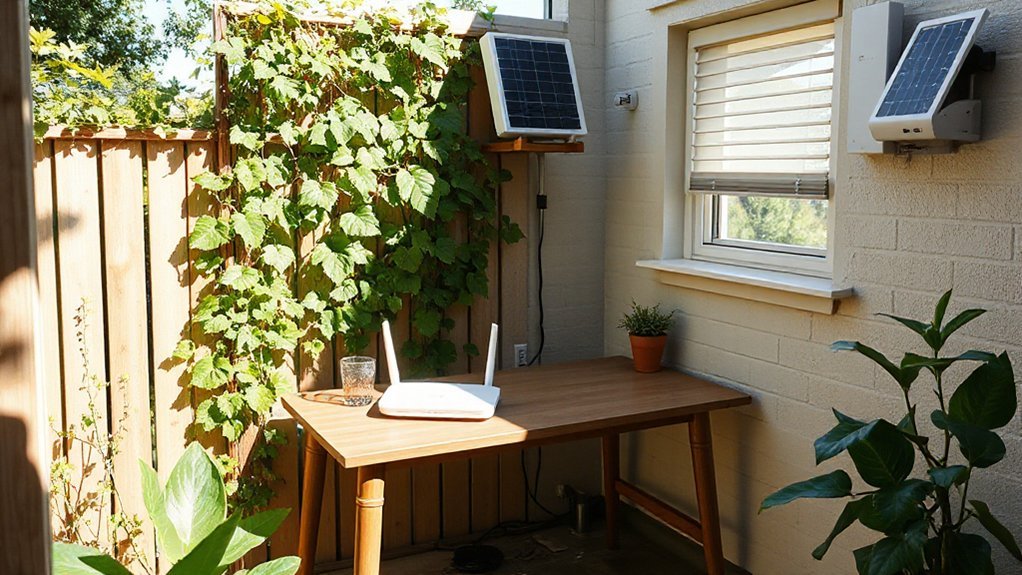
Electrical efficiency and reliable connectivity are essential for a productive garden office, especially in compact spaces where every watt and signal must count. You’ll optimize power management to prevent waste and outages, prioritizing high-quality outlets, surge protection, and auto-off timers for idle equipment.
Use a dedicated circuit or subpanel when possible to isolate loads and simplify troubleshooting. For connectivity, deploy wired Ethernet where feasible, paired with a robust Wi‑Fi mesh system to blanket the area without dead zones.
Select energy-conscious routers and access points, and place modems away from heat sources. Cable management matters: route power and data separately, label circuits, and use conduit or cable trays to minimize interference.
Regularly assess demand, upgrading converters or switches as device footprints grow.
Greenery Tactics: Living Walls and Planters
Living walls deliver scalable greenery with minimal footprint, boosting air quality, acoustics, and visual impact in compact offices.
Planters should pair high- and low-light species, optimize irrigation zoning, and consider modular layouts for future reconfiguration.
Living Wall Benefits
Are you maximizing interior performance with a living wall? Its benefits extend beyond aesthetics, delivering measurable microclimate gains and enhanced acoustics. A properly executed living wall increases humidity moderation, reduces ambient temperature swings, and lowers dust particulate levels, all while supporting user comfort in compact spaces.
You’ll notice improved air quality and mental well-being through sustained greenery exposure, anchored by modular systems that allow scalable, low-maintenance upkeep. Emphasize vertical gardening strategies to maximize floor savings and create visual depth without expanding footprint.
Use eco-friendly materials for structure and liners to guarantee longevity and sustainability.
- Optimized microclimate effects through dense foliage
- Reduced noise transmission via lush vertical surfaces
- Sustainable construction with low-impact, recyclable components
Planting Plan Ideas
To optimize performance and aesthetics, align plant selection with microclimate, light exposure, and maintenance cycles. Then, integrate modular living walls with strategically positioned planters for scalable greenery that adapts to room layout and workflow.
Your planting plan should prioritize vertical density without obstructing circulation, employing modular panels and tiered containers for rapid reconfiguration.
Choose species that tolerate indoor humidity fluctuations and low to medium light, minimizing irrigation demands through drought-tolerant mixes.
Implement irrigation zoning to support water-wise landscaping, with drip lines and smart sensors guiding cycles.
Incorporate bird-friendly planting near windows or entry points to encourage wildlife interaction without compromising productivity.
Document airflow impact and cleanup access, ensuring plants contribute to acoustic attenuation and visual calm while sustaining a low-maintenance, high-performance workspace ambiance.
Multi-Function Furniture for Small Footprints
Multi-function furniture is essential for compact garden offices, where every square foot must serve multiple tasks without sacrificing comfort or productivity. You’ll optimize workflow with modular components that adapt to changing needs, enabling you to switch from writing to reviewing without rearranging the room.
Choose pieces that combine storage, seating, and work surfaces in a single footprint, emphasizing robust construction and ease of use. Favor space-saving designs that balance accessibility with tension-free ergonomics, ensuring you maintain focus throughout long sessions.
Integration with built-in systems and cable management reduces clutter, while material choice enhances durability in outdoor-adjacent environments.
- Modular desks with hidden storage and fold-away components
- Multi-use seating that converts into work surfaces or filing spaces
- Integrated organizers and cable management for clean, minimal setups
Quick DIY Accessories to Boost Productivity
Quick DIY accessories can markedly boost productivity in a garden office by streamlining workflows and reducing interruptions. You implement lightweight cable channels and magnetic clips to eliminate desk clutter, then label cords by function to minimize search time.
Build a compact document hub with a wall-mounted board and a simple file rack, ensuring your reference materials stay within reach without consuming desk real estate. For comfort, position a keyboard tray and monitor at elbow height, tightening angles to reduce strain; this serves as ergonomic workspace essentials.
Add a reusable whiteboard calendar near eye level to synchronize tasks, deadlines, and breaks, enabling quick organizational tips that keep you focused. Finish with a timer-based Pomodoro tool to sustain momentum.
Real-Life Tiny-Garden Office Case Studies
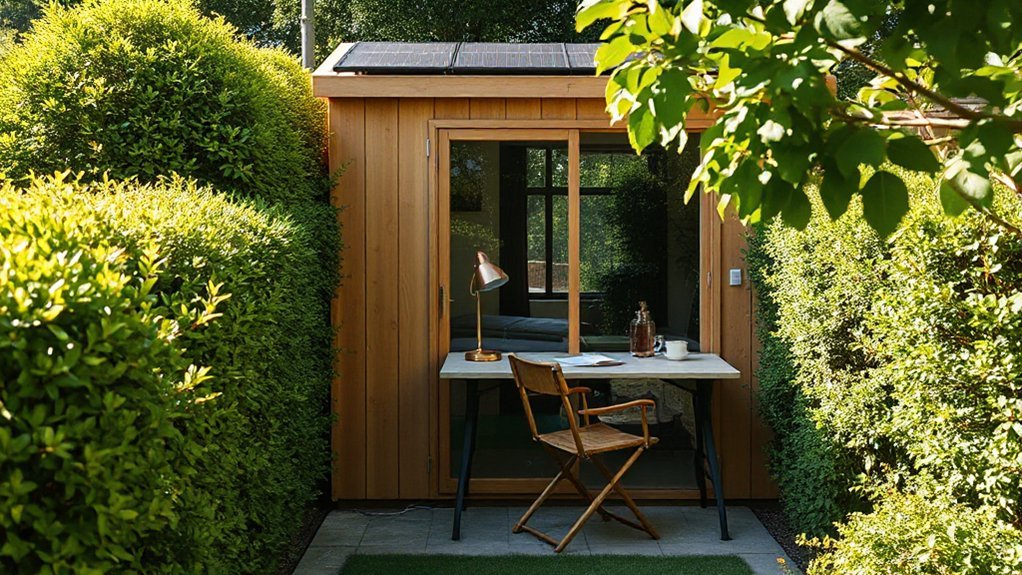
- Compact layouts maximize functional zones
- Urban farming elements boost cognitive engagement
- Outdoor furniture balances durability and comfort
Frequently Asked Questions
How Much ROI Can a Tiny Garden Office Provide?
A tiny garden office can yield a solid ROI, often 5–15% annually, depending on location and design. You boost garden value and outdoor workspace efficiency, attracting buyers who prize functional, energy-efficient spaces and enhanced property versatility.
What Is the Fastest Way to Install Electrical Outlets?
Can you wire it fast? Use wireless wiring methodology and secure power sourcing from a dedicated circuit, then install outlets along a protected run with proper conduit and GFCI protection, ensuring code-compliant spacing and minimal downtime for your workspace.
Can a Garden Office Be Eco-Friendly on a Budget?
Yes, you can, by using sustainable materials and minimizing energy use. You’ll implement off grid power with efficient insulation, solar panels, and LEDs, keeping costs low while delivering a functional, eco-friendly garden office on a budget.
How Do I Address Heat in a Sunny Spot?
Start by noting 60% fewer overheating incidents when you implement targeted shade solutions and active ventilation. You address heat in a sunny spot by optimizing shade solutions and ventilation options to maintain comfortable temperatures and maintain productivity.
What Are the Legal Limits for Garden Structures?
You’ll need to check local building permits and zoning regulations before any project; most jurisdictions cap height, footprint, and setbacks. Guarantee compliance, submit plans, and confirm whether exemptions apply for garden structures to avoid invalidation or penalties.
Conclusion
In tiny outdoor spaces, a garden office proves it’s not just possible, it’s efficient. By maximizing footprint with compact layouts and multi‑function furniture, you can boost productivity without enlarging your yard. An eye‑opening stat: environmental shading and green walls can cut cooling needs by up to 30%, slashing energy costs. Prioritize weatherproofing, smart storage, and thoughtfully integrated greenery to sustain comfort year‑round. With precise planning, your limited space becomes a high‑yield work oasis.
About the Author