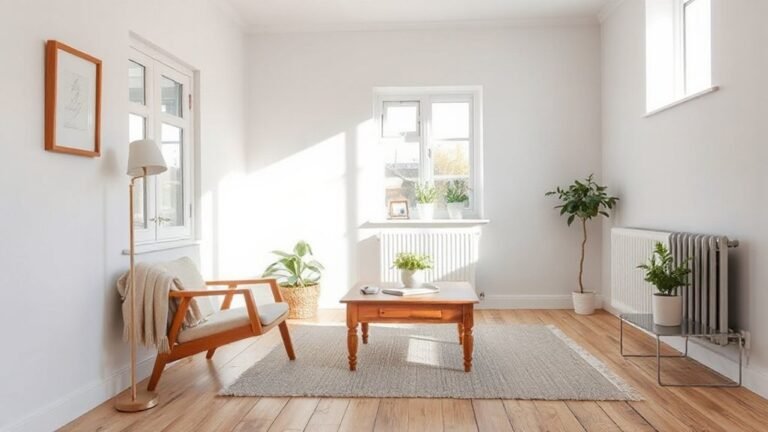
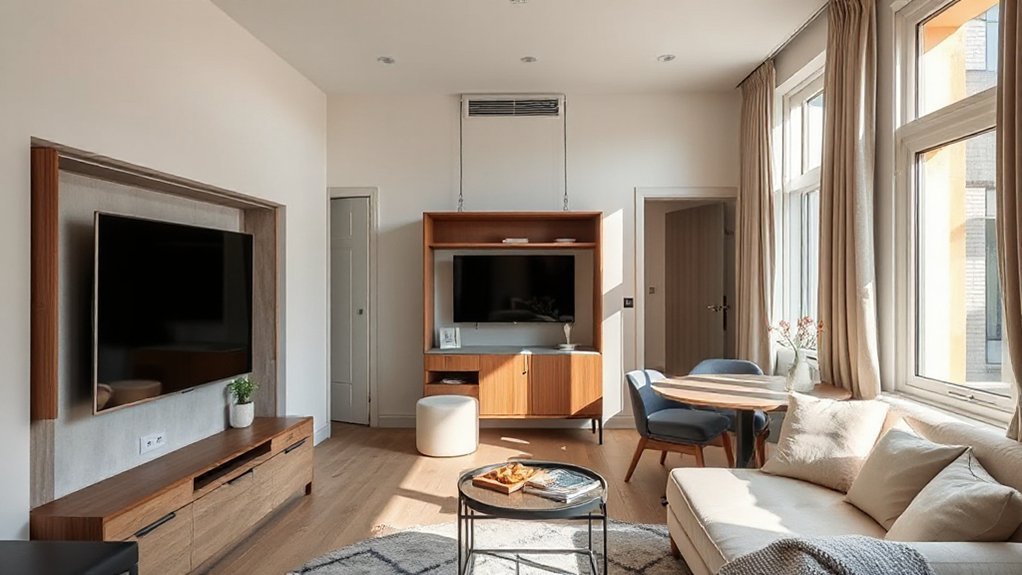
In UK apartments, start with precise measurements of every room, including alcoves, doorways, beams, sockets, and utilities, then set clear zoning goals for work, dining, and relaxation. Use open-plan tricks like low dividers, color shifts, and modular furniture to define spaces without breaking flow. Prioritize space-saving, multi-functional pieces with integrated storage, and keep finishes cohesive and light to maximize brightness. Enhance light with mirrors and skylights where possible, and expect smarter tech, wall grids, and storage hacks to follow. If you keep exploring, you’ll gain more techniques.
Assess Your UK Small Space: Measurements, Constraints, and Goals
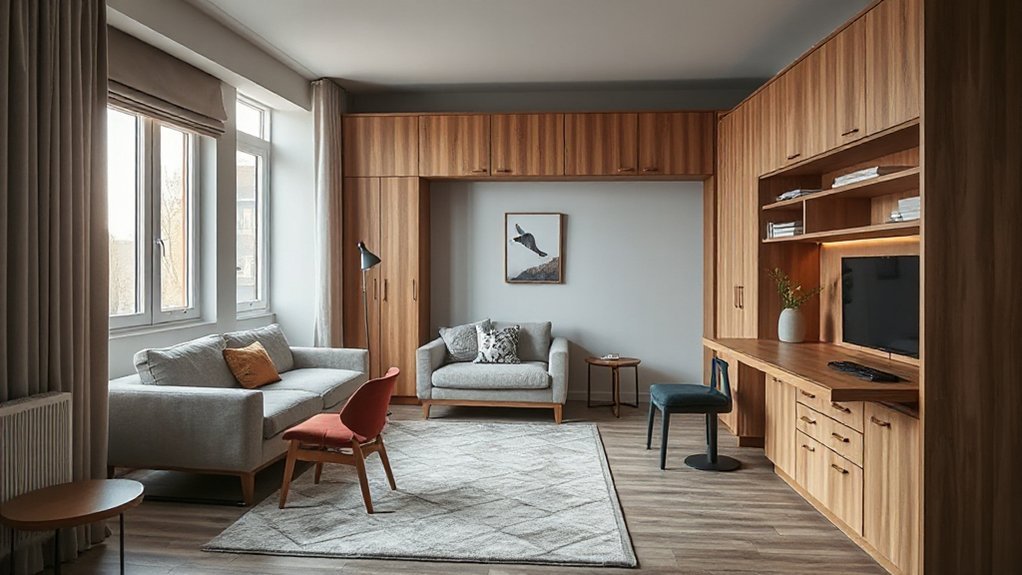
Begin by precisely mapping the space you have: measure every room, alcove, and doorway, noting wall lengths, ceiling heights, and any protrusions or irregularities. You’ll establish a reliable baseline for scale, function, and interference patterns.
Define constraints—structural beams, radiators, sockets, and fixed utilities—to prevent late design redos.
Set clear goals: adaptable living, efficient circulation, and defined zones for work, dining, and relaxation.
Prioritize furniture placement that preserves flow and sightlines, selecting compact, multi-functional pieces where possible.
Consider window treatments for privacy and light control without overwhelming proportions.
Document all data in a single reference sheet, with annotated sketches.
This disciplined approach informs layout decisions, enhances usability, and guides material, color, and finish choices toward cohesive, scalable solutions.
Increase Natural Light in UK Flats: Practical Hacks
To maximize natural light in UK flats, start by optimizing window exposure and minimizing obstructions: position mirrors opposite windows to bounce daylight deeper, remove or relocate bulky furniture that blocks sightlines, and choose sheer or lightly tinted blinds that admit brightness without sacrificing privacy.
Next, select window treatments that preserve glare control while maximizing daylight diffusion, such as light-filter roller shades or frosted films on non-sunny facades.
Enhance brightness through plant placement that doesn’t obstruct sightlines—short, narrow varieties near sill lines keep vertical light paths open.
Use reflective surfaces strategically: glass tabletops, pale finishes, and recessed shelving to bounce light without crowding.
Finally, prioritize skylights or light tubes only where feasible, and verify glare angles across rooms at noon.
Space-Saving Furniture Ideas for UK Homes
Space-saving furniture for UK homes focuses on maximizing usable area without sacrificing comfort or style. You’ll seek modular, stackable, and transformable pieces that adapt to daily needs while preserving fluid circulation.
Prioritize multi-functional units, such as sofa beds, storage ottomans, and wall-mounted desks, to reclaim floor space without visual clutter. Choose compact profiles with slim armrests and low backs to maintain sightlines and airiness.
Opt for furniture with integrated storage to reduce accessory clutter and support tidy environments. Consider lightweight, easy-to-readjust configurations that respond to traffic patterns and zoning.
Use decorative accents and restrained color schemes to emphasize cohesion and perceived openness. Precision joinery, durable finishes, and accessible mounting improve longevity in compact layouts while ensuring effortless reconfiguration for evolving occupants.
Open-Plan Zoning That Works in UK Apartments
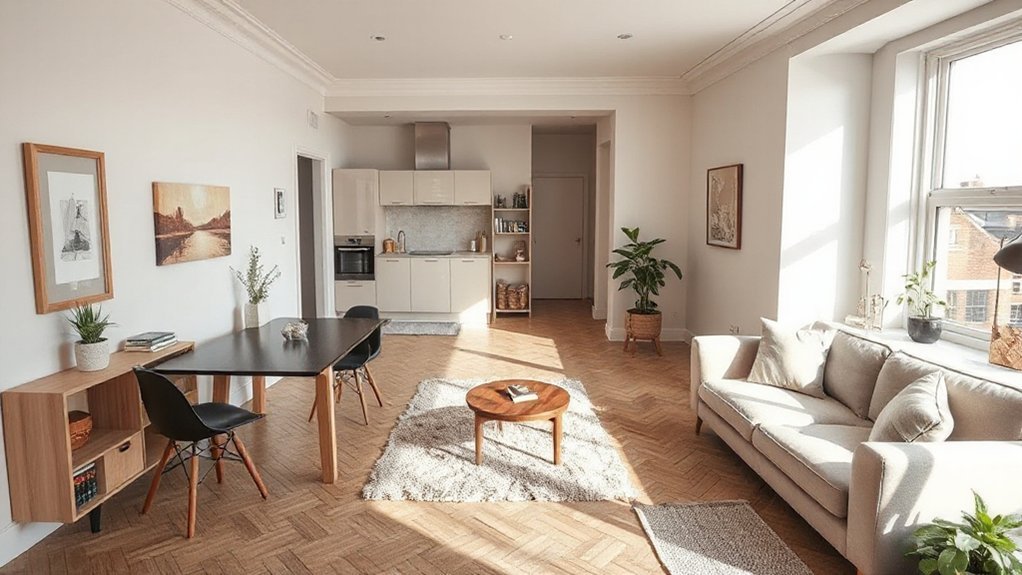
You’ll define open zones by clearly separating functions while maintaining sightlines and flow. Use multi-functional furniture to flex spaces for living, dining, and work without clutter.
Plan traffic paths that minimize interruptions. This approach hinges on precise zoning, responsive layouts, and intentional, space-efficient design.
Defining Open Zones
Start with room division that feels deliberate, not artificial: align activities to neutral zones, so passages remain fluid rather than abrupt. Implement zoning strategies that leverage architectural cues—ceiling height, core partitions, and furniture placement—to delineate living, dining, and working pockets without walls.
Use calibrated scales: low dividers, screened shelving, or color shifts to cue function while maintaining openness. Label zones in your plan to test ergonomics, traffic paths, and acoustic separation, ensuring each area supports performance without compromising overall cohesion.
Multi-Functional Furniture
To make open-plan zoning work in UK flats, choose multi-functional furniture that anchors zones while preserving flow. You’ll prioritize pieces that visually divide without walls, using height, texture, and color to cue function.
Select convertible sofas to toggle seating and lounging areas without sacrificing floor space; they convert overnights into compact margins, keeping living rooms flexible. Fold away beds serve guest rooms when needed, folding discreetly into slim silhouettes that don’t encroach on circulation.
Implement VSF: vertical storage and subtle, low-profile tables create defined perimeters while maintaining airy sightlines. Favor modular components you can reconfigure for different activities, enabling you to rezone as needs shift.
Guarantee finishes are durable, easy to clean, and harmonize across zones to sustain a cohesive, efficient environment.
Traffic Flow Management
Efficient traffic flow in open-plan UK flats hinges on clear, unobstructed pathways and deliberate zoning cues that guide movement. You implement measured zoning to delineate cooking, living, and dining zones without visual clutter, using low-profile partitions, tactically placed rugs, and furniture alignment that directs foot traffic.
Prioritize clear sightlines from entry to primary destinations to support spatial navigation and quick wayfinding. Keep door swings and corridor widths free of obstruction, and exploit ceiling height and lighting contrasts to cue progressions between zones.
Use consistency in furniture footprint and anchor points to reduce decision fatigue during peak moments. Regularly review circulation patterns for changes in usage, adjusting placements to preserve open, intuitive paths and maintain a balanced, cohesive open-plan experience.
Traffic flow remains precise, scalable, and adaptable.
Storage Hacks That Don’t Compromise Style
Prioritize hidden storage that remains seamless with your finishes, so every square meter serves a purpose without visible clutter.
Combine multi-purpose furniture that stacks, folds, or doubles as seating, desk space, or bed storage to maximize flexibility.
Elevate vertical space with wall-mounted systems and tall, slim units to access storage without sacrificing floor area.
Hidden Storage Solutions
Hidden storage is essential in compact UK homes, where every square inch counts. You’ll implement discreet, high-precision solutions that blend with architecture while maximizing capacity. Focus on hidden compartments and concealed shelving to maintain clean sightlines and flexible layouts.
- Under-stair drawers that align with run-length and skirting
- Lift-up bed bases with reinforced supports and shallow compartments
- Wall recesses for valuables, folded textiles, and seasonal items
- Floating shelves with integrated brackets and soft-close lips
- Ceiling nooks above doorframes for rarely used objects
Choose materials with minimal grain, matte finishes, and chamfered edges to reduce visual weight. Guarantee you test load, airflow, and accessibility.
Prioritize hidden compartments that double as design features, keeping pathways clear and rooms visually expansive.
Multi-Purpose Furniture Pieces
Choose convertible sofas in living zones to substitute guest accommodation without sacrificing seating quality, ensuring frame integrity and ease of operation.
Prioritize fold away beds that deploy smoothly and stow compactly, reducing daytime bulk while maintaining mattress comfort.
Opt for higher-density hinges, soft-close mechanisms, and concealed storage within ottomans, coffee tables, or modular benches.
When measuring, account for circulation angles and door clearances, preserving flow between kitchen, living, and entry.
Color, texture, and leg lift matter: lighter finishes, slim profiles, and exposed legs visually expand the room.
Finish with removable covers for quick maintenance and adaptable aesthetics.
Vertical Space Optimization
Vertical space is your most underutilized resource in small UK flats, and when you plan for it, you free up valuable floor area without sacrificing aesthetics. You’ll implement precise zoning, selecting fixtures and fixtures-free zones that maximize storage without visual clutter.
Focus on ceiling lighting to free shelf real estate while maintaining ambient balance, and consider vertical gardens as living panels to soften walls and improve air quality. Use modular, stackable units that align with wall planes, not protrude from them.
- Ceiling lighting integration for compact storage alcoves
- Wall-mounted, height-adjustable shelving systems
- Hidden storage in stair voids and vertical landings
- Slim, pull-out pantry towers beside kitchens
- Vertical gardens as partition and decorative storage
Multi-Functional Rooms: Quick Transformations
When a room must serve more than one function, quick transformations hinge on clear sightlines, modular furniture, and built-in storage that stays visible yet unobtrusive. You implement defined zones using scalable screens, lift-top tables, and wall-mounted desks to preserve flow.
Prioritize a neutral palette with accent cues to delineate uses without clutter. Opt for modular seating that rearranges into compact configurations; choose cushions and fabrics that endure frequent reconfiguration.
Storage should be accessible and integrated, from wall pockets to under-bed drawers, so daily clutter never blocks function. Illumination remains task-focused and adjustable, ensuring each zone feels distinct yet cohesive.
Embrace multi purpose layouts that adapt with time, enabling quick transformations through intentional, space-aware planning and precise hardware placements. Quick transformations optimize space, efficiency, and comfort.
Designing a Durable, Efficient Kitchen for Small UK Flats
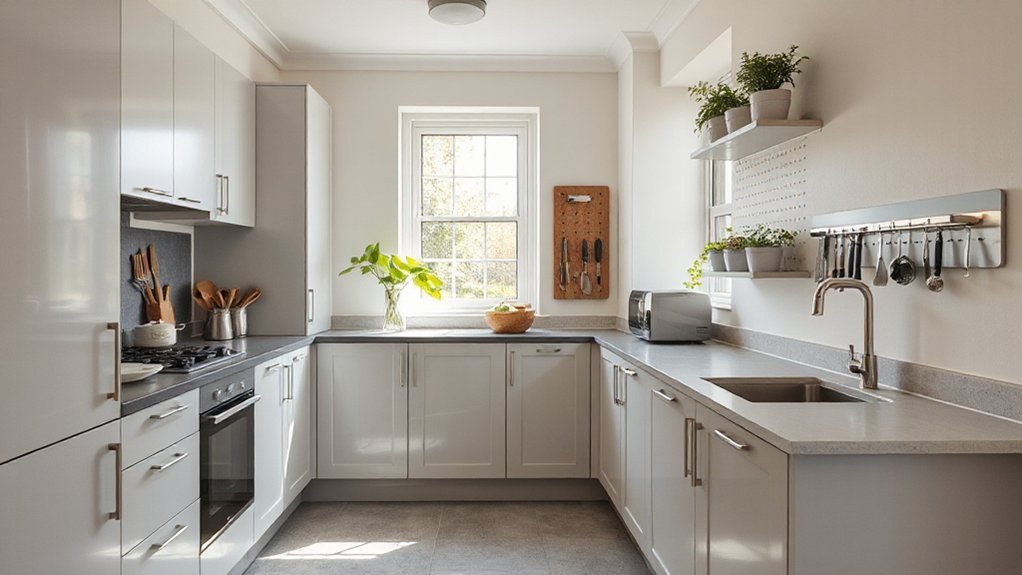
- Zone-driven layout with clear traffic flow
- Moisture-resistant surfaces and seamless joins
- Integrated appliances for streamlined lines
- Pull-out storage and tall pantry solutions
- Thoughtful lighting and ventilation for durability
Bathroom Tricks for Narrow UK Spaces
Ever wondered how to maximize a narrow UK bathroom without sacrificing function or style? Begin with vertical storage and recessed niches to keep countertops clear, then choose a compact vanity with integrated shelving.
Optimize shower space saving by installing a frameless enclosure and a door that slides or pivots; this minimizes clearance needs and visually enlarges the room.
Use wall-hung fixtures to create open floor space, improving perceived breadth.
Select matte finishes with light-reflective surfaces and a slim mirror to boost brightness without bulk.
Implement bathroom organization through labeled, modular containers tucked into risers and corner units.
Prioritize accessible rails and a single, consistent hardware language to reduce visual clutter.
Finish with unified grout lines and a restrained palette to maintain calm, functional flow.
Bright, Cozy UK Palettes: Colour and Materials
Bright, Cozy UK Palettes balance warmth and light to expand a compact footprint. You’ll optimize perception by pairing color psychology insights with deliberate material textures, guiding mood and daylight reflection across spaces. Use lighter neutrals as anchors, then introduce accent hues that read larger when coordinated with cabinets, floors, and hardware.
- Color psychology-driven accents
- Low-sheen finishes to reduce glare
- Textured surfaces for tactile depth
- Monochrome base with subtle contrast
- Reflective planters and metallic touches
Through controlled saturation, you create visual breadth without physical expansion. Select materials that contrast warmth and coolness, balancing tactile variety with ease of maintenance. Keep edges crisp, joints tight, and grain patterns aligned to reinforce order.
Prioritize light sources and reflective surfaces to maximize daylight. This palette supports efficient zoning and cohesive flow across compact rooms.
Soft Furnishings and Textiles to Maximize Perceived Space
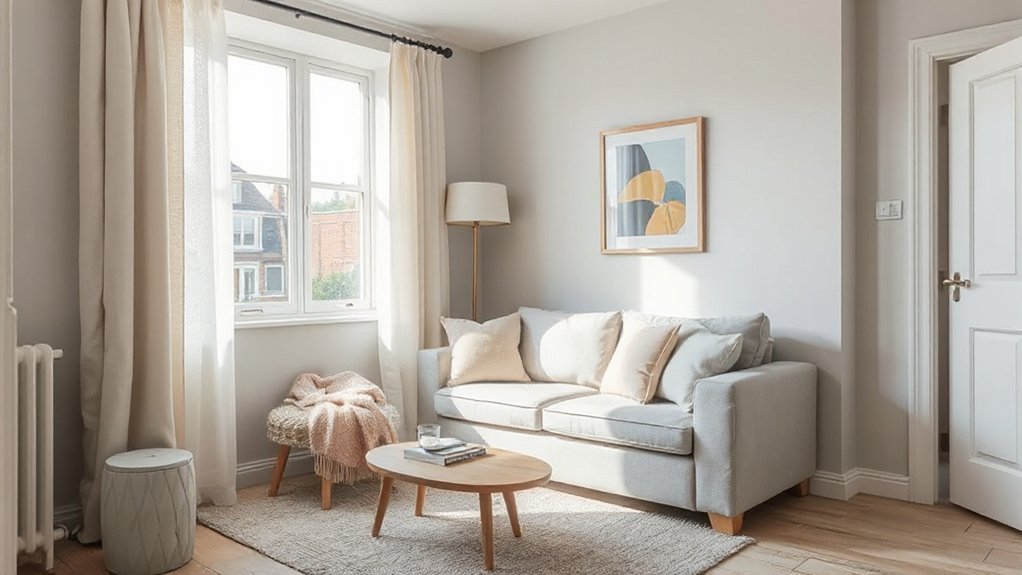
You can elevate perceived space by selecting light-weight textiles that breathe and layer them strategically to avoid bulk.
Use sheer or semi-sheer drapery with a lighter upholstery base, layering with subtle textures to create depth without crowding.
Align fabric weights and color values to reflect more light and visually expand each zone.
Light-Weight Textiles Tricks
Light-weight textiles can dramatically alter perceived space by shaping light, airflow, and visual weight. You’ll optimize rooms through deliberate textile layering and fabric selection, prioritizing weight, opacity, and drape to modulate brightness and conceal clutter.
- Choose sheer curtains to diffuse daylight without bulk.
- Use light-walled upholstery in neutral hues for airiness.
- Employ minimal, compact cushions with tight weaves.
- Integrate tonal throws to add depth without heaviness.
- Prefer breathable linens and cottons for comfort and flow.
Technique notes: balance translucence with opacity to control glare; fold and store excess fabrics to maintain clean sightlines. Consider scale and repetition to amplify room size.
Test textures under varied lighting; lighter fabrics reflect more ambient light, while avoiding visible seams that disrupt continuity. Textile layering and fabric selection drive perceived space without sacrificing comfort.
Layered Fabrics For Perception
Layered fabrics can intensify perceived space by shaping textures and light at multiple depths. You harness layered textiles to modulate glare, create soft zones, and define boundaries without heavy furniture.
Start with a sheer underlayer to filter daylight, then add midweight drapery that absorbs stray reflections and adds depth. Choose fabric textures that contrast—matte weaves with subtle sheen—to cue dimensional shifts rather than overwhelming the eye.
Align drape widths with window reveals to avoid visual clutter, and ensure precise header heights to maintain clean, architectural lines.
In seating areas, pair smooth upholstery with tactile cushions to fragment planes and expand perceived surface area.
Avoid busy patterns; opt for restrained palettes and repeatable motifs to sustain coherence across rooms. This approach guarantees space while enhancing perceptual clarity.
Smart Tech and Lighting for Ambience and Efficiency
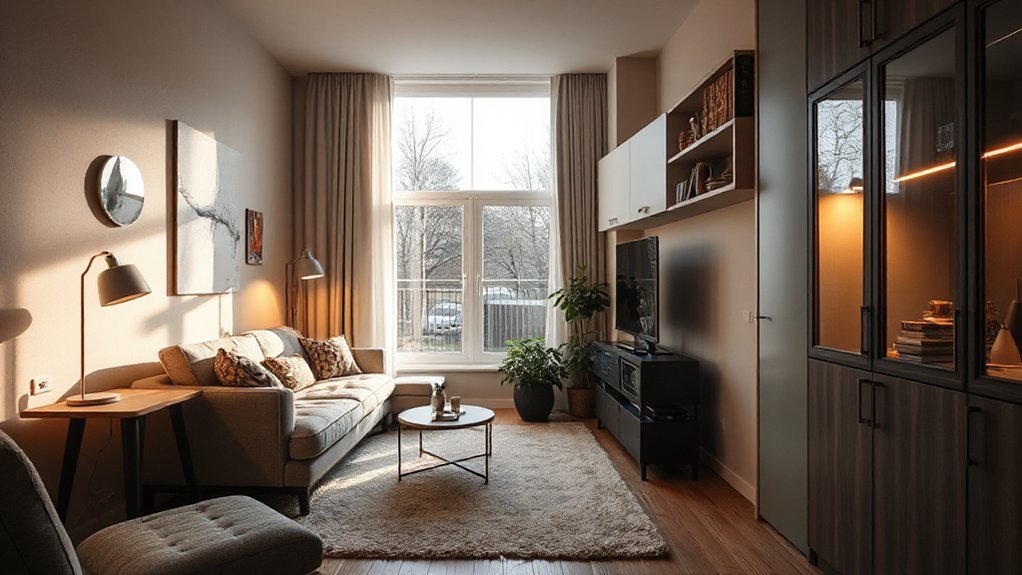
Smart tech and lighting streamline both ambience and efficiency in compact UK flats by prioritising automated control, scalable fixtures, and energy-aware performance. You tailor systems to space, cost, and daily rhythms, balancing task light with mood lighting for every zone.
- Smart lighting that adapts to occupancy and daylight
- Circadian-aware colour temps for ambience control
- Dimmable, modular fixtures to preserve sightlines
- Centralized apps for scenes, schedules, and energy tracking
- Integrated sensors to reduce standby draw and heat load
You’ll gain precise control without clutter, enabling quick scene changes for work, meals, or relaxation. Prioritise low-profile fittings, plug-in solutions, and reliable wireless protocols to maintain responsiveness.
The result is a cohesive, efficient environment where ambience control supports space optimisation and predictable power use.
Creative Wall Solutions: Shelves, Panels, and Grids
Creative wall solutions release vertical storage and display without consuming floor area. You configure shelves, panels, and grids as modular lattices that align with your room’s geometry, not against it.
Precision matters: fixed or floating shelves must carry expected loads, with discreet brackets and timber or steel finishes that refuse visual clutter. Panels offer clean surfaces for wall decoration, enabling integrated whiteboards, cork zones, or magnetic strips without penetrating the room’s rhythm.
Grids create flexible dashboards for books, plants, and devices, allowing reconfiguration in minutes as needs shift. Consider channels for cables, hidden fasteners, and a consistent material language to preserve cohesion.
The result is practical, light, and stylistically restrained, enhancing perceived space while maintaining approachable, durable aesthetics.
Budget-Friendly Upgrades With Big Impact
You can refresh your walls and storage approach with budget-friendly upgrades that read as high-design, not high-cost. Start with a precise wall refresh using paint and smart panel accents to sharpen dimensions while keeping surface disruption minimal.
Pair that with space-smart storage hacks—floating fixtures, modular cores, and hidden organizers—that maximize footprint without crowding rooms.
Budget-Friendly Wall Refresh
Ever considered a wall refresh that’s low-cost but high-impact? You can transform proportions and mood by precise wall treatments that don’t break the bank. Focus on finish quality, scale, and subtle contrast to maximize space perception.
Wall art and paint techniques work together to define zones, create depth, and guide flow through compact rooms.
- Select a neutral base and a single accent hue to delineate areas
- Use matte vs. satin sheens strategically to control light reflection
- Apply geometric or stripe patterns with painter’s tape for crisp edges
- Layer art with varying frame weights to balance focal walls
- Incorporate DIY texture via faux plaster or subtle stenciling for tactile interest
Aim for clean lines, consistent hardware, and measured color density to sustain a cohesive, spacious feel.
Space-Smart Storage Hacks
Smart, space-conscious storage solutions start with measuring and planning: define zones, prioritize accessible reach, and select modular pieces that compress and expand with your needs. You’ll map high-use items to reachable shelves, and reserve slim, tall cabinets for vertical space.
Choose multi-functional furniture—coffee tables with drawers, ottomans hiding seasonal gear, beds with underframe drawers—and guarantee trackable labeling for quick access. Use uniform hardware and integrated fittings to reduce visual clutter, reinforcing a clean, technical aesthetic.
Opt for concealed storage behind decorative accents to maintain calm surfaces, and integrate mood lighting to highlight organized zones while enhancing depth. Maintain tension between openness and enclosure; rotate infrequently used items to secondary spaces.
Finally, photograph configurations to refine layout decisions and sustain long-term efficiency.
Real-World UK Tiny-To-Reveal Makeovers You Can Try
From real-world UK tiny-to-reveal makeovers, you’ll see how compact homes maximize every square foot with precise layout shifts, smart storage, and durable finishes that resist daily wear. You’ll apply proven tactics that balance aesthetics and function, prioritizing clear circulation, adaptable zones, and mindful material choice.
- Integrate urban gardening features in small balconies or kitchens to boost texture and air quality.
- Use multi-purpose furniture with built-in storage to reduce clutter without sacrificing style.
- Optimize acoustic insulation with under-floor layers and wall-embedded panels for calmer living.
- Choose durable, easy-clean finishes that withstand daily use and spills.
- Employ vertical shelving and magnetic grids to free floor space while keeping essentials accessible.
Frequently Asked Questions
How Can I Measure for Future Renovations Accurately in a Tiny UK Flat?
You measure with laser or steel tape, top-to-bottom and wall-to-wall, documenting offsets, door swings, and utilities. You validate with three plans, test furniture placement virtually, and note clearances for Storage solutions and precise furniture placement.
What Are Cost-Effective Lighting Options That Make Spaces Feel Bigger?
For cost-effective lighting, choose ambient lighting with soft, even spread, plus reflective surfaces to amplify brightness; you’ll reduce shadows, enlarge perceived space, and save on fixtures while maintaining precise, design-forward, space-optimized outcomes.
Which Uk-Approved Compact Appliances Balance Performance and Footprint?
Brita’s compact UK-approved washer-dryer combo balances performance and footprint; you install it with appliance installation precision, maximizing space and energy efficiency. For a hypothetical flat, you save cabinet space, reduce heat, and improve overall efficiency.
How Can I Prevent Moisture and Mold in Small Bathrooms Effectively?
Install robust ventilation strategies, then implement moisture barriers to curb damp. You should exhaust humid air, monitor humidity, seal joints, use moisture-resistant surfaces, and plan drainage. You’ll reduce mold risk while optimizing tight bathroom space with precision.
What Legal Considerations Affect Small-Space Redesigns in UK Flats?
You must consider Legal restrictions and Planning permissions before any small-space redesign in UK flats; submit proposals early, comply with permitted development rules, fire safety standards, and building regulations, and document alterations for future resale or tenancy requirements.
Conclusion
In these compact UK spaces, tiny rooms become testbeds for precision. Think of each measured inch as a coin in a sunlit fountain—water rises with careful drop-by-drop planning. You’ll pair slender furniture with smart storage, letting light travel like a clean circuit through every pane and panel. Let your choices act as a hinge: small upgrades pivot bigger living. When the gridlines align—walls, lights, and sits—you reveal room, rhythm, and a calm, usable home.
About the Author